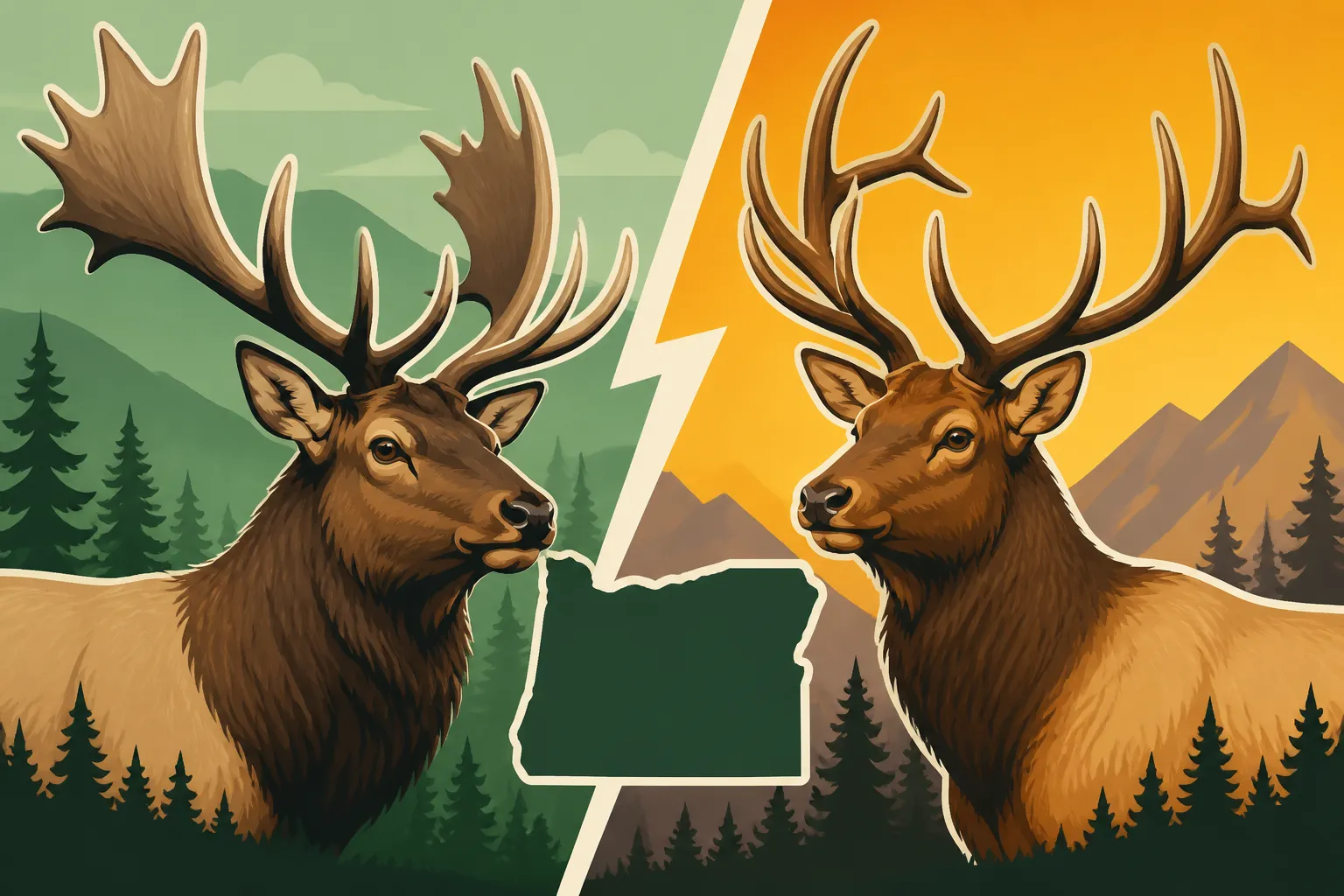
Roosevelt Versus Rocky Mountain Antler Score
It can feel like you need a secret decoder ring sometimes, trying to figure out what makes a 'trophy' elk, especially when you're hunting in Oregon where we're blessed with both massive Roosevelt and magnificent Rocky Mountain elk. The frustration often comes from seeing pictures or hearing stories about scores and realizing that what's impressive for one subspecies might be completely different for another. This guide is here to untangle that knot, walking you through the distinct characteristics and Boone and Crockett scoring nuances for Roosevelt versus Rocky Mountain antler scores, helping you understand what to look for and where.
The Fundamental Differences in Elk Species in Oregon
Before we dive deep into the nitty-gritty of antler scoring, it's really helpful to understand the basic distinctions between the two magnificent elk species we have roaming our incredible state. Oregon is unique in that it hosts both Roosevelt and Rocky Mountain elk, and they are as different as the landscapes they inhabit. Recognizing these fundamental differences is the first step to truly appreciating their antler characteristics and what constitutes a true trophy for each.
Where Oregon's Two Elk Subspecies Roam
Think of Oregon almost like a divided house when it comes to elk. Generally, you’ll find the impressive Roosevelt Elk in Western Oregon, thriving in the dense, wet coastal rainforests and the Cascades. These are often the deep timber, high-rainfall areas, where visibility can be limited, and the brush is thick. If you’ve ever hunted the Coast Range or the western slopes of the Cascades, you’ve likely been in Roosevelt country. They are built for these environments, often moving silently through nearly impenetrable vegetation, making them a challenging, yet rewarding, quarry.
On the flip side, head east of Where Highway 97 Splits Oregon's Two Elk Subspecies, and you're squarely in Rocky Mountain Elk in Eastern Oregon territory. This landscape is a stark contrast: drier, more open sagebrush flats, juniper forests, and rimrock canyons. Here, you'll often be glassing vast expanses, and the elk might travel much longer distances between feed and water. While there are areas where the two subspecies overlap, primarily along the Cascade crest, for the most part, their ranges are distinct, influencing everything from their behavior to, yes, their antler growth. This clear geographical divide is key to understanding their differing characteristics.
General Appearance and Body Size
Beyond just where they live, Roosevelt and Rocky Mountain elk also have noticeable physical differences that go beyond their antlers. Roosevelt bulls are generally larger, heavier-bodied animals, often appearing a darker, more chocolate brown in color. Their sheer mass is impressive, and they carry a robustness that suits their rugged, brushy habitat. If you've ever had to pack one out, you know exactly what I mean about their size! They are truly kings of the coastal jungle, with their build adapted to pushing through heavy cover and navigating steep, wet terrain. This formidable physique supports the kind of dense, powerful antlers they are known for.
Rocky Mountain elk, while still large and powerful animals, tend to be a bit more slender and often lighter in color, a tan or grayish-brown, especially in their drier environments. They are built for speed and endurance over longer distances, often moving gracefully across vast, open landscapes. Think of the difference between a dense forest brawler and a wide-open plains runner. While there’s certainly overlap and individual variation, if you see an elk with immense body size and a very dark coat, particularly in western Oregon, chances are you're looking at a Roosevelt. How Roosevelt bulls get to be so large is a testament to the lush, nutrient-rich environments they inhabit for much of the year, which directly impacts their body and antler development.
Understanding Boone and Crockett Scoring for Elk
Now, let's get to the heart of antler evaluation: the Boone and Crockett scoring system. This is the gold standard for officially measuring North American big game trophies, and while the principles remain consistent across species, the characteristics that drive a score can vary significantly between Roosevelt and Rocky Mountain elk. It's not just about how many points; it's about symmetry, length, mass, and spread, all measured with painstaking detail.
Basic Principles of the B&C System
The Boone and Crockett Club's scoring system is meticulous, aiming to quantify the size and symmetry of an animal's antlers or horns. For elk, it involves a series of precise measurements. You start with the main beams, measuring their length along the outer curve from the burr to the tip. Then, you measure all the normal points (tines), from the tip to the nearest edge of the main beam. Circumference measurements are taken at four specific places along each main beam, typically between the points (H1, H2, H3, H4). Finally, an inside spread measurement is recorded – the widest distance between the main beams. All these individual measurements are added together to form the gross score.
The core idea is to arrive at a "gross score" by adding all these measurements together. The real trick, and often the point of contention, comes with the "net score." For typical animals, the B&C system rewards symmetry. Any difference in length between corresponding points on opposite antlers, or any abnormal points that don't match, are deducted from the gross score to arrive at the net score. This emphasis on symmetry is what makes a truly "typical" trophy stand out. For a non-typical animal, abnormal points are actually added to the gross score, rather than subtracted, recognizing their unique character. Understanding the Boone and Crockett Minimums for Roosevelt Elk can give you a baseline of what truly qualifies as a record-class animal; it's a system designed to recognize true antler quality, not just raw size.
Key Scoring Differences Between Roosevelt and Rocky Mountain
This is where the rubber meets the road. While both elk subspecies are scored using the same B&C rules, their typical antler growth patterns lead to very different scoring profiles, making direct comparisons sometimes misleading.
Roosevelt elk are famous for their sheer mass and robust appearance. Their antlers tend to be dense, heavy, and often described as "clubby" or "blocky," carrying exceptional girth throughout the beams. The main beams, while thick, might not achieve the incredible lengths often seen on Rocky Mountain bulls, often appearing shorter and more compact for their bulk. Their points can be shorter and often show more variation, with "dog-leg" or irregular formations common, which can sometimes lead to deductions if not perfectly symmetrical. The circumferences on a Roosevelt score incredibly well because of this mass, often contributing a significant portion to the overall score. While an exceptional Roosevelt might not have the sweeping spread of a Rocky Mountain bull, its sheer volume of bone is what drives its score. Think heavy bases, strong circumferences, and sometimes a jumble of points that contribute greatly to the gross score, making Roosevelt Bull Body Size and Antler Shape critical to its scoring potential.
Rocky Mountain elk, on the other hand, are celebrated for their long, sweeping main beams and often symmetrical, well-defined points. Their antlers tend to be more slender, elegant, and can achieve truly impressive lengths, often extending far beyond the animal's nose. The inside spread of a mature Rocky Mountain bull can be quite wide, adding significant inches to the score. While they might not have the same "clubby" mass as a Roosevelt, their main beam length and the uniformity of their points (G1, G2, G3, etc.) are often exceptional, leading to clean, high scores. A truly magnificent Rocky Mountain bull often scores high due to its incredible main beam length, generous spread, and near-perfect symmetry, leading to minimal deductions. The challenge with scoring a Rocky Mountain bull is often finding one that has maintained that perfect symmetry throughout its life. This is reflected in discussions around Rocky Mountain Bull Antler Growth in Oregon, which often emphasizes length and spread.
Here's a quick comparison of some general tendencies:
| Feature | Roosevelt Elk Antlers | Rocky Mountain Elk Antlers |
|---|---|---|
| Main Beams | Shorter, denser, thicker; often "clubby" appearance | Longer, more slender, graceful sweep |
| Mass (Circ.) | Exceptionally heavy, significant score contribution | Good mass, but generally less pronounced than Roosevelt |
| Points (Tines) | Often shorter, stockier, more irregular; "dog-legs" common | Longer, more defined, typically symmetrical |
| Spread | Generally narrower inside spread | Often wider, contributing significantly to score |
| Symmetry | More prone to deductions due to irregular growth | Often highly symmetrical, minimizing deductions |
| Typical Appearance | Heavy, powerful, rugged look | Elegant, majestic, classic "royal" look |
What Influences Antler Score Beyond Genetics
While we can talk all day about the physical differences in antlers, it's crucial to remember that a score isn't just a predetermined outcome. Several factors play a huge role in how big an elk's antlers will truly get, regardless of whether it's a Roosevelt or a Rocky Mountain. Understanding these elements can give you a better appreciation for the animal and a leg up in your scouting efforts.
Age, Nutrition, and Habitat
These three elements are inextricably linked when it comes to antler growth. An elk's antlers are a true reflection of its overall health and environment, acting as an indicator of its condition over the past year.
- Age: Elk, like most antlered animals, don't grow their biggest antlers until they reach prime maturity. For bulls, this typically means between 5.5 and 9.5 years old. Younger bulls might have respectable antlers, but they often lack the mass, length, or number of points that truly mature animals possess. As a bull ages past its prime, antler quality can sometimes start to decline, though this varies greatly depending on the individual and environmental conditions. Allowing bulls to reach this age class is often a key management strategy for trophy potential.
- Nutrition: This is arguably the most critical factor. Antlers are bone, and bone requires a tremendous amount of protein, calcium, phosphorus, and other minerals. If an elk lives in an area with abundant, high-quality forage throughout the year – think lush grasses, forbs, and browse – it has the building blocks to grow larger antlers. Conversely, periods of drought, severe winters, or overpopulated ranges can lead to poorer nutrition, resulting in smaller antlers, even in prime age-class bulls. This is why you'll often hear discussions about Antler Growth and Nutrition being paramount for maximizing a bull's potential.
- Habitat: The specific habitat dictates the quality and quantity of food available. Western Oregon's wet climate and diverse forest ecosystems often provide rich forage, contributing to the impressive body size and mass of Roosevelt elk. Eastern Oregon, with its high desert and open country, can also be rich in nutrients, but extreme weather variations can put stress on elk herds. A consistent, varied food supply year-round, along with adequate cover and water, is ideal for maximum antler development and overall herd health.
Genetic Potential and Herd Health
You can have the best nutrition and ideal age, but genetics still play a foundational role in antler size and shape. Just like people, some elk are simply predisposed to grow larger antlers than others, with specific genes influencing everything from main beam length to the number and placement of points. These genetic traits are passed down through generations, and identifying areas with a history of producing larger animals can often point to strong genetic potential within the herd.
Beyond individual genetics, overall herd health is a significant factor. When a herd is healthy, with a good bull-to-cow ratio and balanced population numbers relative to the available habitat, individual animals generally thrive. This means less competition for prime forage and more resources available for antler development. Overpopulated units can lead to increased stress, competition for resources, and a higher prevalence of disease, resulting in stunted growth and smaller antlers across the board. Factors like disease outbreaks or significant predation can impact a herd's vitality and, consequently, antler development, even in genetically strong populations.
Practical Implications for Oregon Hunters
All this talk about scoring and subspecies is great, but what does it mean for you out in the field? For an Oregon hunter, understanding these distinctions has real-world applications, helping you set expectations, refine your scouting, and ultimately, make informed decisions when you're looking at a bull through your optics.
Setting Realistic Expectations
The most important takeaway is this: don't go into a Roosevelt elk hunt expecting a typical 400-class Rocky Mountain rack, and vice-versa. What constitutes a "trophy" is highly relative to the subspecies. A 300-inch Roosevelt bull is an absolutely phenomenal animal, a true monster of the dense timber, and often represents a lifetime achievement for many western Oregon hunters. That same score for a Rocky Mountain bull, while still a respectable animal, might not put it in the same "top tier" as its Roosevelt cousin, simply due to the differing growth patterns and what's considered "average" or "exceptional" for each.
It's about appreciating the characteristics inherent to each species. When you're Archery Elk Hunting Oregon's August and September Seasons in the Coast Range, you'll be looking for heavy, dense beams, strong circumferences, and maybe a few extra irregular points that give a Roosevelt its unique character. If you're Glassing Eastern Oregon Rimrock for Mule Deer (or Rocky Mountain elk!), you might be focused on length of main beam, the sweeping arc, and the clean, symmetrical points. Setting these realistic expectations helps prevent disappointment and allows you to celebrate the incredible animal you've pursued, whatever its score. Don't let a number diminish the experience.
Utilizing Scouting Tools for Antler Assessment
In today's hunting world, we have more tools than ever to help us understand the potential of a specific unit or area. Many hunters rely on platforms like GoHunt, which can offer historical harvest data, draw odds, and mapping features that highlight public land access and terrain. By looking at past harvest reports or consulting maps to understand the terrain and forage quality, you can gain insights into the potential for growing larger antlers in a given area. You can also research Oregon Record Book Roosevelt Bulls to see the caliber of animals taken in various parts of the state.
E-Scouting Oregon Units With Satellite Imagery is also an invaluable way to identify prime habitat. You can spot historical burn areas that produce new forage, locate bedding areas, and identify travel corridors that might be more conducive to larger bulls. Combining this digital scouting with boots-on-the-ground reconnaissance, perhaps through Public Land Scouting in Oregon Before the Draw Results, gives you a well-rounded picture of the unit's potential. Even knowing basic information about Rifle Choice for Oregon Elk and Deer can indicate the type of terrain and shot opportunities you're preparing for.
Finding and Judging Trophy Animals
Once you're actually in the field, knowing what to look for can make all the difference, especially when you're trying to make a quick decision. When glassing a bull, especially at a distance, quickly assess its overall shape and mass to determine its potential.
For a Roosevelt bull, focus on:
- Mass: How thick are the main beams, especially at the bases? Do they carry that thickness out well? This is often the biggest contributor to their score.
- Density: Do the antlers look "heavy" and dark, or more slender? A dense, dark rack usually signifies good mass.
- Points: Are there numerous points, even if they aren't perfectly symmetrical? Are they strong and blocky? Look for those heavy, character-filled tines.
- Main Beam Shape: Are they shorter and more compact, or do they sweep out broadly? Roosevelt beams tend to be shorter in proportion to their mass.
For a Rocky Mountain bull, look for:
- Length: How long are the main beams? Do they extend significantly past the animal's head and neck? Length is a huge factor.
- Spread: How wide is the inside spread? Does it extend past the ears or even beyond the body? A wide spread adds significant inches.
- Symmetry: Do the points on one side closely mirror the other? Are the points distinct, long, and well-defined? Minimal deductions mean higher net scores.
- Overall Form: Does the rack have an elegant, sweeping appearance, characteristic of a classic royal bull?
Remember, judging a bull in the field, especially under pressure, is tough. Practice by looking at photos and videos of different bulls. Focus on distinguishing mass from length and understanding what makes a typical "scoring" point versus an abnormal point. And regardless of the score, the true trophy is the experience and the memories made out in Oregon's incredible wild spaces. Knowing your Shot Placement on a Bull at Close Range and having confidence in your shot is ultimately what matters most when the moment of truth arrives.
Disclaimer
This article is for general informational purposes only and does not constitute professional advice. Laws, prices and regulations vary by location and change over time. Consult a qualified professional for guidance on your specific situation.