California Quail Versus Mountain Quail
Oregon's diverse landscapes offer incredible opportunities for upland bird hunters, but sometimes it feels like a puzzle trying to figure out which bird you're after. Many hunters, especially newer ones, find themselves wondering about the subtle (and sometimes not-so-subtle) differences between the common California quail and the more elusive mountain quail. This guide will help you confidently identify, locate, and hunt both species, transforming that confusion into clarity for your next outing.
Understanding Oregon's Quail Species
When you hit the fields and forests of Oregon, you're primarily going to encounter two main species of quail that offer fantastic hunting challenges: the California quail and the mountain quail. While both are "quail," they couldn't be more different in their habits, preferred terrain, and how you approach hunting them. It’s easy to lump them together, but knowing their distinct personalities is key to success and enjoying your time afield.
The Ubiquitous California Quail
Ah, the California quail! For many, this is the quintessential quail of the West, and for good reason. They are the most widespread and abundant quail species in Oregon, thriving in a variety of habitats that are often closer to human activity. You'll find them almost anywhere there's a good mix of dense cover for protection, open ground for feeding, and a water source nearby. Think about those areas on the edges of agricultural fields, brushy draws along riparian zones, or even in suburban greenbelts and parks.
These little birds are often found in large coveys, especially outside of breeding season, making for explosive flushes that can both thrill and surprise you. Their social nature means that if you find one, you're likely to find many. This abundance, however, doesn't mean they're easy pickings. They are notoriously adept at running through cover, often preferring to leg it rather than take to the air, which can be incredibly frustrating if you're trying to get a shot off. They use their strong legs and knowledge of their home turf to evade predators, including hunters, with remarkable skill.
The Elusive Mountain Quail
Now, the mountain quail is a different beast entirely. These are the true high-country specialists, preferring the dense, often steep, brushy slopes of Oregon's mountain ranges. They are far less common than their California cousins and certainly more challenging to locate and hunt. Imagine scaling a steep hillside, pushing through thick manzanita or chapparal, with the reward being a small covey of these beautiful, yet incredibly shy, birds. That's mountain quail hunting.
Their elusive nature is a big part of their appeal for many hunters. Finding them often feels like earning a true trophy, not just in terms of meat for the pot, but in the effort and wilderness experience gained. They don't typically form the massive coveys of California quail; instead, you might find them in smaller family groups or pairs. When they do flush, they tend to fly downhill and quickly disappear into the next patch of dense cover, making follow-up shots tricky. This is a bird that demands respect for its habitat and its ability to vanish into thin air.
Key Differences: Identification, Habitat, and Behavior
Distinguishing between California and mountain quail isn't just an academic exercise; it's crucial for tailoring your hunting approach. You wouldn't use the same tactics for chasing deer in a clearcut as you would for still-hunting in dense timber, and the same principle applies here. Understanding their unique traits will dramatically improve your chances of success.
Spotting the Visual Cues
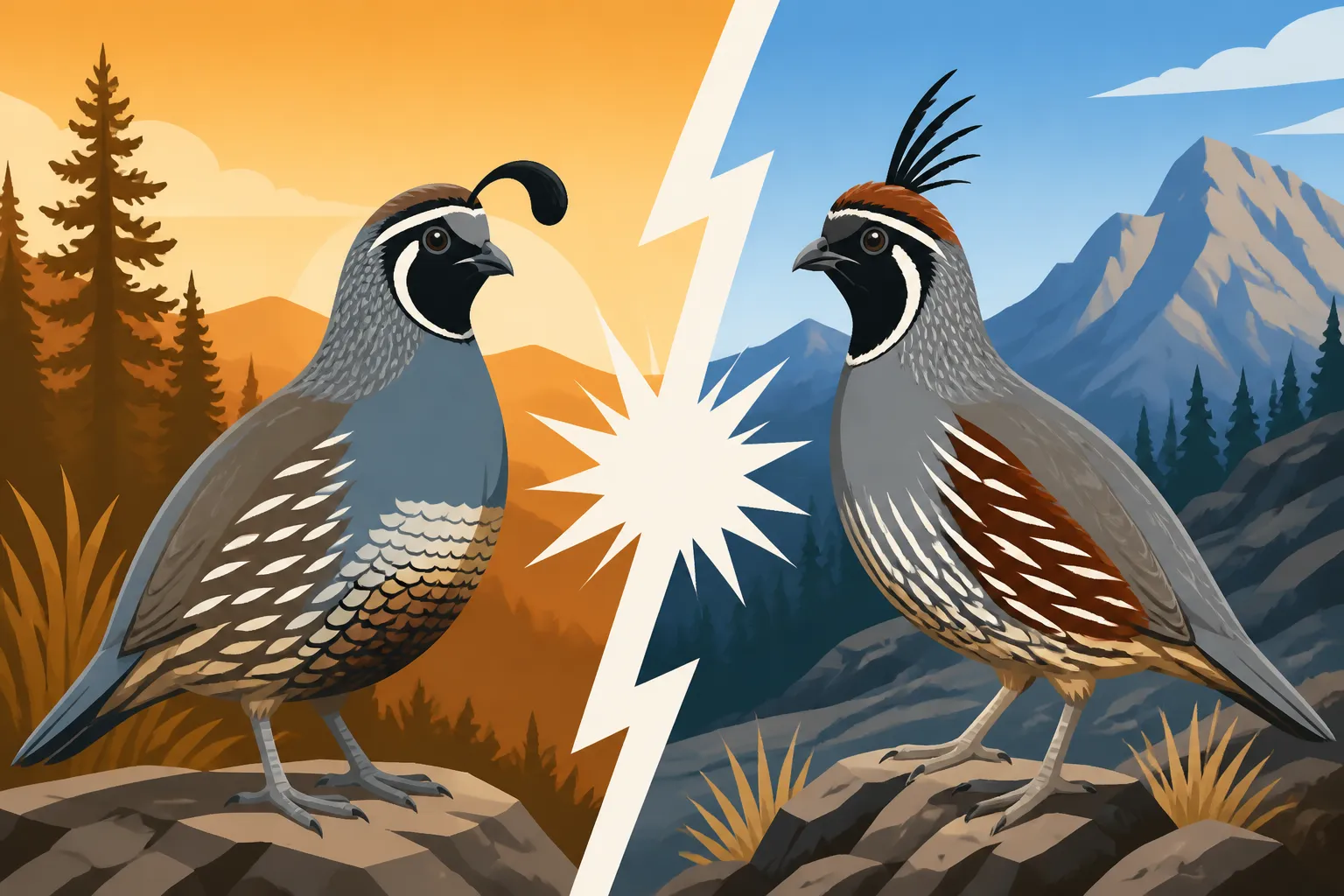
At first glance, both are "quail," but a closer look reveals some pretty clear distinctions. The California quail, also known as the Valley quail, is arguably the more striking of the two, with its jaunty, forward-curving black plume that looks almost like a single teardrop. Males boast a bold black face bordered by a crisp white stripe, a chestnut crown, and a scaly-looking belly pattern. Females are similar but a bit duller in coloration and have a smaller plume. They're compact birds, built for bursting through thick brush and quick, low flights.
The mountain quail, on the other hand, sports a much longer, straight, and slender head plume, almost like a pair of slender antennae sticking straight up or slightly backward. Their plumage is generally richer and more uniform: a deep olive-brown back, warm rufous (reddish-brown) flanks with bold white barring, and a chestnut throat bordered by a clean white line. They lack the elaborate facial markings and scaly belly of the California quail. Mountain quail are also noticeably larger and more robust than California quail, reflecting their tougher, higher-elevation environment. They're built for navigating steep slopes and dense undergrowth.
Here's a quick comparison table to keep those visual differences straight:
| Feature | California Quail | Mountain Quail |
|---|---|---|
| Size | Smaller, compact (approx. 9.5-11 inches) | Larger, robust (approx. 10.5-12 inches) |
| Head Plume | Short, black, forward-curving (teardrop shape) | Long, straight, slender, brown/black (two feathers) |
| Facial Markings | Black face, white border, chestnut crown | Chestnut throat, clean white border, no bold face |
| Body Color | Grey breast, scaly belly | Olive-brown back, rufous flanks with white bars |
| Behavior | Often runs, explosive covey flush | More elusive, flies downhill into dense cover |
Habitat Preferences and Where to Find Them
This is perhaps the biggest differentiator for hunters. California quail are birds of the lower elevations, preferring valley bottoms, foothills, and riparian corridors. You'll often find them in juniper woodlands, oak savannas, brushy clearcuts, and areas with mixed agricultural use. They thrive where there's a mosaic of tall grasses, shrubs like blackberry or wild rose, and scattered trees that provide roosting cover. Access to water is non-negotiable for them; think about checking creek bottoms, irrigation ditches, or even cattle troughs. When scouting, look for dense pockets of cover right next to more open, seed-rich areas. Chukar and Quail Country in Oregon often shares habitat characteristics with these birds, focusing on areas with good cover and food sources.
Mountain quail, however, are exactly where their name suggests: the mountains. These birds inhabit the dense, often rugged, brushy slopes of the Coast Range, Cascades, and other mountain systems in Oregon. Their preferred habitat is typically higher in elevation, often in areas with mature timber, but they’ll concentrate in brushy openings, clearcuts that have grown up dense with rhododendron, manzanita, or huckleberry, and around mountain springs. They love thick understory that provides both cover from predators and a bounty of berries and seeds. Finding them means putting in the legwork, often far from roads, in terrain that would make a flatlander weep.
Distinctive Calls and Behaviors
Both species have unique vocalizations that can be a dead giveaway to their presence, and understanding these calls can be a huge asset when you’re out in the field. The California quail is famous for its distinctive "chi-ca-go!" or "cu-ca-cow!" call, a clear, three-note whistle that's easy to recognize. They are quite chatty, especially in a covey, using a variety of clucks and chirps to communicate. When flushed, they often scatter with a burst of wings and then almost immediately start calling to regroup. This behavior can be used to your advantage by listening for those calls to pinpoint where they landed for a follow-up approach.
Mountain quail are much quieter, which contributes to their elusive reputation. Their most characteristic call is a loud, rising "w-e-eerk!" or "whooo-eeerk!" that can carry quite a distance through the timber. It's a single, sharp whistle that sounds distinct from the California quail's more complex call. They don't chatter much and are far less likely to call to regroup after a flush. When threatened, they are much more prone to running silently through the underbrush rather than flying, and if they do fly, it's typically a powerful, downhill glide that puts them out of sight and into thick cover almost instantly. Their preference for running means you often jump them much closer than you might expect, making for exhilarating, if brief, encounters.
Hunting Strategies for Each Quail Species
Hunting quail in Oregon is a truly rewarding experience, but you need to adjust your mindset and tactics depending on whether you're chasing the valley dwellers or the mountain dwellers. It's not a one-size-fits-all game. Preparing for each type of hunt means considering everything from your footwear to your dog's training.
Chasing California Quail in the Lowlands
Hunting California quail is often about covering ground in prime habitat and being ready for those explosive covey flushes. These birds love edge habitat: think the transition zones between open fields and dense brush, along the banks of creeks or rivers, or the fringes of clearcuts. They often feed in the more open areas in the mornings and evenings, then retreat to thicker cover during midday. Using a good mapping tool, like the features available on GoHunt, can help you pinpoint these transition areas and potential water sources ahead of time.
Walking systematically through likely areas with a well-trained bird dog is undoubtedly the most effective method. A good pointing dog will lock up on a covey, allowing you to move in and get ready for the flush. Without a dog, you'll need to work slowly and methodically, kicking brush piles and pushing through dense cover. Pay close attention to calls after a flush; those birds are trying to regroup, giving you a second chance. Don't be afraid to follow up on single birds that splinter off, as they can often be found huddled in small patches of cover nearby. Remember, they'd rather run than fly, so stay alert for birds zipping through the underbrush.
Pursuing Mountain Quail in the High Country
Mountain quail hunting is a much more physical endeavor, often requiring serious elevation gain and navigating dense, unforgiving terrain. Forget the wide-open fields; here you're looking for steep, brush-choked slopes, often with mature timber nearby, and areas around mountain springs or seeps. Early season, before heavy snows, is typically the best time, as they'll be higher up. As the season progresses and snow falls, they'll often move down to lower, yet still brushy, elevations. You might even find them migrating vertically through the same unit where you're hunting deer or elk.
A silent, close-working dog is invaluable here, one that can work through thick cover without getting lost or spooking birds too far ahead. Because mountain quail tend to flush downhill and quickly vanish, you need to be ready to swing fast. Walking ridge lines and working down into brushy draws can be effective, as it forces the birds to flush, potentially giving you a better shot as they fly across a small opening. Be prepared for a tough retrieve if you do connect, as downed birds can quickly disappear into the dense undergrowth. Physical fitness is a major component of success in this pursuit; Chukar Country Footwear and Fitness details gear and conditioning that applies directly to this kind of hunting.
Essential Gear and Tactics
Regardless of which quail you're targeting, there are some universal truths when it comes to gear. Comfortable, durable footwear is non-negotiable. For California quail, a sturdy pair of hiking boots will do, but for mountain quail, you'll want something with excellent ankle support and waterproofing for the steep, wet terrain. Lightweight upland bird vests are perfect for carrying shells, water, and any birds you bag. A reliable shotgun, typically a 12 or 20 gauge, with an open choke (improved cylinder or modified) is ideal for the close-quarters, fast-flying action.
A good bird dog, as mentioned, is a game-changer for both species. For California quail, a dog with a strong nose and a tendency to range a bit can help cover more ground and bust coveys. For mountain quail, a dog that works closer and is less likely to get far ahead in the dense timber is preferred. Always carry plenty of water for yourself and your dog, especially in the dry, warm early seasons. And don't forget to review your Oregon Upland Bird Validation requirements before you head out, to make sure all your paperwork is in order.
Conservation and Management of Oregon's Quail
As hunters, we have a vital role to play in the conservation of Oregon's wildlife, and quail are no exception. Understanding the health of these populations and contributing to management efforts ensures that future generations can enjoy the same fantastic hunting opportunities we do.
Population Trends and Challenges
Both California and mountain quail populations fluctuate due to a variety of factors, but overall, they are generally considered stable across much of Oregon, though localized declines can occur. Habitat loss and fragmentation due to development, changes in agricultural practices, and wildfire impacts are ongoing concerns. For California quail, the encroachment of suburban areas can reduce available habitat, while for mountain quail, large-scale timber harvesting without adequate regeneration of suitable understory can be detrimental. Predation also plays a role, with coyotes, raptors, and domestic cats taking a toll on quail. Reading an Oregon Big Game Statistics Report can sometimes provide insights into trends that might indirectly affect smaller game species like quail.
Drought years can also hit quail populations hard, as access to water and the abundance of forage and insects (crucial for chick survival) are reduced. Climate change, bringing more extreme weather patterns, is a long-term challenge that wildlife managers are continually evaluating. Organizations like the Oregon Department of Fish and Wildlife work to monitor populations through surveys and hunter harvest reports, adjusting seasons and bag limits to ensure sustainable hunting.
How Hunters Contribute to Quail Health
Hunters are, and always have been, the primary funding source for wildlife conservation in Oregon. Through the purchase of licenses and tags, as well as excise taxes on firearms and ammunition (Pittman-Robertson Act funds), hunters directly contribute millions of dollars that go towards habitat improvement, wildlife research, and management programs that benefit all game and non-game species, including quail. Every time you buy an Oregon hunting license, you're investing in the future of these birds.
Furthermore, hunters often act as citizen scientists, reporting observations from the field that can help wildlife agencies understand local conditions and population dynamics. Responsible hunting practices, adherence to regulations, and ethical behavior in the field are all crucial contributions. By respecting private landowners, practicing good land stewardship, and participating in voluntary habitat projects, we help ensure healthy quail populations. Remember to always Checking Oregon Fire Closures Before the Season as wildfires can significantly impact quail habitat and hunting access. Supporting groups focused on upland bird habitat, like Quail Forever, is another excellent way to get involved and ensure these incredible birds continue to thrive in Oregon.
Disclaimer
This article is for general informational purposes only and does not constitute professional advice. Laws, prices and regulations vary by location and change over time. Consult a qualified professional for guidance on your specific situation.