Where Highway 97 Splits Oregon’s Two Elk Subspecies
For many Oregon hunters, the concept of "elk" often feels monolithic. You draw a tag, you hunt elk. Simple, right? But the reality on the ground, especially when you start diving deep into Oregon's diverse landscapes, reveals a fascinating, and sometimes confusing, truth: not all elk are created equal here. We have two distinct subspecies roaming our state, and understanding where they live, how they differ, and why their habitats are separated is absolutely critical for anyone hoping to be consistently successful. This guide is going to peel back the layers on that fundamental divide, focusing on the iconic geographical marker that defines their territories: Highway 97.
The Fundamental Divide: Highway 97 as a Geographical Marker
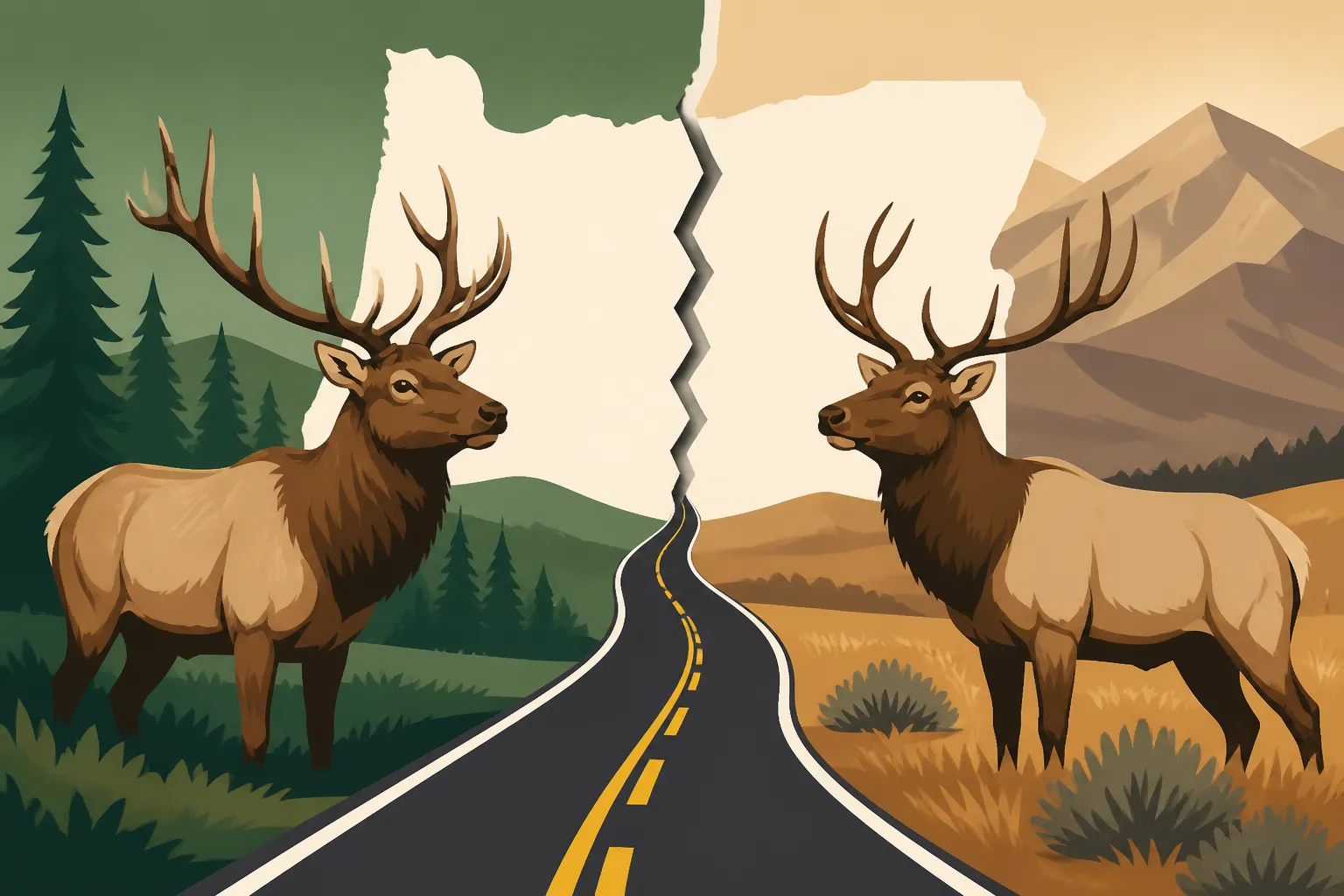
If you've spent any time driving through Oregon, you know Highway 97. It's a major artery, cutting north to south through the heart of the state, tracing the eastern flank of the mighty Cascade Range. What many folks don't realize is that this seemingly arbitrary line on a map actually represents one of the most significant ecological boundaries for our state's elk populations. It's not just a road; it's a centuries-old, natural split that dictates which kind of elk you're likely to encounter.
The Historical and Ecological Significance
Think about it this way: Oregon is a state of dramatic contrasts. To the west, you have the verdant, rain-soaked Coast Range and western Cascades, often referred to as temperate rainforests. To the east, you encounter vast expanses of high desert, sagebrush plains, and the drier, more rugged Blue Mountains. These drastically different ecosystems didn't just appear overnight; they were shaped by massive geological forces, primarily the uplift of the Cascade Mountain Range.
Over millennia, as these mountains rose, they created a profound rain shadow effect. Moisture-laden air from the Pacific Ocean slams into the Cascades, gets forced upwards, cools, and drops its precipitation on the western slopes. By the time that air crosses the crest, it's largely dry, leading to the arid conditions we see in Eastern Oregon. This environmental split created two vastly different evolutionary pathways for the elk that colonized these areas. The elk that adapted to the dense, wet forests of the west evolved differently from those that adapted to the more open, high-desert, and pine-studded country of the east. Highway 97, running right along the edge of that rain shadow and the base of the eastern Cascades, simply became the most convenient and recognizable line separating these two distinct worlds, effectively defining where the two elk subspecies overlap.
Understanding the Geographical Boundary
So, when we talk about Highway 97, we're really talking about a dividing line that roughly follows the eastern foothills of the Cascade Range. To its west, stretching all the way to the Pacific Ocean, is the domain of the Roosevelt elk. This includes units like the Trask, Wilson, Santiam, and McKenzie. These areas are characterized by dense timber, thick undergrowth like salal and sword fern, and a significant amount of precipitation, especially during hunting season.
East of Highway 97, however, is where you'll find the Rocky Mountain elk. This vast territory encompasses everything from the eastern slopes of the Cascades to the far reaches of the Blue Mountains and Wallowas. Here, you're looking at units like the Wenaha, Sled Springs (or what used to be Sled Springs, now part of the new hunt areas), Starkey, and Heppner. The landscape shifts dramatically—pockets of Ponderosa pine and Douglas fir give way to expansive sagebrush flats, rimrock canyons, and high-elevation meadows. The climate is generally drier, with more distinct seasons, often featuring deep winter snows and hot, dry summers. It's crucial for hunters to understand these differences, as they profoundly impact everything from elk behavior to optimal hunting tactics and even your choice of rifle calibers that suit Oregon elk.
Understanding Roosevelt Elk: Western Oregon's Rainforest Giants
There's something truly majestic about a Roosevelt elk bull emerging from the mist of a western Oregon clearcut. These are hardy animals, perfectly adapted to the challenging, dense, and often unforgiving landscape of the Coast Range and the western slopes of the Cascades. If you've ever tried to still-hunt blacktails in wet Oregon coastal brush, you know the kind of environment I'm talking about—thick, noisy, and constantly damp.
Distinct Physical Characteristics and Adaptations
Roosevelt elk, often called "Roosies," are generally larger-bodied than their Rocky Mountain cousins. They possess a stockier, more robust build, which helps them navigate the incredibly dense underbrush they call home. When you look at a Roosevelt bull's antlers, you'll often notice a distinct configuration: they tend to have more mass and often grow straight back with shorter tines, rather than the wide, sweeping racks typically associated with Rocky Mountain elk. This antler shape is actually an adaptation to their environment. Tightly-packed antlers are less likely to get tangled in the thick timber and dense brush they constantly move through.
Their coat coloration is also often a bit darker, especially in the damp, shaded environment of the rainforest. These physical traits are not just for show; they are direct results of centuries of evolution in a specific habitat. Their larger lungs and robust musculature are built for navigating steep, broken terrain choked with downed timber and tangled vegetation, requiring immense strength and endurance. If you're comparing how Roosevelt and Rocky Mountain elk differ, their sheer size and antler structure are often the first obvious indicators.
Habitat and Behavior in Western Oregon
The domain of the Roosevelt elk is, without a doubt, the wet side of Oregon. We're talking about the deep, dark timber of the Siuslaw National Forest, the vast clearcuts of the Tillamook and Clatsop State Forests, and the rugged, steep canyons of the western Cascades. These elk thrive in areas with heavy rainfall, abundant forage, and extensive cover. They prefer the security of dense timber, often using it as bedding areas and escape routes, venturing into clearcuts and forest openings primarily for feeding.
Their behavior is also heavily influenced by their environment. Due to the thick cover, Roosies tend to be more secretive and elusive. They don't often spend extended periods in wide-open spaces like their eastern counterparts. You'll hear them bugle, especially during the rut, but their calls might sound different—often more raspy and guttural, less the high-pitched screaming bugle of a Rocky Mountain bull. Hunters often find success calling Roosevelt elk in Oregon rainforest timber, utilizing their instinct to respond to close-quarters vocalizations rather than covering vast distances to investigate. Spot-and-stalk tactics, while sometimes employed, are far more challenging in this dense environment, making still-hunting speed in wet brush a critical skill. Their daily movements are often predictable, following established trails through the dense vegetation, making understanding these patterns vital for success.
Delving into Rocky Mountain Elk: Eastern Oregon's High Country Kings
Crossing Highway 97 to the east, the landscape opens up, and so does the behavior of the elk. Rocky Mountain elk, true to their name, are creatures of grand vistas, rugged mountains, and open, sweeping landscapes. The change in scenery from the coastal range is immediate and dramatic, and so is the elk.
Physical Traits and Adaptations to Arid Landscapes
Rocky Mountain elk are often perceived as being more "classic" elk, with the iconic wide, symmetrical antlers that hunters dream of. While generally slightly smaller in body size compared to their Roosevelt cousins, they are still imposing animals, incredibly powerful and built for covering vast distances. Their antlers tend to have a greater spread and longer, more elegant tines, designed for displaying dominance in more open environments rather than navigating dense thickets.
Their coat color tends to be lighter, a tawny brown, often with a distinct cream-colored rump patch that stands out in the more open sagebrush and pine forests. These physical traits, including a lighter build, are adaptations to the more varied terrain of Eastern Oregon. They might contend with deep snow in the winter, requiring strong legs for movement, but their primary habitat in summer and fall often involves more open country, where visual displays and covering ground are key to survival and reproduction. The annual cycle of Rocky Mountain bull antler growth in Oregon is fascinating, often reflecting the health of the herd and the available nutrition in their particular range.
Eastern Oregon Habitats and Movement Patterns
Eastern Oregon is a mosaic of habitats: the towering Ponderosa pine forests of the Blue Mountains, the rugged canyons of the Wallowas, and the high desert plateaus dotted with juniper and sagebrush. Rocky Mountain elk thrive in this diverse terrain, often moving between different elevations and habitat types throughout the year. They utilize timbered slopes for bedding and cover, but are much more comfortable feeding in open meadows, agricultural fields, and expansive sagebrush draws.
These elk are known for their migratory patterns, often moving from high-elevation summer ranges down to lower, snow-free wintering grounds as the colder months set in. Herd sizes can be larger than those typically found in Western Oregon, and they are often more visible in open country. This makes glassing sage and juniper for Eastern Oregon mule deer—or in this case, elk—a common and effective hunting tactic. Understanding these large-scale movements and seasonal shifts is crucial for hunting success. Tools like GoHunt's mapping features are invaluable for E-Scouting Oregon units with satellite imagery, allowing you to identify these migration corridors, bedding areas, and feeding grounds long before you set foot in the field. These animals are accustomed to covering ground, and a successful hunt often involves extensive scouting and knowing how to interpret the movements of these wide-ranging animals. When we consider Oregon elk herd numbers by region, the Eastern Oregon populations are often well-studied due to their more observable habits.
Habitat Overlap and Hybrid Zones: The Gray Areas
While Highway 97 provides a generally clear delineation, nature, as always, has its own rules. The boundary isn't a hard, impassable wall. There are fascinating areas where the two subspecies meet, mingle, and even interbreed, creating what biologists call "hybrid zones." These areas present unique challenges and opportunities for hunters and wildlife managers alike.
Where the Subspecies Meet: A Zone of Intermingling
Imagine the Cascade Mountains as a vast, forested spine. While the densest Roosevelt populations are further west and the strongest Rocky Mountain herds are further east, there's a corridor, particularly along the eastern slopes of the Cascades and the areas immediately adjacent to Highway 97, where the two subspecies can and do interact. This is where the term "where the two elk subspecies overlap" truly comes to life. These zones aren't just a mixing pot of genetics; they represent a blend of habitats, where the wet, dense timber begins to give way to drier, more open forest types.
In these areas, you might find elk that exhibit characteristics of both subspecies. A bull might have the robust body of a Roosevelt but a slightly wider rack more typical of a Rocky Mountain elk, or vice versa. These hybrid zones are a testament to the adaptability of elk and the fluidity of natural boundaries. It's a reminder that while scientific classifications help us understand the natural world, nature itself is rarely as neatly compartmentalized as our maps and guidebooks might suggest. These zones are often dynamic, shifting slightly over time due to environmental changes, herd movements, and even hunting pressure.
Challenges in Identification and Management
For hunters, identifying whether you've encountered a pure Roosevelt or Rocky Mountain elk in these overlap areas can be incredibly challenging, even for seasoned veterans. Is that a Rocky Mountain bull with a slightly denser rack, or a Roosevelt bull that's simply gotten exceptional nutrition? Unless you're dealing with very distinct specimens, it can be hard to tell definitively without genetic testing. This complexity means that for hunting purposes, ODFW primarily manages elk based on the Wildlife Management Unit (WMU) you are in, rather than explicitly by subspecies within these mixed areas.
From a wildlife management perspective, these hybrid zones also present unique considerations. Monitoring herd health, understanding population dynamics, and implementing conservation efforts become more nuanced when dealing with mixed genetics. Biologists need to consider potential impacts on genetic integrity, disease transmission, and habitat utilization by both subspecies. These challenges underscore the importance of ongoing research and adaptive management strategies to ensure the health and vitality of Oregon's entire elk population, recognizing that disease issues like elk hoof disease in Western Oregon or other regional challenges can impact these intermingling populations.
Hunting Implications: What This Means for Your Tag and Strategy
Understanding the Roosevelt-Rocky Mountain elk divide isn't just an academic exercise; it has very real, practical implications for your hunting strategy, especially when it comes to tag selection and on-the-ground tactics. Oregon is a state that demands adaptability from its hunters, and knowing your elk is a huge part of that.
Tagging Regulations and Unit Designations
Oregon's tagging system, primarily managed through the Oregon Controlled Hunt Draw Explained, assigns tags to specific Wildlife Management Units (WMUs) or, more recently, larger herd ranges. While ODFW doesn't typically issue a "Roosevelt tag" or "Rocky Mountain tag" directly (except perhaps in very specific, limited circumstances or research projects), the unit you draw will inherently dictate which subspecies you'll be pursuing. For instance, drawing an Archery Elk Hunting Oregon's August and September Seasons tag for a unit in the Coast Range means you're almost certainly targeting Roosevelt elk. Conversely, a rifle tag for a unit in the Blue Mountains puts you squarely in Rocky Mountain elk territory.
It's absolutely vital to thoroughly research the unit you're applying for or planning to hunt during the general season. This means pouring over the ODFW regulations, examining map boundaries, and utilizing mapping resources. Platforms like GoHunt provide excellent tools to visualize unit boundaries, historical success rates, and even terrain features, helping you make informed decisions. Knowing your unit's predominant elk subspecies will directly inform your preparation, from the type of boots you wear to the specific calls you practice. Always confirm the most up-to-date Oregon's wildlife management units and new hunt areas, as boundaries and regulations can change.
Adapting Your Hunting Tactics
The differences between Roosevelt and Rocky Mountain elk, and their respective habitats, demand entirely different hunting tactics. If you're hunting Roosevelt elk in the dense, wet timber of Western Oregon, your focus will be on stealth, patience, and close-quarters calling. Still-hunting, tracking, and setting up ambushes near bedding areas or travel corridors are often highly effective. You might find yourself focused on reading clearcut edges for blacktail bucks, but similar principles apply to Roosies seeking forage in these openings. Your calling sequences, like those described in calling bull elk during Oregon's archery season, might lean more heavily on cow calls versus bugling in heavy timber to draw an inquisitive bull into close range, rather than trying to pull him across an open basin.
For Rocky Mountain elk in Eastern Oregon, especially during the rifle seasons, your strategy might shift dramatically. This often involves extensive glassing of open slopes, draws, and rimrock at first light, covering vast amounts of ground, and being prepared for longer shots. You might be focused on glassing eastern Oregon rimrock for mule deer, but the same techniques apply to spotting elk herds. Effective e-scouting Oregon units with satellite imagery becomes paramount to identify water sources that hold deer in dry country, prime feeding areas, and remote bedding locations. Rifle choice for Oregon elk and deer will also be a major consideration, favoring calibers that offer flatter trajectories and greater energy retention at longer distances. And physical fitness is key, as you might be hiking many miles over varied, often steep terrain, making physical training for an Oregon elk hunt a necessity. Remember to check Oregon road closures before you go, as access to Eastern Oregon units can sometimes be limited, especially in late season.
Conservation Efforts and Future Management
Oregon's elk populations, both Roosevelt and Rocky Mountain, are a precious resource. Maintaining healthy, thriving herds requires a significant commitment to conservation, careful management, and the active participation of hunters. It's a complex dance involving scientific research, habitat protection, and thoughtful regulation.
Monitoring Herd Health and Population Dynamics
Wildlife agencies, primarily ODFW, continuously monitor the health and population dynamics of both Roosevelt and Rocky Mountain elk. This involves everything from aerial surveys to assess herd numbers and bull-to-cow ratios, to tracking calf survival rates and studying migration corridors. These efforts help identify challenges such as disease outbreaks, like the persistent issue of elk hoof disease in Western Oregon, which specifically impacts Roosevelt herds. They also track the effects of predation from cougars and wolves, and the impacts of habitat changes, whether from natural events like wildfires (hunting a recent burn for elk) or human activities.
Understanding these factors is crucial for making informed management decisions, such as adjusting tag numbers, modifying hunt unit boundaries, or implementing habitat improvement projects. The data gathered helps shape future hunting seasons, aiming to strike a balance between providing hunting opportunities and ensuring the long-term sustainability of the elk populations. Keeping up with changes to Oregon's 2026 Mule Deer Hunt Area Changes is a good practice, as elk management can also be influenced by broader big game initiatives.
The Role of Hunters in Species Conservation
Hunters are, without a doubt, one of the most vital pillars of wildlife conservation in Oregon and across North America. Our license and tag fees directly fund ODFW's extensive wildlife management programs, habitat acquisition, and enforcement efforts. But our role goes beyond just financial contributions.
Active participation in discussions about proposed rule changes, responsible hunting practices, and adhering to regulations are all critical. One often-overlooked but incredibly important aspect is Oregon mandatory harvest reporting and the $25 penalty for failing to do so. This data, collected from every hunter, provides invaluable information to ODFW about harvest success, effort, and population trends, directly influencing future management decisions for both Roosevelt and Rocky Mountain elk. Using resources like GoHunt not only helps with planning your hunt but also provides a platform to stay informed about ODFW proposals and contribute to the conversation around wildlife management, helping to protect these magnificent animals for generations to come.
Comparing Oregon's Elk Subspecies: Roosevelt vs. Rocky Mountain
To help visualize the distinct characteristics we've discussed, here's a quick comparison of Oregon's two elk subspecies.
| Feature | Roosevelt Elk | Rocky Mountain Elk |
|---|---|---|
| Primary Habitat | Western Oregon: Coast Range, Western Cascades | Eastern Oregon: Blue Mountains, Eastern Cascades |
| Landscape Type | Dense, wet temperate rainforest, thick timber | Open sagebrush, Ponderosa pine forests, rimrock |
| Body Size | Generally larger, more robust, stockier build | Slightly smaller, more athletic build |
| Antler Shape | More mass, shorter tines, often less spread | Wider spread, longer, more symmetrical tines |
| Typical Behavior | More secretive, uses dense cover, less open-country | More visible in open areas, often migratory |
| Calling Style | Raspy, guttural bugles, responsive to cow calls | High-pitched bugles, vocal across open distances |
| Hunting Tactics | Still-hunting, tracking, close-range calling | Glassing, long-range calling, covering ground |
Disclaimer
Please note that hunting regulations, seasons, and unit boundaries are subject to change. Always consult the most current Oregon Department of Fish and Wildlife (ODFW) hunting regulations and pamphlets before planning any hunting trip. This guide is for informational purposes only and should not be used as a substitute for official ODFW publications. Ensure you understand and comply with all applicable laws and regulations.