Calling Roosevelt Elk in Oregon Rainforest Timber
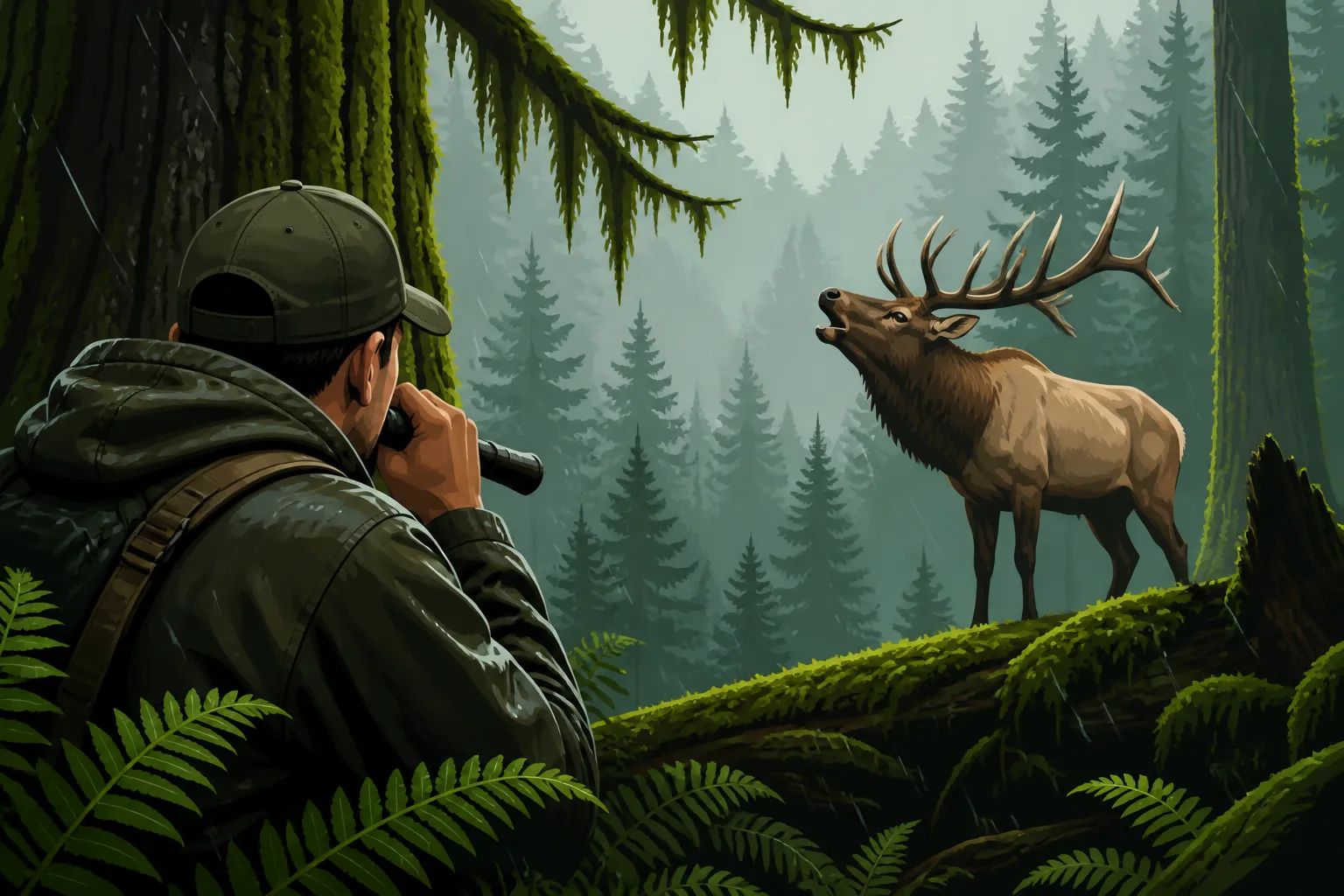
Hunting Roosevelt elk in Oregon's dense, rain-soaked timber is a challenge that can test even the most seasoned hunters. The thick underbrush, low visibility, and the reclusive nature of these coastal giants make finding them a monumental task. This guide will dive deep into the specific calling techniques and strategies you need to master to effectively locate and draw in Roosevelt elk in their native rainforest habitat.
Understanding the Roosevelt Elk's Rainforest World
The very first step to successfully calling Roosevelt elk isn't about blowing into a tube; it's about truly understanding the environment they call home and how it shapes their behavior. Oregon's coastal and Cascade rainforests are a world unto themselves, vastly different from the open sagebrush of Eastern Oregon or the expansive parks where Rocky Mountain elk often roam.
The Unique Challenges of Coastal Timber Habitat
Imagine trying to navigate a maze blindfolded, while someone whispers directions from afar. That's a bit like what it feels like to hunt Roosevelt elk in their typical haunts. The timber here is incredibly dense, often a mix of towering old-growth Douglas fir, Western hemlock, and Sitka spruce, with an understory so thick it can feel like a solid wall. We're talking about salal, sword fern, vine maple, devil's club, and rhododendron that can easily grow taller than your head. Visibility is often measured in yards, not hundreds of yards, making visual scouting or spotting-and-stalking a monumental effort.
This dense cover creates several unique challenges. Firstly, it amplifies sound in strange ways and then dampens it almost immediately. A bugle that would carry for miles in open country might only travel a few hundred yards here before being absorbed by the vegetation. This means elk calls are often much softer and less overt, and your calls need to be projected with a bit more power than you might think. Secondly, constant moisture is a given. Rain, mist, and fog are common, not only making footing treacherous and gear management difficult but also affecting how sound travels and how elk perceive their surroundings. Third, the sheer noise of the forest itself – dripping water, creaking trees, distant rivers – means elk often rely more on subtle cues than loud bugles. They’re masters of stealth, moving through this thick cover with uncanny silence. You, as the hunter, need to adapt your entire approach to this quiet, damp, and visually restrictive environment.
Roosevelt Elk Behavior and Vocalizations
Roosevelt elk are, by nature, generally more reclusive and less vocal than their Rocky Mountain cousins. While you might encounter a screaming match between two bull Rocky Mountains across an open basin, a Roosevelt bull is far more likely to slip away silently or respond with a soft, cautious vocalization. This difference is largely a function of their habitat; a loud, drawn-out bugle in dense timber can give away a bull’s position too easily to predators or other elk. They simply don't have the luxury of vast open spaces to project their dominance.
Their vocalizations tend to be softer, more varied, and used in closer proximity. You'll hear a lot of subtle cow mews, chirps, and shorter, grunting-like bugles. The full, screaming bugle is rare, but not unheard of, particularly when a bull is hot on a cow, or directly challenged at close range. More common are shorter, guttural bugles that sometimes end with a chuckle or glunk, indicating a bull moving through the timber. Calf calls are also incredibly important and often overlooked. A lost calf sound can elicit a strong maternal response from cows and can sometimes draw in a bull checking on his herd. You really need to hone your ears to distinguish these nuances. Understanding Why Roosevelt Bulls Bugle Less Than Rocky Mountain Bulls is crucial for setting realistic expectations and tailoring your calling strategy. They simply operate on a different acoustic wavelength.
Essential Calling Gear for Wet Conditions
The rainforest environment is brutal on gear, especially calling equipment. If your call gets soaked, it might become unusable, and a missed opportunity is the last thing you want when you finally get a Roosevelt bull to talk. Choosing the right calls and knowing how to maintain them is paramount.
Diaphragm Calls and Maintenance
Diaphragm calls are often considered the bread and butter of serious elk callers, and for good reason. They are hands-free, allowing you to manipulate your bow or rifle while calling, and they can produce a remarkably realistic range of elk sounds, from soft mews to sharp bugles. The downside, especially in Oregon's rainforests, is their susceptibility to moisture. A wet diaphragm call can lose its tension, stick to the roof of your mouth, or simply produce a weak, reedy sound that an elk will immediately recognize as unnatural.
To combat this, start with high-quality calls designed for durability. Brands like Phelps Game Calls, Primos, and Bugling Bull Game Calls offer a variety of options. Invest in a good, waterproof call case that keeps your diaphragms dry until you need them. Some hunters even carry a small, breathable bag with desiccant packs to absorb moisture. When you're using them in the field, try to keep them tucked inside your mouth or protected under your hat or neck gaiter when not actively calling. If a call does get wet and sticky, sometimes simply warming it in your mouth for a minute or two can revive it temporarily. Always make sure to thoroughly dry and air out your calls after each hunt to prevent mold and prolong their life. Think of them as precision instruments that require careful handling in damp conditions.
External Reed Calls and Bugles
External reed calls, often used with a bugle tube, offer a different set of advantages and disadvantages. They are generally easier for beginners to learn, as the reed control is external, and they can produce very loud, far-reaching sounds, which can be useful when trying to locate elk in vast areas or cut through dense timber. The main drawback is that they require the use of your hands, which can be problematic if an elk comes in quickly and you need to shoulder your weapon.
When choosing external reed calls for rainforest conditions, look for durable materials that can withstand moisture. Plastic or rubber calls tend to hold up better than traditional wood calls, which can swell or crack. For bugle tubes, consider composite materials over lighter, thinner plastics, as they tend to produce a richer, deeper tone that resonates better. A good bugle tube isn't just about amplification; it's about shaping the sound. Practice with your external reed calls to achieve a realistic variety of mews, chirps, and bugles. While they might not offer the same hands-free convenience as diaphragm calls, they can be an excellent tool for specific scenarios, especially when you need to project sound further or make an aggressive challenge.
Electronic Calls and Oregon Regulations
Now, let's talk about electronic calls. For some species, in some states, these can be incredibly effective. They offer consistent, high-quality sound and can replicate a full range of vocalizations with the push of a button. However, for big game hunting in Oregon, electronic calls are generally not legal. Oregon Revised Statute 498.112 prohibits the use of any "electronic device which simulates an animal call" for hunting big game animals.
This means you cannot use an electronic call to hunt Roosevelt elk, or any other deer or elk species in Oregon. While they might be tempting, attempting to use them would result in a significant fine and potential loss of hunting privileges. It's always best to check the current Oregon Department of Fish and Wildlife (ODFW) regulations pamphlet before each season to ensure you're compliant with all laws. While they might be useful for practicing your calling techniques at home or for calling predators like coyotes in areas where legal, keep them out of your elk hunting pack. Rely on your diaphragm and external reed calls, and the skill you develop with them.
Mastering the Art of Cow and Calf Calls
If you want to be successful calling Roosevelt elk, you must become proficient in cow and calf vocalizations. These are the sounds that resonate most deeply with these more reclusive animals, often eliciting curiosity or maternal instincts that can draw them into shooting range.
Emulating Natural Cow Mews
The cow mew is the most fundamental and versatile call in your arsenal. It’s a soft, often drawn-out sound that communicates reassurance, curiosity, or simply the presence of other elk. Think of it as the general "hello" of the elk world. Roosevelt cows tend to have a slightly deeper, more guttural mew than their Rocky Mountain counterparts, though there's variation within both subspecies.
You'll use cow mews for several key purposes. Firstly, locating: if you're still-hunting through thick timber and haven't heard any elk, a series of soft, questioning mews can sometimes provoke a subtle response from a nearby cow or bull. Secondly, reassuring: if you've made a sharp noise or want to calm a bull that's acting skittish, a soft mew can convey that all is well. Thirdly, drawing in curious bulls: during the rut, a bull will often respond to a cow mew, hoping to find a receptive female. Your goal is to make it sound as natural and non-threatening as possible. Start with a soft, nasal "mew," letting it trail off. Vary the pitch and length slightly to sound like multiple cows. When calling, don't just blast it out. Try to make it sound like it's coming from an elk moving through the brush, perhaps by muffling it slightly or turning your head. Remember, in dense timber, these calls often need to be a bit louder than you'd expect to penetrate the cover, but don't overdo it. The key is natural variation.
Calf Calls and Lost Calf Sequences
Calf calls are incredibly effective, especially for drawing in cows, which can, in turn, pull in a bull. A calf call is typically a higher-pitched, more urgent mew, sometimes with a slightly pleading tone. This sound taps into the strong maternal instincts of cows and can also pique the curiosity of a bull who might be with a herd or looking for one.
The "lost calf" sequence is a particularly potent tactic. It starts with several high-pitched, distressed calf mews, suggesting a young elk separated from its mother. After a few of these, pause and listen intently. Then, follow up with softer, reassuring cow mews, as if a mother elk is trying to locate her calf. This creates a compelling narrative that can pull in both cows and bulls. You can even add a few very subtle chirps or clicks, mimicking the sounds a herd makes when moving. The trick is to paint an auditory picture of a situation that elicits a natural response. This sequence can work wonders when other calls fail, especially during the early archery season or even into the rifle seasons when calves are still close to their mothers.
Timing and Volume Considerations in Dense Timber
The dense, damp nature of Oregon's rainforest timber significantly impacts how sound travels and how you should adjust your calling strategy. Unlike open country where sound carries far and wide, the thick vegetation here acts like a giant sound dampener. This means two critical things for your calling: volume and patience.
Firstly, you often need to call louder than you might intuitively think. A soft mew that sounds perfect in your living room might not even make it 50 yards in the woods. However, there's a fine line between loud and unnatural. The goal isn't to shatter eardrums but to project a realistic sound that can penetrate the cover. Experiment with different levels, listening to how your calls sound in the immediate environment. You're aiming for a strong, clear sound that an elk a couple of hundred yards away can hear without it sounding like you're right on top of them.
Secondly, patience is not just a virtue; it's a necessity. Roosevelt elk are notoriously slow to respond, if they respond at all. You might throw out a calling sequence and hear nothing for 10, 20, or even 30 minutes. Don't assume they're not there or not interested. They might be circling downwind, trying to get a scent, or simply taking their time to assess the situation. After a calling sequence, commit to sitting absolutely still and listening for an extended period. Listen for the subtlest sounds: a twig snap, a faint mew, the rustle of leaves. The rain and wind can mask these sounds, so focus and active listening are key. Don't rush into another calling sequence unless you're sure the initial one has completely played out.
The Subtle Power of the Roosevelt Bugle
While Roosevelt elk are less vocally aggressive than their Rocky Mountain cousins, the bugle still holds a place in their communication, albeit a more subtle one. You won't hear the same piercing screams, but understanding their nuanced bugles can be incredibly effective when used correctly.
Soft Bugles and Chuckles for Close-Range Encounters
Forget the long, drawn-out, high-pitched bugles often associated with elk. For Roosevelts, especially in dense timber, soft bugles and chuckles are far more common and effective. A soft bugle is a shorter, guttural sound, sometimes almost a grunt, that might end in a series of chuckles or glunks. This communicates a bull’s presence without overtly challenging every other bull in the forest. It’s often used by bulls to check on their cows, to express contentment, or to show a subtle level of dominance to a nearby rival.
Chuckles are particularly vital. These are the soft, gurgling sounds a bull makes with his throat, often accompanying a bugle or following a series of cow calls. They convey a variety of emotions: contentment, frustration, or even defiance. When a bull is closing in, or you’ve already had a response, a soft bugle followed by a few chuckles can be incredibly enticing. It tells the bull that there’s a bull nearby, but perhaps one that isn't overtly aggressive, making him more likely to investigate. Practice these sounds to be quiet and realistic. You want to sound like a bull that's comfortable in his environment, not a desperate challenger.
Aggressive Bugles and Challenge Scenarios
While subtle calls are the norm, there are times when a more aggressive bugle can be appropriate for Roosevelt elk. However, these scenarios are fewer and far between compared to Rocky Mountain hunting. An aggressive bugle should generally only be deployed when you've already located a bull, perhaps heard him respond to a softer call, and you believe he's either alone, has a few cows, or is already in a territorial mood. Sending out a full-on, screaming bugle into a quiet forest without prior communication can often scare a Roosevelt bull into silence or send him running the other way.
When you do opt for an aggressive bugle, make it short, sharp, and intense, often ending with a series of deep, guttural chuckles. You can enhance the realism by raking a small tree or breaking a branch, mimicking a bull thrashing his antlers. This adds a visual and auditory element that can really convince a bull that there's a rival in his territory. The "bugle and run" tactic can also work: emit an aggressive bugle, then quickly move 20-30 yards away through the brush, making some noise, as if a bull is moving off. This can provoke a bull to follow, thinking the challenger is retreating. Just be ready, as they can sometimes close the distance surprisingly fast. This is a high-risk, high-reward strategy, so use it judiciously and only when you're confident in the bull's temperament.
Understanding Bull Responses (or Lack Thereof)
One of the most frustrating aspects of calling Roosevelt elk is their propensity for silence. You might put out what you think is a perfect sequence, only to be met with deafening quiet. Don't mistake silence for absence or disinterest. Roosevelt bulls are incredibly adept at circling downwind to get a whiff of whatever is making the noise. They are cautious and often move slowly and silently through the dense timber.
A lack of an immediate bugle response can mean several things. The bull might be coming in silently, trying to confirm your presence with his nose. He might be sending out very soft mews or chuckles that you can't quite hear over the ambient forest noise. Or he might simply be moving away, deciding it's not worth the trouble. The key is to wait, watch, and listen intently. Look for subtle movements in the underbrush, listen for quiet footfalls, or the rustle of leaves. Sometimes, a series of soft cow mews after an initial bugle can draw out a response from a bull that was initially silent. If a bull does respond, pay attention to the type of call. A soft mew often means curiosity, while a deep chuckle might indicate a bull that's moving closer and feeling a bit more confident. For more on these nuanced vocalizations, exploring Cow Calling Versus Bugling in Heavy Timber can provide additional context.
Setting Up for Success in Roosevelt Country
Calling an elk is only half the battle; getting into a position to take a shot is the other, often more difficult, part, especially in the thick Roosevelt timber. Your setup is absolutely critical.
Caller and Shooter Positioning
In dense rainforest timber, caller and shooter positioning is not just important; it’s non-negotiable for success and safety. The primary goal is to ensure the shooter has a clear line of sight to where the elk is expected to appear, while the caller remains hidden and slightly removed to draw the elk’s attention away from the shooter. A common and highly effective setup involves placing the shooter 40-80 yards ahead of the caller, and crucially, slightly off to the side of the expected approach path.
Here’s why: elk, especially a wary Roosevelt bull, will almost always try to circle downwind to scent the source of the call. By placing the shooter off to the side, and the caller directly in front or slightly behind the shooter (relative to the elk's approach), the elk is more likely to pinpoint the caller's position first. This gives the shooter a precious few seconds to identify the animal, assess the shot, and potentially draw a bow or shoulder a rifle before the elk fully commits to the call or smells the hunter. The caller should be completely hidden, perhaps behind a large tree or a thick patch of salal, and remain absolutely still once the elk is approaching. Communication between the caller and shooter should be minimal and pre-planned. In this dense habitat, a few feet can make all the difference between a clean shot and a missed opportunity.
Using Terrain and Cover to Your Advantage
Oregon’s rainforests offer abundant cover, and you must use it to your advantage, both for concealment and for directing elk movement. Always, and I mean always, hunt into the wind. Roosevelt elk have an incredible sense of smell, and if they catch your scent, the game is over. If the wind shifts, be prepared to move and re-strategize.
When setting up, look for natural funnels, benches, and saddles that elk are likely to use as travel corridors. Elk often prefer to move along contours rather than straight up and down steep slopes. Positioning yourself near the edge of a mature timber patch that borders a younger clearcut, or near a natural pinch point created by dense brush or a creek, can concentrate elk movement. Large old-growth trees, fallen logs, and thickets of brush provide excellent cover for both the caller and shooter. Remember that even though you might be calling, you're also still-hunting with your ears. Move slowly, taking deliberate steps, pausing often to listen. The principles of Still-Hunting Speed in Wet Brush apply directly here; slow is smooth, and smooth is fast when you're trying to move silently. You can also gain insight from methods like Reading Clearcut Edges for Blacktail Bucks as the way deer and elk utilize edges in these habitats can be quite similar.
Patience and Persistence: The Roosevelt Hunter's Virtues
Let me be blunt: hunting Roosevelt elk in the timber is not a fast-paced affair. It requires a level of patience and persistence that can wear down even the most dedicated hunter. These animals are masters of their environment, and they rarely make mistakes. You might call for an hour without a peep, only to have a bull silently appear at 30 yards.
After initiating a calling sequence, resist the urge to immediately move or call again if you don't hear a response. Sit for at least 15-20 minutes, listening intently. A bull might be circling, testing the wind, or slowly making his way through the brush. Every twig snap, every rustle, could be a sign. Staying mentally sharp in these conditions means focusing on every detail: the wind, the sounds, the subtle shifts in the forest. Don't get discouraged by silence. It’s a common tactic for a wise Roosevelt bull. Be prepared for long periods of inactivity punctuated by brief, intense encounters. Your ability to remain focused and patient will often be the deciding factor between success and a long, quiet walk back to the truck.
Advanced Tactics for Rainforest Roosevelts
Once you've mastered the basics, it's time to layer in some advanced strategies that can truly make the difference when facing a cagey old Roosevelt bull. These tactics involve combining and varying calls, interpreting subtle cues, and integrating your calling with other hunting methods.
Mixing Calling Sequences for Different Reactions
A common mistake new callers make is sticking to one type of call or one sequence. Roosevelt elk, like all animals, react differently based on their mood, the time of year, and the specific dynamics of their herd. To truly be effective, you need to be dynamic with your calling, constantly assessing the situation and adjusting your approach.
Start soft. A few quiet cow mews are often a good way to test the waters and see if there are any curious elk nearby without alarming them. If you get a soft response, you can slowly increase the intensity. If you hear nothing, try a lost calf call to pique maternal instincts. If that gets a response, perhaps from a cow, you might then transition to a more excited cow sequence, as if several cows are gathering. The "lost calf leading to a cow fight" scenario is particularly effective. Start with distressed calf calls, then switch to aggressive cow chatter, lip bawls, and even light sparring sounds (if you can convincingly make them). This creates a highly emotional situation that can draw in bulls eager to protect their herd or investigate a disturbance. You can even vary calls to sound like multiple animals—one caller can make a cow call, another (or you with a different call) can make a different cow call or a bull chuckle, creating the illusion of a small, active herd. The key is to tell a story with your calls, rather than just making noise.
Reading Elk Body Language and Approaching Responses
In the dense rainforest, spotting an elk before it spots you is a significant challenge. Often, the first sign of an approaching animal won't be a visual, but an auditory cue. You need to become an expert at listening and interpreting subtle sounds. Listen for distinct sounds like twigs snapping underfoot, the rustle of ferns, the displacement of water, or the soft "glunking" sound a bull sometimes makes when moving.
Once you do spot an elk, pay close attention to its body language. Ears swiveling back and forth indicate it's trying to locate the source of the sound. A head held high, sniffing the air, means it's trying to catch your scent. If an elk is slowly walking towards you with its head down, occasionally pausing to browse, it's likely relaxed and curious. If it suddenly stops, throws its head up, and stares intently in your direction, it's likely it's spotted something, or smelled something, and is now on high alert. This is your cue to freeze, get ready for a shot, and potentially let out a soft, reassuring mew to try and calm it down. Sometimes, a subtle flick of an ear or tail can give away an elk's position in thick brush. Your preparation for a shot should happen before the elk is fully visible.
Combining Calling with Still-Hunting and Tracking
Calling doesn't have to be a stationary activity. In fact, combining calling with slow, deliberate still-hunting is one of the most effective strategies for Roosevelt elk in timber. The idea is to move through the forest with extreme stealth, covering ground slowly, and then pausing to call.
Here’s how it works: you move perhaps 50-100 yards through the dense timber, taking 15-20 minutes to cover that distance, focusing on moving silently. Every few steps, pause for 30-60 seconds, listening intently. After covering a reasonable distance or reaching a likely spot (like a bench, saddle, or drainage crossing), set up for a calling sequence. Try a few soft cow mews, wait 10-15 minutes, then move another 50-100 yards. This keeps you actively searching for elk and gives you the opportunity to surprise them, or to have them respond to your calls as you move into their range.
If you jump an elk, or make a marginal hit, calling can also play a role in Blood Trailing in Oregon Rainforest Understory. After waiting a sufficient time (at least an hour for a gut shot, 30 minutes for a good lung shot), if you're struggling to find a blood trail, a soft cow call can sometimes get a response from a wounded animal, helping you pinpoint its location. Similarly, understanding how to read tracks, even in the mud and moss of the rainforest, can be combined with calling. While Tracking Bucks in Fresh Eastern Oregon Snow offers principles for snow, the underlying idea of understanding gait, direction, and speed applies across terrains. If you find fresh tracks, a soft call can sometimes confirm if the animal is still nearby.
Practical Tips for Hunting in Oregon's Rainforest
Hunting Roosevelt elk in Oregon's rainforests is an immersive experience that demands not only calling skill but also a robust understanding of gear, navigation, and the unique environment itself.
Gear Considerations for Wet Weather
If there's one thing you can count on in Oregon's coastal and Cascade elk country, it's moisture. Rain, mist, heavy dew – it's all part of the package. Your gear needs to be up to the challenge, or your hunt will be miserable and potentially dangerous.
Firstly, invest in high-quality waterproof outerwear. We're talking about durable rain gear that actually stays dry. Look for materials like Gore-Tex or similar proprietary waterproof/breathable fabrics from reputable brands like Sitka, Kuiu, or First Lite. Your outer shell should shed water, but also allow perspiration to escape to prevent you from getting clammy and cold. This applies to your pants, jacket, and gloves. Secondly, your footwear is critical. You'll be traversing steep, slippery terrain, often covered in thick mud, wet moss, and slick roots. Waterproof, well-insulated boots with aggressive tread are non-negotiable. Look for boots designed for wet conditions, perhaps with a rubber rand for added protection. Prioritizing Rain Gear That Actually Stays Dry and Boots for Wet Coastal Hunting will make your entire hunt more comfortable and safer. Carry extra dry layers in a waterproof stuff sack inside your pack. Keep a lens cloth handy for your optics, as fogging is common. And remember to protect your calls, as discussed earlier.
Navigation and Safety in Dense Timber
Getting lost in Oregon's dense timber is a real possibility, and it can quickly turn a challenging hunt into a life-threatening situation. Visibility is so limited that it's easy to become disoriented, even if you know the area.
A reliable GPS device or a smartphone app like GoHunt with downloaded maps is absolutely essential. Don't rely solely on cell service, as it's often nonexistent in these remote areas. Download detailed topographic maps and satellite imagery of your hunting unit before you leave home. Learn how to use waypoints to mark your vehicle, key terrain features, and where you plan to hunt. Carry a physical compass and map as a backup, and know how to use them. Before your hunt, make sure to read Reading a Travel Management Area Map Before You Drive, as understanding road access and closures is paramount.
Safety is paramount. Always tell someone your detailed hunting plan, including where you'll be, your expected return time, and your vehicle description. This is crucial for a potential search and rescue operation, and you can find more details in Leaving a Trip Plan With Someone at Home. Carry a robust first-aid kit, a headlamp with extra batteries, fire-starting materials, a water filter, and emergency food. A personal locator beacon (PLB) or satellite messenger like a Garmin inReach is a worthwhile investment for remote hunts. Remember that the dense timber can make communication difficult, so these devices can be life-savers.
Understanding Roosevelt Elk Habitat and Movement Patterns
Successful calling relies heavily on being in the right place at the right time. Roosevelt elk habitat in Western Oregon is primarily characterized by a mosaic of mature and regenerating timber, often interspersed with riparian zones and small clearcuts. They are masters of using this cover for security.
During the day, Roosevelt elk typically bed in dense, mature timber, often on north-facing slopes or in deep, dark canyons where they feel secure from predators and heat. In the early morning and late evening, they will move to feeding areas, which often include younger clearcuts (typically 5-15 years old, where palatable browse like huckleberry, salal, and fireweed are abundant), riparian zones, or areas with recent logging activity that have opened up the canopy. Understanding how these elements interact is key. They will often travel along benches, saddles, and natural drainage systems to move between bedding and feeding areas. Pay attention to fresh sign—tracks, droppings, rubs, and wallows—to confirm their presence and movement patterns. Elevation also plays a role; in the early season, elk might be higher, moving lower as snow begins to accumulate or feed becomes scarce. Learning about Roosevelt Elk in Western Oregon will give you a deeper appreciation for their habits and how they navigate their challenging environment.
Maximizing Your Chances: General Season vs. Controlled Hunts
Oregon offers two primary avenues for elk hunting: general season and controlled hunts. Both have their pros and cons, and your calling strategy might need to adapt depending on which tag you hold.
General Season Strategies
Oregon's general season elk hunts typically offer over-the-counter tags, making them accessible to many hunters. However, this accessibility comes with increased hunting pressure. You'll likely be sharing the woods with more people, which can make elk warier and more challenging to call in.
For general season, your strategies need to account for this pressure. Firstly, focus on overlooked or harder-to-reach areas. Most hunters stick to easily accessible roads and trails. By venturing a bit deeper into roadless country, or targeting steep, nasty terrain that others avoid, you can find less pressured elk. Even a mile or two from a road can make a huge difference. Secondly, hunt during the week if possible. Weekends see a surge in hunter numbers. Mid-week hunts often provide a quieter, more natural environment where elk are more likely to respond to calls. Thirdly, be aware of the season timing. Early general season hunts (often in late September/early October) might catch the tail end of the rut or the post-rut, where bulls are still somewhat vocal. Later seasons (November) will see elk focused more on feeding and moving into winter range, where bugling is less common and cow/calf calls become even more dominant. For more details on the differences, explore Oregon General Season Versus Controlled Hunt Tags.
Controlled Hunt Advantages
Controlled hunts, on the other hand, require applying through Oregon's draw system, often accumulating preference points over several years to draw a desirable tag. The payoff, however, is significantly reduced hunter numbers and often better bull-to-cow ratios, leading to potentially higher success rates and less pressured animals.
The primary advantage of a controlled hunt is the decreased competition. With fewer hunters in the woods, elk are generally more relaxed and more likely to respond to calls. This can translate into more consistent bugling from bulls, making your calling efforts more effective. In a controlled hunt scenario, you might have the luxury of spending more time working a particular bull, knowing that another hunter is less likely to move in on your setup. While still cautious, these elk might be more inclined to investigate a call rather than immediately retreating. However, drawing a controlled hunt tag often requires years of planning and accumulating Oregon Preference Points and How They Work. Understanding the Oregon Controlled Hunt Draw Explained is the first step to securing one of these coveted tags. If you do draw, leverage the lower pressure by being patient, persistent, and confident in your calling strategies, knowing that the odds are more in your favor.
| Calling Type | Target Elk | Primary Purpose | Sound Characteristics | Best Time/Situation |
|---|---|---|---|---|
| Cow Mew (Soft) | All Elk | Locate, Reassure, Attract Curiosity | Soft, drawn-out, nasal "mew" | Early morning, mid-day, after aggressive calls, seeking location |
| Cow Mew (Excited) | Cows, Bulls | Create Interest, Simulate Herd Movement | Louder, more urgent, varied pitch and length | When elk are responsive, simulating active herd |
| Calf Call (Distress) | Cows, Bulls | Evoke Maternal Instinct, Pique Curiosity | High-pitched, pleading, urgent | Initial locator call, "lost calf" sequence, exciting cows |
| Roosevelt Bugle (Soft) | Bulls, Cows | Announce Presence, Subtle Challenge, Herd Check | Short, guttural, sometimes ending in chuckles/glunks | Close range, checking on herd, light challenge, post-mew |
| Roosevelt Bugle (Aggressive) | Bulls | Direct Challenge | Sharp, intense, often followed by deep chuckles/raking sounds | When bull is located, in range, already vocal, or in rut |
| Chuckles/Glunks | Bulls | Contentment, Defiance, Close Proximity | Gurgling, throaty sounds | Any time a bull is moving, responding, or feeling confident |
Disclaimer
Please remember that hunting regulations and conditions can change rapidly. Always consult the most current Oregon Department of Fish and Wildlife (ODFW) regulations pamphlet before heading into the field. This guide is for informational purposes only and does not supersede official regulations or personal safety precautions. Be safe, ethical, and responsible in your hunting endeavors.