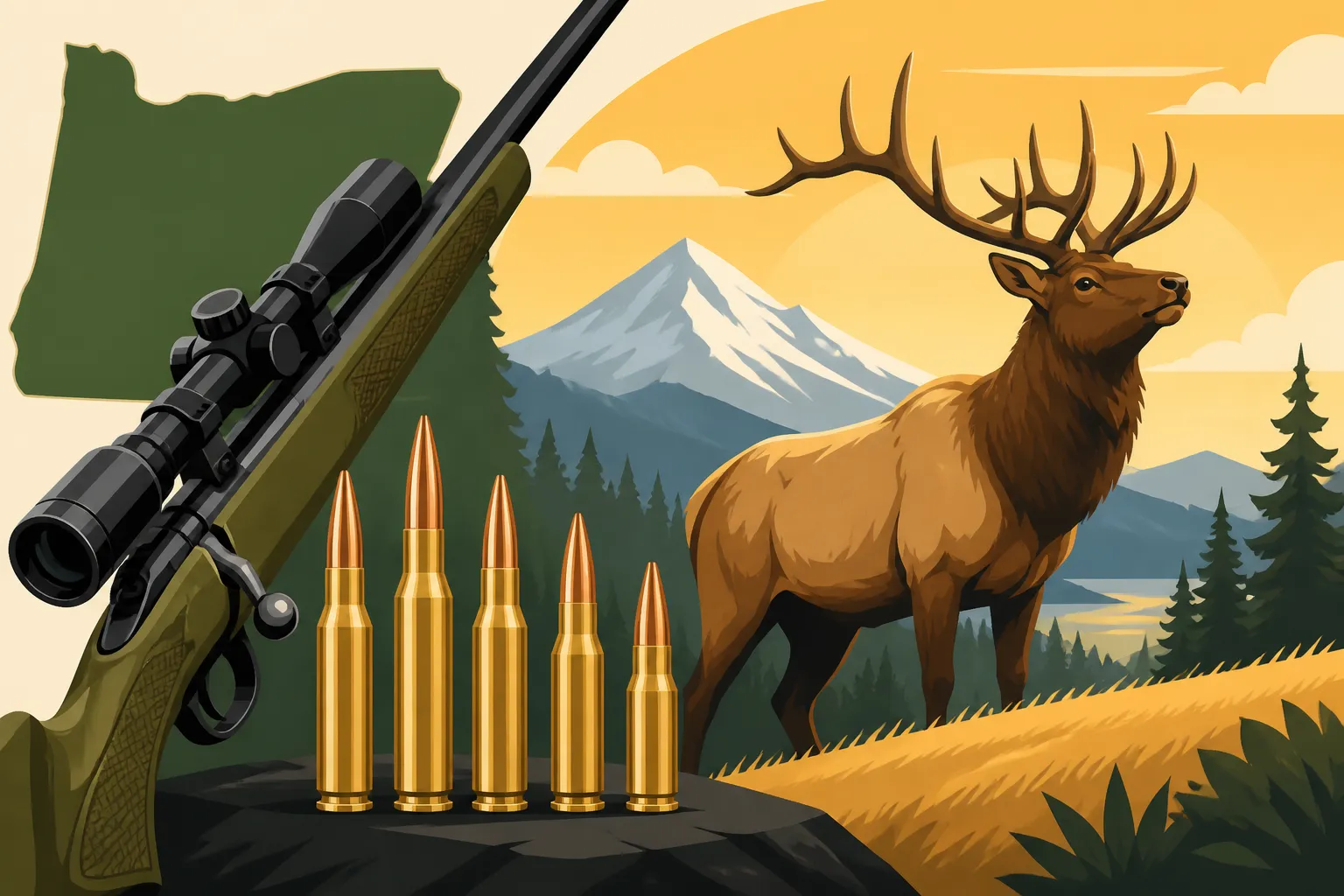
Rifle Calibers That Suit Oregon Elk
Choosing the right rifle caliber for an Oregon elk hunt can feel like stepping into a confusing maze, especially when you consider the vast differences between hunting dense coastal rainforests and the wide-open spaces of eastern Oregon. Many hunters get bogged down in ballistics charts, trying to find that one perfect round, but the truth is, the "best" caliber often comes down to balancing power with your ability to shoot it accurately under real hunting pressure. This guide aims to clear up the confusion, walking you through the practical considerations for selecting a rifle caliber that will put an Oregon elk on the ground ethically and effectively.
Understanding Oregon Elk Hunting Conditions
Oregon is a state of incredible diversity, and that extends directly to its elk habitats. What works perfectly for a Roosevelt elk in the Coast Range might be a significant handicap when chasing a Rocky Mountain elk across the high desert. Understanding these distinct environments is the first step in choosing a suitable rifle caliber.
Western Oregon Rainforest Encounters
Imagine hunting in the thick, wet coastal timber, where visibility can often be measured in yards, not hundreds of feet. This is the realm of the Roosevelt elk. These magnificent animals live in dense forests, often among thick stands of timber, clearcuts choked with brush, and steep, broken terrain.
When you’re hunting Roosevelt elk, your shots are typically close-range, often within 100 yards, and frequently through some amount of brush or understory. The challenge here isn't usually hitting a small target at a great distance, but rather delivering enough energy to penetrate heavy hide, muscle, and bone from a relatively close encounter. A flat-shooting, hyper-velocity magnum isn't always the primary advantage here. Instead, you need a caliber that delivers a solid thump, pushing a heavy bullet that can retain its energy even if it clips a branch or two on the way. Bullet construction that ensures deep penetration and controlled expansion is paramount in this kind of environment.
For those planning to spend their November seasons in the Coast Range or Cascades, understanding the terrain will guide your rifle choice. When you're focusing on methods like Still-Hunting Blacktails in Wet Oregon Coastal Brush (though for elk, the principles of close-quarters movement and shot placement are similar), you're thinking about quick, decisive shots.
Eastern Oregon Open Country Challenges
Now, shift your mental image to the vast, sagebrush-covered hills, rimrock canyons, and scattered juniper stands of eastern Oregon. Here, you'll be pursuing Rocky Mountain elk, often at much longer distances. The terrain can be brutally steep, but the visibility is often expansive, offering opportunities for shots out to 300, 400, or even 500 yards.
In this environment, a flat-shooting caliber that resists wind drift is a huge advantage. You'll spend a lot of time glassing, spotting animals often far away, and then planning your approach. However, sometimes that ideal approach isn't possible, and you might need to take a longer shot. Precision and trajectory are key here. The bullet needs to fly true, buck the wind, and still carry sufficient energy to ethically dispatch an elk at extended ranges. Recoil management becomes a different kind of factor; while you want power, you also need to be able to comfortably shoot your rifle from various field positions, whether prone, kneeling, or off a pack. The physical demands can be significant, so understanding how to best operate your firearm in these conditions is crucial. For those venturing into this region, mastering skills like Glassing Sage and Juniper for Eastern Oregon Mule Deer will be directly transferable to elk hunting.
Essential Ballistics for Elk Calibers
Beyond just picking a name off a shelf, understanding some basic ballistic principles will truly help you select a rifle caliber that is up to the task of hunting Oregon elk. It's not just about the biggest number on the box; it's about what that number actually does downrange.
Minimum Energy and Bullet Construction
When it comes to ethically harvesting an elk, kinetic energy at impact is a critical factor. While there's no single, universally agreed-upon "minimum" energy requirement, most experienced elk hunters and ballisticians recommend a bullet deliver at least 1,500 to 2,000 foot-pounds (ft-lbs) of energy at the point of impact. This energy, combined with proper bullet construction, is what allows for deep penetration and sufficient hydrostatic shock to incapacitate a large animal like an elk.
However, energy alone isn't the whole story. Bullet construction plays an equally, if not more, important role. You're not shooting paper targets; you're shooting through tough hide, thick muscle, and potentially heavy bone. A bullet designed for rapid expansion on thin-skinned game might fragment or completely blow up on the shoulder plate of a bull elk, failing to reach vital organs.
Look for bullets specifically designed for large, tough game. These typically feature bonded cores, partition designs, or solid copper construction. Brands like Nosler Partition, Hornady InterBond, Barnes TSX/TTSX, or Swift A-Frame are excellent examples. These bullets are engineered to retain a high percentage of their original weight, penetrate deeply, and expand reliably but not explosively, creating a larger wound channel while still driving through to the vitals. A well-constructed 165-grain .30-06 bullet, for instance, will perform far better on an elk than a lightly constructed 180-grain bullet designed for deer, even if they have similar muzzle energy.
Recoil Management and Shot Placement
This is perhaps the most overlooked, yet most crucial, aspect of caliber selection. It doesn't matter how powerful your rifle is if you flinch every time you pull the trigger. Elk are large animals, but their vital zone (heart and lungs) is still a relatively small target, especially when viewed through scope magnification at distance, or glimpsed briefly in thick timber.
A perfectly placed shot from a .308 Winchester or a 7mm-08 Remington will put an elk down far more effectively and humanely than a poorly placed shot from a .300 Winchester Magnum or a .338 Winchester Magnum. Excessive recoil can lead to:
- Flinching: Anticipating the recoil causes you to jerk the trigger, pull off target, or close your eyes.
- Poor Follow-Through: You might not stay on target after the shot, making it harder to spot your impact or take a follow-up shot if needed.
- Lack of Practice: If shooting your rifle is genuinely unpleasant, you won't practice as much as you should, further degrading your accuracy under pressure.
Be honest with yourself about what you can shoot accurately and comfortably. If you're sensitive to recoil, consider a rifle with a good recoil pad, a muzzle brake, or even a suppressor (where legal and practical). Alternatively, opt for a slightly lighter recoiling caliber that you can practice with extensively. Remember, confidence in your rifle and your ability to shoot it accurately trumps raw power every single time. A solid hit on the lungs is better than a shoulder shot with a bullet that fragments, or a gut shot because you flinched.
Popular Rifle Calibers for Oregon Elk
Let's dive into some specific calibers that have proven themselves time and again in Oregon's diverse elk hunting grounds.
The Go-To Mid-Range Choices
These calibers represent a fantastic balance of power, manageable recoil, and ammunition availability, making them excellent all-around choices for many Oregon elk hunters.
-
.30-06 Springfield: If there's a quintessential "American elk cartridge," this is it. The .30-06 Springfield has been anchoring elk for over a century, and for good reason. It offers a wide range of bullet weights, from 150 to 200 grains, allowing hunters to tailor their load to the specific conditions. A 180-grain premium bullet in a .30-06 is more than capable of taking any elk in Oregon. It has sufficient energy for most shots out to 300-350 yards, and its recoil is stout but manageable for most hunters. For a general season hunter who might be hunting coastal timber one year and eastern sage the next, the .30-06 is incredibly versatile. It's truly a workhorse, performing admirably whether you're taking a close shot in the thick stuff or reaching out a bit further. When researching how others approach hunting specific units, resources like GoHunt often highlight the prevalence and success of calibers like the .30-06 due to their adaptability.
-
.308 Winchester: Often considered the younger, slightly more compact brother to the .30-06, the .308 Winchester is another stellar choice, particularly for hunters who prefer a shorter action rifle or are more recoil-sensitive. While it typically shoots slightly lighter bullets at slightly slower velocities than the .30-06, a 165 or 180-grain premium bullet from a .308 has plenty of power for elk out to 250-300 yards. Its inherent accuracy and mild recoil make it a joy to shoot, which translates directly to better shot placement in the field. Don't let anyone tell you a .308 isn't an "elk caliber"; with modern bullet technology, it's absolutely lethal when put in the right spot.
-
7mm-08 Remington: For those truly sensitive to recoil but still wanting ample power, the 7mm-08 Remington is a dark horse that consistently impresses. It's essentially a .308 necked down to accept 7mm bullets. With 140 to 160-grain premium projectiles, it offers excellent ballistics, a flat trajectory, and surprisingly good penetration for its mild recoil. It’s effective out to around 250 yards for elk, making it a fantastic choice for younger hunters, those with smaller frames, or anyone who simply wants to maximize their accuracy without the punishment of a magnum.
Magnum Powerhouses for Eastern Oregon and Beyond
When longer shots are the norm, and you want every bit of downrange energy and a flatter trajectory, magnum calibers truly shine.
-
.300 Winchester Magnum: This is arguably the most popular magnum elk cartridge in North America. The .300 Win Mag launches 180 to 200-grain bullets at blistering velocities, making it an outstanding choice for those longer shots across eastern Oregon's expansive landscapes. It carries significant energy out to 400+ yards, providing a substantial margin for error in bullet drop and wind deflection. The trade-off, of course, is recoil. It's significantly more noticeable than a .30-06, and consistent practice is essential to shoot it well. For hunters confident in their ability to manage recoil, the .300 Win Mag offers exceptional performance, especially when hunting Rocky Mountain Elk in Eastern Oregon.
-
7mm Remington Magnum: A perennial favorite, the 7mm Rem Mag offers a very flat trajectory and excellent ballistic coefficient with its common 150-175 grain bullets. It rivals the .300 Win Mag in effective range and delivers plenty of punch for elk while often having slightly less perceived recoil. Many hunters find the 7mm Rem Mag to be the sweet spot between trajectory, power, and recoil. It's a fantastic choice for open country, helping you reach out across those vast canyons or sage flats with confidence.
-
.338 Winchester Magnum: If you want to hit an elk like a freight train, the .338 Win Mag is your ticket. Launching heavy 200 to 250-grain bullets, it delivers unparalleled energy and penetration, making it an excellent choice for the largest bulls or when you anticipate very tough angles. While its trajectory isn't as flat as the .300 Win Mag or 7mm Rem Mag, its sheer kinetic energy and knockdown power are undeniable. Recoil is substantial, so a good recoil pad, muzzle brake, or heavier rifle is highly recommended. For the hunter who prioritizes absolute power and confidence in ethical penetration, the .338 Win Mag is a top-tier choice.
Less Common but Effective Options
While not as widely used, a few other calibers can certainly do the job for Oregon elk.
-
.338 Federal: This is an interesting modern cartridge that fits into a short-action rifle. It uses a .308 Winchester case necked up to accept a .338 diameter bullet. It delivers impressive energy with 180-225 grain bullets, making it a powerful thumper for close to mid-range elk hunting, especially in dense timber. It offers near-.338 Win Mag performance in a more compact package with less recoil, making it a great option for the Western Oregon hunter.
-
.35 Whelen: A classic wildcat that went mainstream, the .35 Whelen is a .30-06 case necked up to .35 caliber. It launches heavy 200-250 grain bullets at moderate velocities, making it a superb choice for short to medium-range timber hunting. It hits very hard and is known for deep penetration. It's a fantastic option for a hunter looking for a powerful, non-magnum cartridge ideal for thick cover.
-
.270 Winchester (with caveats): The .270 Win is a beloved deer cartridge, and while it can take elk, it's generally considered on the lighter end of acceptable. If you use a .270 for elk, you absolutely must use premium, heavy-for-caliber bullets (150-160 grain bonded or solid copper) and restrict your shots to ideal broadside presentations at closer ranges (under 200-250 yards). It requires impeccable shot placement, but for a hunter who shoots it exceptionally well and understands its limitations, it can be effective. Just be mindful of its capabilities compared to dedicated elk cartridges.
Matching Caliber to Terrain and Personal Skill
Ultimately, the best rifle caliber for your Oregon elk hunt is one that matches the specific terrain you'll be hunting and, perhaps even more importantly, your personal shooting skill and comfort level.
Coastal Timber Considerations
For the dense forests and frequent close-range encounters of western Oregon, such as the Oregon Coast Range Hunting Access areas, you want a caliber that delivers substantial kinetic energy and utilizes tough, heavy-for-caliber bullets. Penetration is key, as you might encounter brush or need to break through an elk's shoulder.
Calibers like the .30-06 Springfield with 180-200 grain bullets, the .338 Federal with 200-225 grain bullets, or even the .35 Whelen, are excellent choices. They provide the necessary punch without excessive velocity that can lead to bullet fragmentation if it hits a branch or bone. Short-range accuracy is paramount, and the ability to get off a quick, well-placed shot is often more important than a super-flat trajectory at 400 yards.
High Desert and Mountain Ranges
When pursuing Rocky Mountain elk in the more open landscapes of eastern Oregon, where shots can extend beyond 300 yards, flatter trajectories and resistance to wind drift become more critical. This is where magnum cartridges truly shine.
Calibers like the .300 Winchester Magnum, 7mm Remington Magnum, or even the .300 PRC (a newer, very capable long-range magnum) are fantastic options. They launch heavy, high-ballistic-coefficient bullets at high velocities, minimizing bullet drop and drift over extended distances. However, remember the recoil factor. If you plan to hunt the Blue Mountains Hunting in Northeast Oregon or other expansive areas, extensive practice at longer ranges and from various field positions is essential to make the most of these powerful cartridges. A rangefinder is an indispensable tool, and understanding how to use it proficiently with your chosen cartridge is non-negotiable.
The Importance of Practice
No matter what caliber you choose, nothing, absolutely nothing, replaces practice. Taking a new rifle out for a few shots a week before the season opener is a recipe for disappointment. You need to:
- Become intimately familiar with your rifle: Know its feel, its trigger, its balance.
- Practice from various field positions: Most hunting shots aren't taken from a bench rest. Practice shooting offhand, kneeling, sitting, and prone, ideally using your hunting backpack or trekking poles as rests.
- Shoot at different distances: Know your bullet's drop at 100, 200, 300, and even 400 yards. This is where a good ballistic calculator or range card comes in handy.
- Shoot under pressure: Simulate hunting scenarios. Practice quick target acquisition. This mental preparedness is as important as physical skill.
A hunter who can confidently place a well-constructed bullet from a .308 Winchester into an elk's vitals will be far more successful than one who flinches with a .338 Winchester Magnum and makes a poor shot. Your personal skill and comfort are your greatest assets.
Caliber Comparison for Oregon Elk
To help visualize the differences between some of the popular choices, here's a quick comparison table. Keep in mind that "Effective Range" is a general guideline and heavily depends on bullet choice, hunter skill, and specific environmental factors.
| Caliber | Common Bullet Weight Range (gr) | Approximate Muzzle Energy (ft-lbs) | Effective Range for Elk (yds) | Pros | Cons |
|---|---|---|---|---|---|
| 30-06 Springfield | 150-200 | 2800-3000 | 300-350 | Highly versatile, excellent penetration, good ammo availability, manageable recoil for most. | Can feel a bit "dated" to some, not a true long-range magnum. |
| 308 Winchester | 150-180 | 2600-2800 | 250-300 | Mild recoil, inherently accurate, short-action friendly, excellent ammo availability. | Slightly less power and reach than .30-06, can be perceived as "underpowered" by some. |
| 7mm-08 Remington | 140-160 | 2400-2600 | 250 | Very mild recoil, flat trajectory, surprisingly good penetration with premium bullets. | Ammo can be less common than .30-06/.308, requires premium bullets for elk. |
| 300 Winchester Magnum | 180-200 | 3500-3800 | 400+ | Excellent long-range power, flat trajectory, widely available ammo. | Significant recoil, more expensive ammo, requires dedicated practice. |
| 7mm Remington Magnum | 150-175 | 3200-3500 | 350-400 | Very flat trajectory, good power for range, often perceived as less recoil than .300 Win Mag. | Recoil is still substantial, can be "overkill" for close timber hunting. |
| 338 Winchester Magnum | 200-250 | 3800-4200 | 300-350 | Massive knockdown power, superior penetration on large bone, excellent for grizzly/brown bears. | Heavy recoil, heavy rifle often needed, very specialized for elk, expensive ammo. |
When planning your hunt, consider consulting your hunting regulations for specific details, especially if you're looking at Oregon Muzzleloader Equipment Rules or other specialized seasons.
Choosing the right rifle caliber for your Oregon elk hunt is a highly personal decision that should be based on a realistic assessment of your hunting style, the specific terrain you'll be in, and your shooting proficiency. Don't fall into the trap of thinking a bigger caliber automatically means a better hunter. Focus on accuracy, choose a quality bullet, and practice diligently. A well-placed shot with a "medium" caliber will always outperform a poorly placed shot from a "magnum." Get out there, be safe, and good luck chasing those majestic Oregon elk!
Disclaimer: Hunting regulations and seasons can change. Always consult the most current Oregon Department of Fish and Wildlife (ODFW) regulations pamphlet before planning any hunt. This guide is for informational purposes only and does not supersede official ODFW publications or legal advice.