Still-Hunting Blacktails in Wet Oregon Coastal Brush
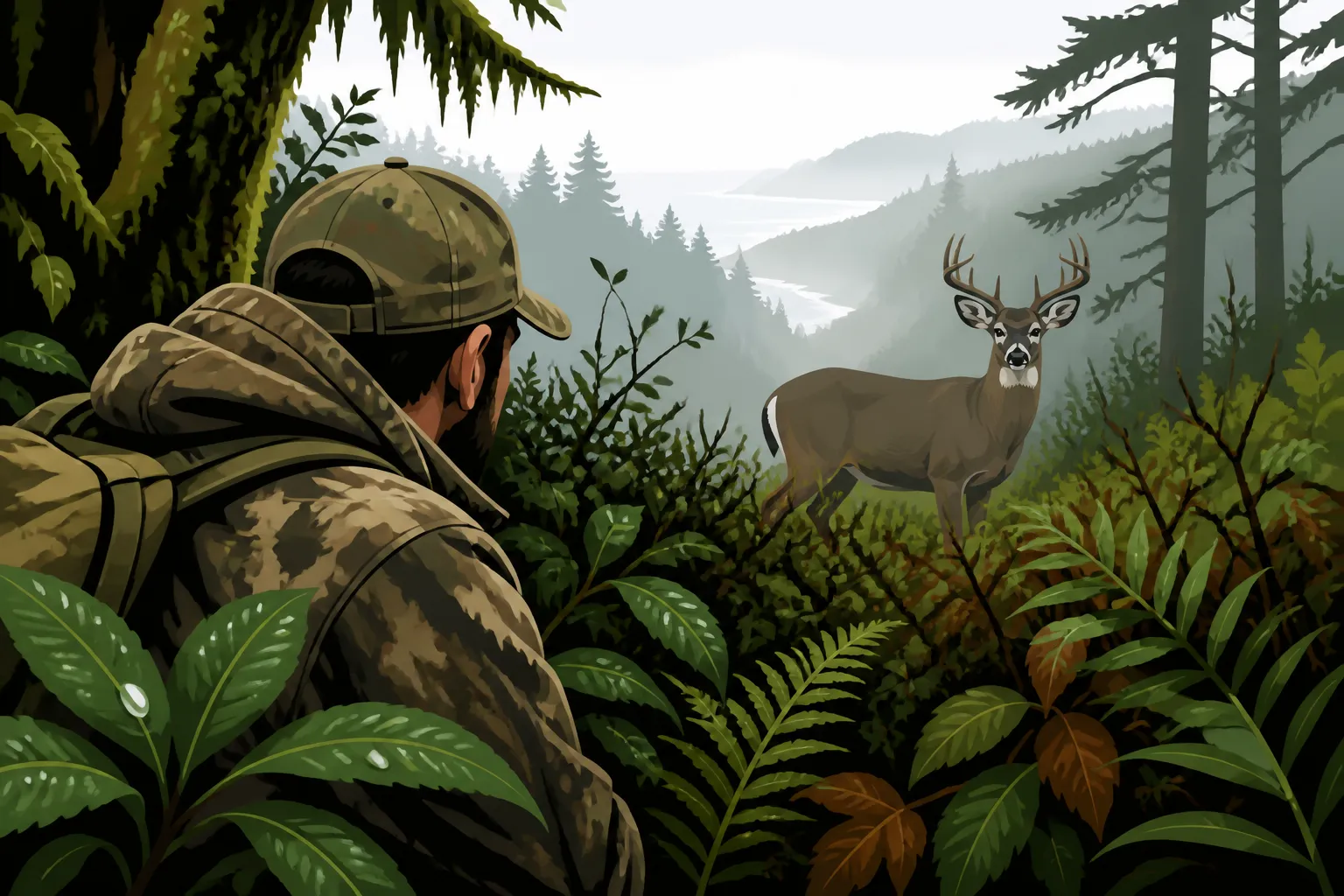
Hunting blacktail deer in the dense, wet coastal brush of Oregon can feel like trying to find a ghost in a green labyrinth. The thick undergrowth, persistent rain, and the blacktail's uncanny ability to melt into the shadows often leave hunters feeling frustrated and empty-handed. This guide will walk you through the challenging yet rewarding art of still-hunting these elusive deer in their natural, often soggy, habitat, offering detailed strategies to tip the odds in your favor.
Understanding the Coastal Blacktail and Its Habitat
Oregon's coastal blacktails are a unique challenge. Unlike their open-country cousins, they thrive in some of the densest, wettest forests imaginable. Successfully hunting them requires a deep understanding of their behavior and the specific features of the terrain they call home.
The Elusive Nature of Coastal Blacktails
Blacktails are masters of stealth. They are often referred to as "grey ghosts" for a reason – their ability to seemingly vanish with minimal movement is legendary. In the coastal timber, this elusiveness is amplified by the sheer amount of cover available. They don't need to run far to disappear; a few steps into a salal thicket or under a curtain of sword ferns is usually enough. Their senses are acutely tuned to their environment, especially their hearing. Every twig snap, every rustle of rain gear, can send them deeper into the brush.
What makes them so challenging is their preference for bedding in areas of extreme cover, often right on the fringes of clearcuts or along game trails that appear impenetrable to humans. They rely heavily on their sense of smell, using the prevailing wind to detect intruders long before they're seen. This means as a still-hunter, you're constantly playing a game of cat and mouse, trying to outwit an animal perfectly adapted to its surroundings. Furthermore, their small size compared to other deer species, like mule deer, and their dark coloration make them incredibly difficult to spot against the backdrop of dark timber and wet foliage. It's not uncommon to be within spitting distance of a blacktail and never know it.
Key Habitat Features in Wet Oregon Brush
The Oregon Coast Range is a mosaic of dense, regenerating clearcuts, mature timber, and riparian zones, all frequently bathed in rain. Understanding these features is paramount. Blacktails prefer areas where food, water, and cover are abundant and close together. Look for young clearcuts, especially those that are two to five years old, offering a mix of browse and dense bedding cover. Areas with a high density of huckleberry, salal, and evergreen shrubs like rhododendron provide excellent forage and concealment.
Water sources are always critical, even in a wet environment. Creeks, springs, and even standing puddles can be natural travel corridors or places deer visit. Pay close attention to the edges where different types of vegetation meet, like the transition from dense timber to a recent burn or clearcut. These "edge covers" are often preferred bedding sites because they offer quick escape routes and thermal regulation. Topographical features like saddles, benches, and finger ridges are also high-percentage spots, as deer use them for easier travel through otherwise difficult terrain. Utilizing tools like the mapping features on GoHunt can help you pinpoint these topographical nuances and vegetation changes before you even set foot in the woods. By thoroughly understanding these habitat preferences, you're not just wandering aimlessly; you're hunting with purpose.
Essential Gear for Wet Coastal Still-Hunting
Hunting in Oregon's coastal forests means one thing: rain. And lots of it. Your gear isn't just about comfort; it's about staying safe and effective in conditions that can quickly turn miserable.
Staying Dry and Comfortable: Layering and Rain Gear
The constant drizzle and often heavy downpours in the Coast Range demand a serious approach to staying dry. Forget cheap ponchos or water-resistant jackets; you need truly waterproof, breathable gear. Start with a good base layer that wicks moisture away from your skin, even when you're exerting yourself. Synthetic materials or merino wool are excellent choices. Avoid cotton at all costs, as it retains moisture and loses its insulating properties when wet, leading to hypothermia risks.
Your mid-layers should provide insulation without bulk, allowing for silent movement through thick brush. Fleece or lightweight synthetic puff jackets work well here. The outer layer is where you absolutely cannot compromise. Invest in high-quality rain gear that actually stays dry, with taped seams and durable waterproof membranes like Gore-Tex or similar technologies. A quiet fabric is also crucial; noisy rain gear will spook deer faster than a bugle in a bedroom. Don't forget waterproof pants that can withstand constant abrasion from wet branches and thorns. It's a significant investment, but staying dry and warm directly impacts your focus and ability to stay in the field longer. Remember that a cold hunter is a miserable and ineffective hunter.
Footwear and Optics for Dense Timber
Your feet are your foundation, especially when still-hunting across slick logs, muddy trails, and through dense undergrowth. You need boots for wet coastal hunting that are not only waterproof but also offer excellent ankle support and aggressive traction. Look for boots with a high rubber rand to protect against scuffs and punctures from sharp sticks and rocks. A good pair of gaiters can also be a game-changer, preventing water, mud, and debris from getting into your boots from the top. Keeping your feet dry is just as important as keeping your core dry.
When it comes to optics, the dark timber and low light conditions prevalent in the coastal brush mean you'll want binoculars with excellent light-gathering capabilities. A magnification of 8x or 10x is usually sufficient; anything higher can be too shaky for quick scanning and reduce your field of view in tight quarters. Look for quality glass with good coatings to minimize glare and maximize clarity in dim light. A rangefinder is also invaluable for confirming distances, especially when shooting lanes are narrow and distances can be deceptive in dense cover. A compact model that can be easily accessed and operated silently is ideal. While a powerful spotting scope might be great for Glassing Eastern Oregon Rimrock for Mule Deer, it's often overkill and too bulky for the close-quarters, still-hunting environment of the Coast Range.
| Gear Category | Key Features for Coastal Still-Hunting | Why It's Important |
|---|---|---|
| Rain Gear | Fully waterproof, breathable membrane (e.g., Gore-Tex), quiet fabric, taped seams | Essential for staying dry, warm, and preventing hypothermia in constant rain. |
| Base Layers | Merino wool or synthetic, moisture-wicking | Keeps sweat away from skin, regulates body temperature, dries quickly. |
| Mid-Layers | Lightweight fleece or synthetic puff, insulating | Provides warmth without bulk, allows for silent movement. |
| Footwear | Waterproof, excellent ankle support, aggressive traction, rubber rand | Prevents wet feet, reduces slips, protects feet in rugged, muddy terrain. |
| Gaiters | Waterproof, durable, quiet material | Keeps debris, mud, and water out of boots and off pant legs. |
| Optics | 8x-10x binoculars, good light gathering, compact rangefinder | Enhances visibility in low light, confirms distances in dense cover. |
| Navigation | GPS device/phone with mapping app, spare battery (e.g., GoHunt) | Crucial for staying oriented, marking sign, and navigating in featureless terrain. |
Mastering the Art of Still-Hunting
Still-hunting is perhaps the most challenging and rewarding way to pursue blacktails in thick cover. It demands patience, acute observation skills, and a deep connection to the environment.
The Slow Walk and Observation Techniques
The core of still-hunting is incredibly slow movement, often described as "stop and go." You're not covering ground quickly; you're moving at a glacial pace, taking a few deliberate steps, then stopping for extended periods – often 5 to 10 minutes, sometimes longer. During these stops, your eyes and ears become your primary tools. Don't just scan; study the landscape. Look for horizontal lines (a deer's back), contrasting colors (patches of black or brown against green), or unnatural shapes (an ear, a leg). Deer blend in exceptionally well, so you're often looking for a part of a deer, not the whole animal.
Use your binoculars constantly, even in dense cover. What looks like a shadow or a tangle of branches to the naked eye can resolve into an antler tip or a deer's flank through good glass. Look under bushes, behind logs, and into the dark pockets of timber. Move your head slowly, searching for flicking ears, a swish of a tail, or the glint of an eye. This slow movement also allows the forest to "reset" around you. Any noise you made moving will dissipate, and nearby deer may resume their natural behavior, giving you a chance to spot them. Focus your gaze on the 50-yard zone immediately in front of you, extending out to the limits of visibility in dense timber, as this is where most shot opportunities will arise.
Reading Sign and Anticipating Movement
Still-hunting isn't just about spotting the deer; it's about understanding where they've been and where they're likely to go. Constantly look for fresh sign: tracks in mud, fresh droppings, rubs on saplings, and browsed vegetation. Fresh tracks, especially those leading through dense cover, can give you a strong indication of a deer's recent travel path. Pay attention to the size and shape of droppings, and if they appear moist and dark, the deer isn't far. Rakes and rubs indicate a buck's presence and activity, particularly during the rut. The information gained from reading sign allows you to predict their next move.
When you find promising sign, try to visualize the deer's behavior. Are they feeding? Bedding? Traveling? Think about what a deer would do next in that specific location. Often, fresh sign will lead you to a natural pinch point, a well-used trail, or a bedding area. Consider the wind direction in relation to the sign – if deer are moving into a specific area, they are almost certainly doing so to catch scent from potential threats. Tools like the GoHunt app can help you overlay wind direction onto your current location and help predict game movement. If you're seeing a lot of sign along a creek bottom, you might consider still-hunting that drainage slowly, anticipating that deer will follow it. Remember, these deer are creatures of habit, and fresh sign is your best clue to unlocking those habits.
Using the Wind and Terrain to Your Advantage
The wind is your best friend or your worst enemy when still-hunting blacktails. Their sense of smell is incredibly acute, and they will bust you long before you see them if your scent travels ahead. Always hunt into the wind or with a crosswind. This isn't always easy in the swirling, unpredictable thermals of mountain terrain, so constant vigilance is key. Carry a small squeeze bottle of powder or a wind indicator to check the wind every few minutes. If the wind shifts, adjust your route immediately, even if it means backtracking or taking a less direct path.
Terrain features also play a vital role. Use ridges, creek bottoms, and dense vegetation to mask your movement and break up your silhouette. Climb to a vantage point when possible, even a slight rise, to get a better overview before dropping into a drainage. When moving on a slope, try to stay just below the ridge line so your profile isn't sky-lined. This is particularly important when Still-Hunting Speed in Wet Brush needs to be ultra-slow and deliberate. Use the natural contours of the land to hide your approach. For example, if you're hunting along a steep hillside, stick to the side of the hill that provides the most cover or a natural fold in the terrain. This combination of wind and terrain awareness is fundamental to getting close to these wary animals.
Strategic Approaches for Different Brush Types
The coastal brush isn't monolithic; it varies wildly. Adapting your still-hunting strategy to different vegetation types is crucial for success.
Navigating Thickets and Underbrush
Oregon's coastal forests are renowned for their impenetrable thickets of salal, sword fern, huckleberry, and rhododendron. These areas, while challenging for hunters, are prime bedding and escape cover for blacktails. When still-hunting these dense zones, your speed should slow to an absolute crawl. We're talking measured steps, sometimes just one or two every minute. Focus on finding natural openings, game trails, or deer tunnels that offer a brief window of visibility. These are often the only places you'll get a clear shot.
Movement in these areas needs to be deliberate and silent. Lift your feet rather than dragging them, and avoid pushing through brush if you can detour around it. If you must push through, do it slowly and deliberately, pausing immediately after any noise to listen for reactions. Often, a deer will hold tight in dense cover, only moving if they feel truly threatened. This gives you a precious second or two to spot them as they break cover. Look for the "brown patch" that seems out of place, or the twitch of an ear within the green wall. Being prepared to shoot quickly and accurately is paramount, as opportunities will be fleeting. These are the areas where hunters often encounter deer at extremely close range, sometimes within bow range, making shot placement critical.
Hunting Clearcuts and Edges
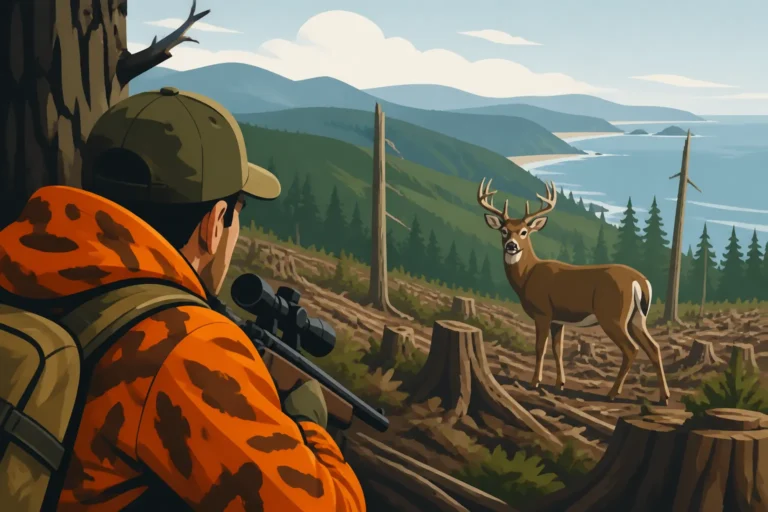
Clearcuts are magnets for blacktails, offering abundant new growth for browse. However, hunting them effectively, especially the younger, dense ones, requires a specific approach. When Reading a Two-Year-Old Clearcut for Bucks, focus on the edges where the timber meets the cut, and any islands of standing timber left within the cut. Blacktails love to feed in the open sections but will bed down just inside the safety of the dense cover.
Still-hunting the clearcut edges can be highly productive. Move slowly along the perimeter, constantly scanning into both the clearcut and the timber. Pay particular attention to pockets of dense regrowth or brush piles within the clearcut itself; deer will often bed in these to gain a vantage point or simply hide. Wind is even more critical here due to the more open nature of the terrain. Always approach with the wind in your face or a steady crosswind to prevent your scent from spooking deer out of the clearcut or the timber edge. Consider how blacktails utilize Blacktail Deer Habitat in Oregon Clearcuts for bedding and feeding. You're trying to catch them unaware as they move between feeding and bedding areas or as they cautiously peek out to feed.
Focusing on Transition Zones
Transition zones are arguably the most productive areas for still-hunting blacktails. These are the places where two distinct habitat types meet – for example, where mature timber transitions into a clearcut, a creek bottom meets a steep hillside, or a dense shrub patch borders more open forest. Deer frequently use these zones for travel, feeding, and bedding because they offer a combination of cover, food, and strategic advantage.
When hunting transition zones, spend extra time studying the subtle changes in vegetation and topography. Look for natural funnels where deer movement is concentrated. A game trail running parallel to the edge of a clearcut, or a saddle connecting two ridges, are classic examples. Still-hunt these areas with extreme caution, pausing frequently to observe. The deer may be feeding along the edge, using the dense cover for concealment, or simply traveling through. These areas are also excellent places to find deer during various times of the day, as they cater to both feeding and bedding needs. By understanding how to approach these nuanced environments, you can dramatically increase your chances of intercepting a blacktail on the move. Don't forget that Reading Clearcut Edges for Blacktail Bucks is an art form itself, requiring you to understand how deer perceive safety and escape routes.
Shot Placement and Post-Shot Procedure in Dense Cover
Successfully still-hunting a blacktail is only half the battle. Executing an ethical shot and recovering the animal in thick, wet conditions presents its own set of challenges.
Ethical Shot Opportunities in Close Quarters
In the dense coastal brush, shot distances are typically much shorter than in open country, often within 100 yards, and frequently much closer. However, clear shooting lanes are rare, making ethical shot placement critical. Always prioritize a broadside or slightly quartering-away shot that targets the vital heart-lung area. Avoid head-on shots or extreme quartering-to shots, as these offer small, less forgiving targets and can lead to wounded animals.
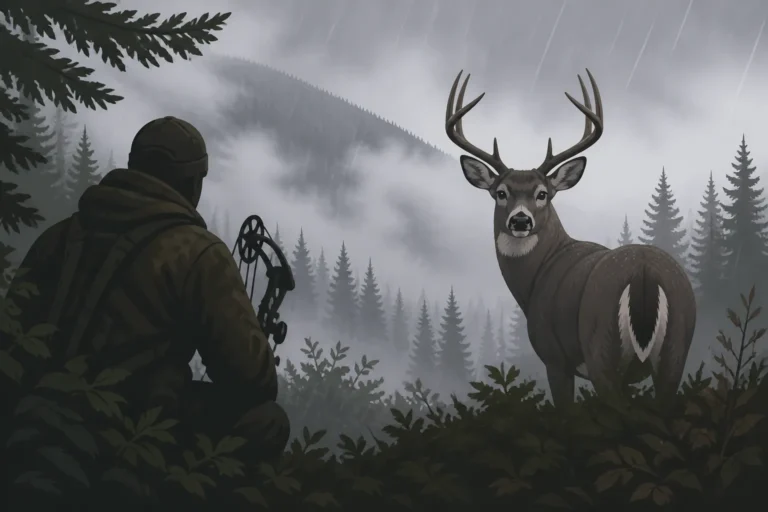
Before you even step into the woods, practice shooting from various unconventional positions – kneeling, sitting, or even leaning against a tree, as these are common scenarios in dense timber. Visualize the trajectory of your bullet or arrow through potential brush. If there's even a single twig between you and the deer, it's best to hold your shot or try to reposition. A deflecting projectile can lead to a non-lethal wound and a lost animal. Wait for the deer to offer the best possible angle, even if it means waiting an extra minute or two while the animal feeds or moves slightly. Patience here is paramount. The deer you wait for will often give you a better shot than the one you rush. Also, be mindful of the rules for Hunting Blacktails in Fog and Drizzle, as visibility can rapidly decrease, affecting your ability to make an ethical shot.
Blood Trailing Challenges in Wet Brush
Even with a perfect shot, recovering a blacktail in wet, dense coastal brush can be incredibly difficult. The constant rain can quickly wash away blood trails, and the thick undergrowth, like sword fern and salal, can make even a strong blood trail hard to follow. After the shot, mark the exact spot where the deer was standing and the direction it ran. Take note of any landmarks. This initial observation is invaluable.
If you believe you made a solid hit, give the animal time, especially if it ran. For heart-lung shots, 30-60 minutes is usually sufficient. For less-than-ideal shots (e.g., gut shots), wait at least 4-6 hours, or even overnight if conditions allow and it's safe from scavengers. When you begin to trail, move slowly and methodically. Look for blood, broken branches, disturbed leaves, or even strands of hair. Mark every spot of blood or sign you find with flagging tape or toilet paper. Don't move past the last confirmed sign until you find the next one. Consider getting a good quality tracking light, if legal in Oregon for night trailing, for when daylight fades. Retrieving a downed animal in the Coast Range often involves navigating incredibly thick cover, so being prepared for a challenging Blood Trailing in Sword Fern and Salal experience is crucial. Sometimes, you might even have to get on your hands and knees to find the next drop of blood.
Navigating Oregon's Public Lands and Regulations
Understanding where you can hunt and the rules that govern your pursuit is just as important as your still-hunting technique. Oregon offers vast opportunities, but knowing the nuances is key.
Identifying Productive Public Land Access
Oregon is blessed with extensive public lands, including National Forests, Bureau of Land Management (BLM) lands, and State Forests, all of which hold blacktails. However, not all public land is created equal for still-hunting these elusive deer. Look for units in the Coast Range and western Cascades that have a mosaic of timber types, especially those with good road access that transitions into walk-in-only areas. These areas often see less pressure.
Utilize online mapping resources and apps like GoHunt to scout potential hunting areas. Look for clearcuts, riparian zones, and areas with dense canopy that might offer good bedding. Pay attention to private timber lands that often intermingle with public ground; some timber companies offer access permits, while others have strict no-trespassing policies. Always double-check boundaries. Learning to read an Oregon Travel Management Area Map Before You Drive is also incredibly important, as many roads are closed to vehicles but open to foot traffic, creating excellent still-hunting opportunities away from vehicle noise. These areas provide the quiet solitude that still-hunting demands.
Understanding Seasons, Tags, and Specific Regulations
Before you even plan your trip, make sure you understand the specific seasons and regulations for blacktail deer in your chosen unit. Oregon has both general season and controlled hunt opportunities for deer. General season buck deer tags for western Oregon are typically over-the-counter, but controlled hunts require an application through the Oregon Controlled Hunt Draw Explained process, often requiring preference points for desirable units. Be absolutely clear on the legal antler requirements (e.g., fork horn or better) for your tag.
Beyond the tag itself, pay close attention to other regulations specific to still-hunting in dense cover. This includes rules on legal hunting hours, firearm/archery requirements, and any special restrictions for the area you're in, such as motorized vehicle restrictions or wilderness area rules. Remember that Oregon Mandatory Harvest Reporting and the $25 Penalty is a critical step after any successful hunt. It's your responsibility to know and follow all regulations. A quick call to the local Oregon Department of Fish and Wildlife (ODFW) office can often clarify any uncertainties you might have about a particular unit or regulation. Always carry a copy of the current hunting regulations with you in the field.
Disclaimer
The information provided in this guide is for informational purposes only and is not a substitute for official Oregon Department of Fish and Wildlife (ODFW) regulations. Hunters are responsible for knowing and adhering to all current hunting laws, regulations, and seasons. Always prioritize safety and ethical hunting practices.