How Many Pack Trips a Bull Elk Takes
There's nothing quite like the feeling of standing over a magnificent bull elk in Oregon's rugged backcountry. It's a moment of immense pride and accomplishment. But let's be honest: that initial rush quickly gives way to the daunting realization that you've just created a lot of work for yourself. Hauling hundreds of pounds of meat, antlers, and gear out of steep timber or across vast sagebrush flats is arguably the hardest part of the hunt, often leaving hunters exhausted, unprepared, and sometimes even compromising their precious meat. This guide is here to realistically address the common question, "How many pack trips does it actually take to get a bull elk out?" and provide actionable strategies to make that monumental task as efficient and safe as possible.
The Sheer Volume and Weight of an Oregon Bull Elk
Before you can even begin to calculate pack trips, you need to understand the sheer mass you're dealing with. A mature bull elk in Oregon, whether a Roosevelt from the Coast Range or a Rocky Mountain from the Blue Mountains, is an enormous animal. Underestimating its weight is a surefire way to invite trouble and exhaustion.
Estimating Carcass Weight and Components
When we talk about a bull elk's weight, it's important to distinguish between live weight and the weight you'll actually be packing. A large Roosevelt bull can easily tip the scales at 800-1000 pounds live weight, with some giants pushing even higher. Rocky Mountain bulls tend to be a bit smaller on average, but are still substantial, often weighing 600-800 pounds.
Once field dressed and quartered, you're still looking at a considerable amount of material. Here’s a rough breakdown of what you might expect to pack out, assuming a large bull with a boned-out approach (which we'll discuss more):
- Meat Quarters: The four primal quarters (front and rear) will make up the bulk of the weight.
- Backstraps and Tenderloins: These prized cuts are relatively light but add to the overall load.
- Neck and Rib Meat: Often overlooked, but excellent for grinding, adding significant pounds.
- Head and Antlers: A major bulk and weight factor, especially for a large rack.
- Cape: If you plan on a shoulder mount, the cape adds considerable weight and bulk.
- Hide: Heavy and awkward, many hunters leave it unless tanning.
Even after removing the guts, hide, and possibly the lower leg bones, you're still looking at 300-500 pounds of usable meat, plus the head, antlers, and cape if you’re taking them.
Bone-In Versus Boned-Out Weight and Volume
This is perhaps the single most critical decision that impacts the number of pack trips you'll make.
- Bone-In Quarters: If you simply split the elk into four bone-in quarters, you'll be dealing with individual loads ranging from 70 to well over 100 pounds each. This method is faster in the field initially, but the weight and awkwardness of the bone make for much tougher packing and usually require more trips. Imagine a 100-pound bone-in hindquarter on your back, trying to navigate blowdown and steep terrain; it's a brutal experience.
- Boned-Out Meat: Taking the time to debone all the meat in the field—removing every last bone—significantly reduces the total weight and, crucially, the volume. A bone-in quarter can lose 30-40% of its weight once boned out. This means a 100-pound bone-in quarter transforms into 60-70 pounds of pliable meat that conforms better to a pack frame. While it takes more time and skill upfront, the reduction in weight and bulk means fewer, more comfortable, and ultimately safer pack trips. Many experienced hunters swear by the Gutless Method on a Bull Elk for its efficiency in getting meat off the carcass and ready for boning out quickly.
Here's a generalized breakdown of boned-out components for a large Oregon bull elk, which can help visualize your loads:
| Component (Boned-Out) | Avg. Weight (lbs) | Avg. Volume (cu ft) | Notes |
|---|---|---|---|
| Front Quarter Meat (x2) | 40-60 each | 1.5-2.0 each | Includes shoulder, brisket. |
| Rear Quarter Meat (x2) | 60-80 each | 2.0-2.5 each | Heaviest cuts, includes round, shank meat. |
| Backstraps | 20-30 | 0.5-0.8 | Removed in whole sections. |
| Tenderloins | 5-10 | 0.1-0.2 | Inner loin, delicate. |
| Neck/Rib/Scrap Meat | 40-60 | 1.0-1.5 | Excellent for grinding, adds significant weight. |
| Total Usable Meat | 265-380+ | ~7.1-9.5+ | Excludes bone, hide, guts. Varies by bull size and boning efficiency. |
| Antlers/Head (w/o cape) | 30-50+ | Variable | Can be bulky and awkward depending on rack size. |
| Cape (for shoulder mount) | 15-25 | Variable | Adds significant weight and bulk to the head load. |
Key Factors Dictating Pack Trip Numbers
Once you have a handle on the weight, several dynamic factors come into play that will directly influence how many times you’ll have to hike in and out.
Terrain and Distance to Access
This is probably the most significant variable after the animal's size. A bull elk taken a quarter-mile from a gravel road on relatively flat ground is a completely different packing challenge than one taken three miles deep into a steep, timbered canyon in the Eagle Cap Wilderness.
- Distance: Every extra mile adds exponential effort. A 1-mile pack-out might be tough, but manageable. A 3-mile pack-out will feel like 10. Planning your hunt, perhaps using tools like GoHunt's mapping features, to identify areas with reasonable pack-out distances from potential game sightings can be a game-changer.
- Elevation Gain/Loss: Oregon's elk country is notoriously steep. Climbing out of a 1,500-foot canyon with 80 pounds on your back is a monumental physical challenge. Descents can be just as difficult, jarring your body and testing your footing.
- Ground Cover: Dense blowdown, thick brush, rocky scree slopes, and deep snow all dramatically slow progress and increase effort. Hauling meat through dense rhododendron thickets in the Coast Range requires a different kind of grunt than over open sagebrush. This is particularly relevant when Packing Out an Elk in Oregon's Wilderness Units, where trails may be less maintained.
Hunter Strength, Conditioning, and Group Size
Your physical capabilities and the number of people in your hunting party are absolutely crucial.
- Individual Fitness: An individual's ability to consistently carry heavy loads over challenging terrain is paramount. If you're not physically conditioned for hauling 80-100 pounds repeatedly, you'll be making more, lighter trips, which extends the entire process. Consider focusing on Physical Training for an Oregon Elk Hunt well before the season opens.
- Group Dynamics: A solo hunter will inherently require more trips than a group. A single hunter might comfortably carry 80-100 pounds per load, but a team of two can share the load, taking potentially 100-120 pounds each on an easier section, or alternating the heaviest loads. A party of three or four can divide the entire animal into much more manageable loads, potentially getting everything out in a single, concerted effort. Sharing the load of the head and antlers, which can be awkward and heavy, is a huge benefit of hunting with partners.
Equipment: Pack Frames, Game Bags, and Game Carts
Having the right gear won't make the elk lighter, but it will make the packing more efficient and less agonizing.
- Quality Pack Frame: This is non-negotiable. A robust, comfortable external or internal frame pack designed for heavy loads is essential. Brands like Kifaru, Mystery Ranch, or Stone Glacier are popular for their ability to carry over 100 pounds comfortably. They distribute weight effectively to your hips, protecting your shoulders and back. Don't skimp here; a cheap pack will make you miserable. When considering your Archery Setup for Wet Oregon Timber, think about how your pack frame integrates with your bow carry system.
- Sturdy Game Bags: High-quality game bags are crucial for protecting your meat from dirt, flies, and debris. They allow the meat to breathe, which is vital for cooling. Having enough clean, breathable game bags for all boned-out meat is a must.
- Game Carts/Wheeled Devices: While tempting, these are rarely practical in true Oregon elk country. They require relatively flat, clear trails or roads. In the thick timber, steep slopes, and rocky terrain that elk inhabit, a game cart is usually more of a hindrance than a help. Don't rely on one unless you've thoroughly scouted a very specific, flat route.
Method of Field Care and Quartering
The initial steps you take after the kill will directly impact your pack-out.
- Gutless Method: As mentioned, the Gutless Method on a Bull Elk is highly efficient for getting meat off the carcass and into game bags quickly, especially when working alone or in warm weather. This method prioritizes meat cooling and greatly simplifies the boning-out process.
- Traditional Field Dressing: While still viable, traditionally gutting an elk, then trying to quarter bone-in meat, often leaves more blood and bodily fluids on the meat and is harder to manage for packing than boned-out meat. In a scenario like Field Dressing an Elk in Warm Early-Season Weather, rapid cooling is paramount, and the gutless method often facilitates this better by allowing quicker meat separation.
Strategies to Minimize Your Pack Burden
No one wants to make more trips than necessary. With a bit of planning and execution, you can dramatically reduce the number of times you trek up and down that mountain.
Boning Out the Carcass on Site
This is, without a doubt, the most impactful strategy. Yes, it takes more time and effort on the kill site, but the payoff during the pack-out is immense.
- Weight Reduction: As noted, boning out removes 30-40% of the total weight you'd otherwise carry. This means an entire elk, which might have required 6-8 bone-in loads, could be reduced to 4-5 boned-out loads for a single strong hunter.
- Increased Pliability: Boned-out meat is far more flexible. It conforms to the shape of your pack, making it less awkward and more comfortable to carry. You can get more meat into each bag and onto your frame.
- Faster Cooling: Spreading out boned-out meat in breathable game bags allows for much faster cooling than large, bone-in quarters, which helps to preserve your hard-earned harvest, especially during early season hunts in Oregon's September heat.
Utilizing Available Manpower and Resources
Don't be a hero if you don't have to be. Leverage your resources!
- Hunting Partners: The simplest and most effective way to reduce trips is to hunt with a reliable partner or group. Dividing the load means each person carries less weight per trip, or you can get the entire animal out in fewer trips collectively. Always confirm your partners are as committed to the packing as they are to the hunting.
- Packers with Stock: For hunters taking a bull deep in wilderness areas like the Wenaha-Tucannon, Horse and Llama Packing Into Oregon Backcountry services can be an absolute lifesaver. While an added expense, these outfitters specialize in getting heavy loads out of remote locations. They can haul an entire boned-out elk in one or two trips, saving you days of back-breaking labor. This also allows you to enjoy a more remote Multi-Day Camps in Oregon's Roadless Country without worrying about the pack-out as much.
- Staged Camps: If you're hunting particularly deep, consider establishing a spike camp or caching gear strategically. This reduces the weight you carry on your initial hike in and allows you to focus solely on meat and antlers during the pack-out.
Strategic Camp Placement and Vehicle Access
Good planning before the hunt can save you immense effort after the shot.
- E-Scouting Access: Use satellite imagery tools like those available through GoHunt to identify potential game hot spots that are also within a reasonable pack-out distance of a road or trail. Look for contours, saddles, and old logging roads that might provide easier access. Remember to use GoHunt to check land ownership and any vehicle restrictions on federal or private timber lands.
- Marking Extraction Points: Before you even leave home, identify and mark potential extraction points on your map. Know where the closest drivable road is, any gates, and potential parking areas. This is where Marking Access Points Before Opening Day truly pays off.
- Considering TMA Rules: If hunting within a Travel Management Area (TMA), be keenly aware of where motorized travel is restricted. Reading Green Roads on an Oregon Travel Management Map can help you understand where you can drive versus where you must walk, influencing your pack-out strategy.
Practical Pack-Out Scenarios and Trip Estimates
Now, let's get down to the brass tacks: how many trips for a bull elk, realistically?
The Solo Hunter's Reality
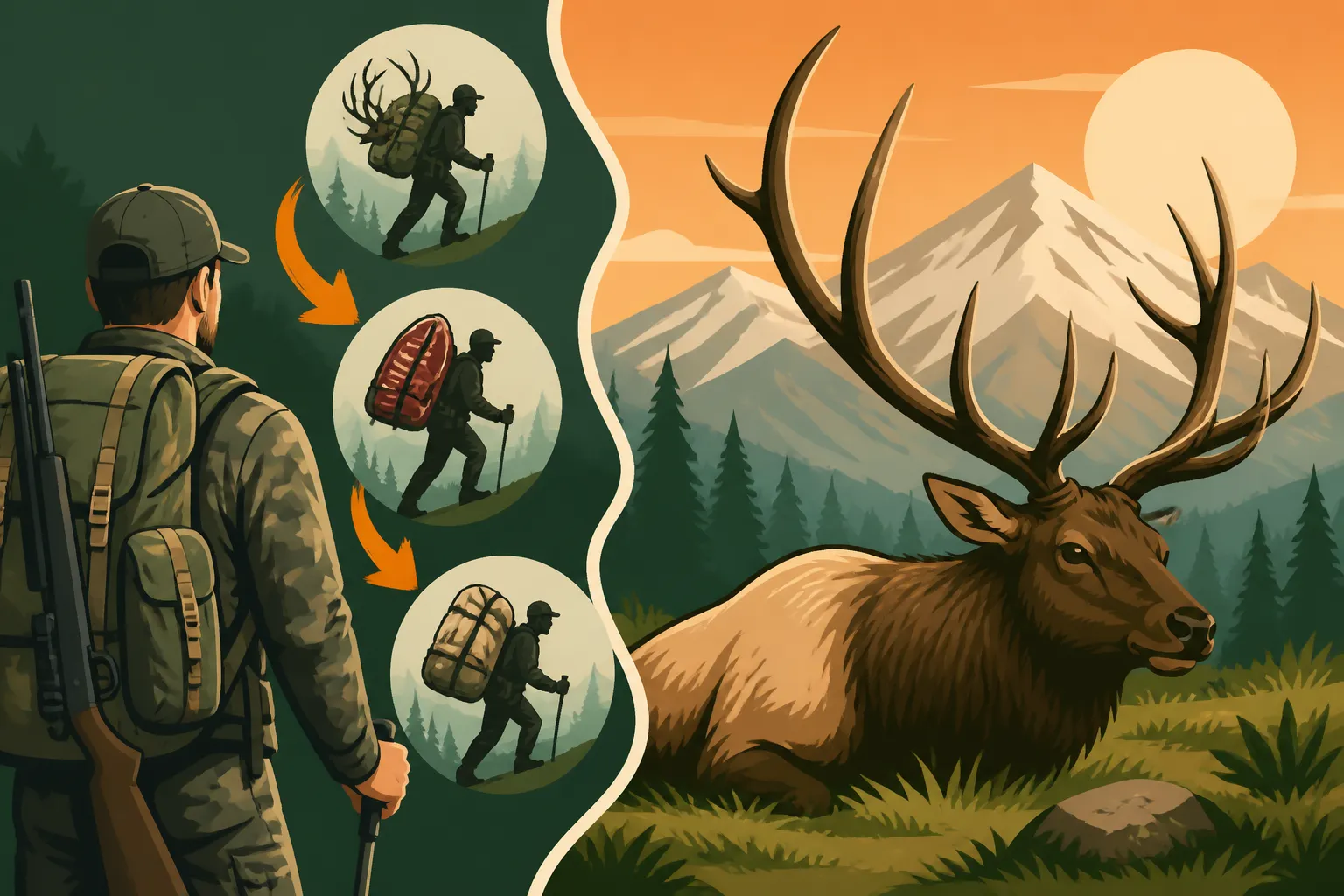
For a strong, well-conditioned solo hunter using a quality pack frame and boning out the meat, a bull elk will typically require 4 to 6 pack trips.
- Trip 1: Meat Load 1: The two rear quarters (boned out) are often the heaviest meat loads. You might combine one rear quarter with some backstraps and tenderloins, aiming for 80-100 pounds.
- Trip 2: Meat Load 2: The second rear quarter and remaining front quarter meat, again targeting 80-100 pounds.
- Trip 3: Meat Load 3: The other front quarter meat, plus neck, rib, and miscellaneous meat. This might be a slightly lighter load, but still substantial.
- Trip 4: Head and Antlers/Cape: This is often a separate, awkward trip. Even if you've done a quick European cut, the antlers are bulky. If caping for a shoulder mount, the cape adds significant weight and must be handled carefully.
- Trip 5 (and 6): Gear and Remaining Meat: Depending on how much camp gear you have, your rifle, and any remaining meat, you might need an additional trip or two. If you're making multiple trips, use your pack's load shelf to haul quarters, then swap to regular pack mode for gear on the final trip.
This assumes ideal conditions. If the terrain is brutal, the distance long, or you opt for bone-in quarters, you could easily add 2-3 more trips, potentially turning a 1-day pack-out into 2-3 days.
Group Hunting Efficiency
Hunting with partners dramatically cuts down on individual effort and total trips.
- Two Hunters: With two strong hunters, a bull elk can often be packed out in 2-3 trips each (total 4-6 loads). Each hunter can take a rear quarter and a front quarter (boned out) per trip, with one taking the head/antlers. This allows for more manageable loads of 60-80 pounds each, depending on the bull's size.
- Three or More Hunters: This is the sweet spot for efficiency. Three hunters can potentially get a bull elk out in one or two concerted trips total. Each hunter could take a substantial load of 70-90 pounds, dividing the meat, head, and camp gear quite evenly. This often means everyone is out of the woods before dark on the day of the kill, or early the next morning.
Prioritizing Meat Quality and Safety
Regardless of how many trips it takes, the overriding priority must be the preservation of your meat. Oregon's early archery and rifle seasons can often be quite warm, and meat spoilage is a real risk.
- Cooling First, Packing Second: Get the hide off and the meat into breathable game bags as quickly as possible. Hang the meat to allow air circulation if feasible. If temperatures are high, you might prioritize making more frequent, lighter trips to get the meat cooled faster rather than pushing for fewer, heavier, slower trips. Referencing advice on Getting Meat Out Before It Spoils is crucial here.
- Ice and Coolers: As soon as the meat is out of the field, get it into coolers with ice. Even if you're hours from a processor, chilling the meat rapidly will prevent spoilage. You can find more tips on Coolers, Ice and the Drive Home From Eastern Oregon to ensure your meat makes it home safely.
Successfully packing out a bull elk in Oregon is a true test of grit, planning, and teamwork. By understanding the weight involved, making smart decisions in the field, utilizing the right gear, and preparing physically, you can turn a potentially miserable experience into another rewarding part of your hunting adventure. Happy packing!
Disclaimer
The information provided in this article is for general guidance and informational purposes only. Hunting regulations, seasons, and access rules in Oregon can change. Always consult the latest Oregon Department of Fish and Wildlife (ODFW) regulations and maps before planning any hunting trip. Personal safety and responsible hunting practices are paramount.