Blacktail Versus Mule Deer Differences
Navigating the varied landscapes of Oregon, it’s easy for even seasoned hunters to sometimes confuse the two primary deer species: the Columbian Blacktail and the Rocky Mountain Mule Deer. While they both fall under the "deer" umbrella, they are distinct animals with different behaviors, habitats, and physical traits, leading to very different hunting approaches. This guide will meticulously break down the crucial differences, helping you confidently identify your quarry and fine-tune your hunting strategies for success in Oregon's diverse environments.
Understanding the Basics: What Exactly Are We Talking About?
Before we dive into the nitty-gritty of distinguishing these magnificent creatures in the field, it’s helpful to understand their general identity and where they fit into Oregon's ecological tapestry. While both are deer, they represent two very different adaptations to the state's varied terrain, climate, and vegetation. It’s not just about a name; it’s about a whole different way of life for these animals.
The Columbian Blacktail Deer
Often simply called "blacktails," these deer are a subspecies of mule deer, specifically Odocoileus hemionus columbianus. However, they're so distinct in their appearance and behavior that most hunters consider them almost a separate species. Blacktails are the deer of the dense, wet, and often rugged western side of Oregon. They thrive in the dark timber, thick brush, and regenerating clearcuts of the Coast Range and the western slopes of the Cascades. When you're hearing the rain patter on your Gore-Tex and pushing through salal and sword fern, you're almost certainly in Columbian Blacktail Deer of Western Oregon country. They are incredibly elusive, preferring to slip away unnoticed through the undergrowth rather than bounding across open spaces.
The Rocky Mountain Mule Deer
On the other side of Oregon, primarily east of Highway 97 and the Cascade crest, you'll encounter the Rocky Mountain Mule Deer (Odocoileus hemionus hemionus). These are the iconic "big-eared" deer of the high desert, rimrock, and sagebrush country. They are more at home in wide-open, arid landscapes, where their keen eyesight and prodigious bounding leap (the "mule deer bounce" or "stot") serve them well in evading predators. When you're spending hours glassing distant hillsides and juniper draws, you're looking for Oregon Mule Deer and the Herd Range Decline. Their presence is inextricably linked to the health of Eastern Oregon's vast, often unforgiving, sagebrush steppe and ponderosa pine forests.
Physical Distinctions: Spotting the Differences in the Field
Identifying a blacktail from a mule deer isn't always as simple as checking a map. Sometimes their ranges can overlap, or you might encounter a deer that has characteristics of both. Knowing the subtle (and not-so-subtle) physical cues is paramount for correct identification, which directly impacts your hunting strategy and ensures you’re harvesting the correct animal for your tag. These details are etched into their very being, a testament to the environments they call home.
Ears and Face Shape
This is perhaps the most famous distinguishing feature, leading to the "mule" in mule deer.
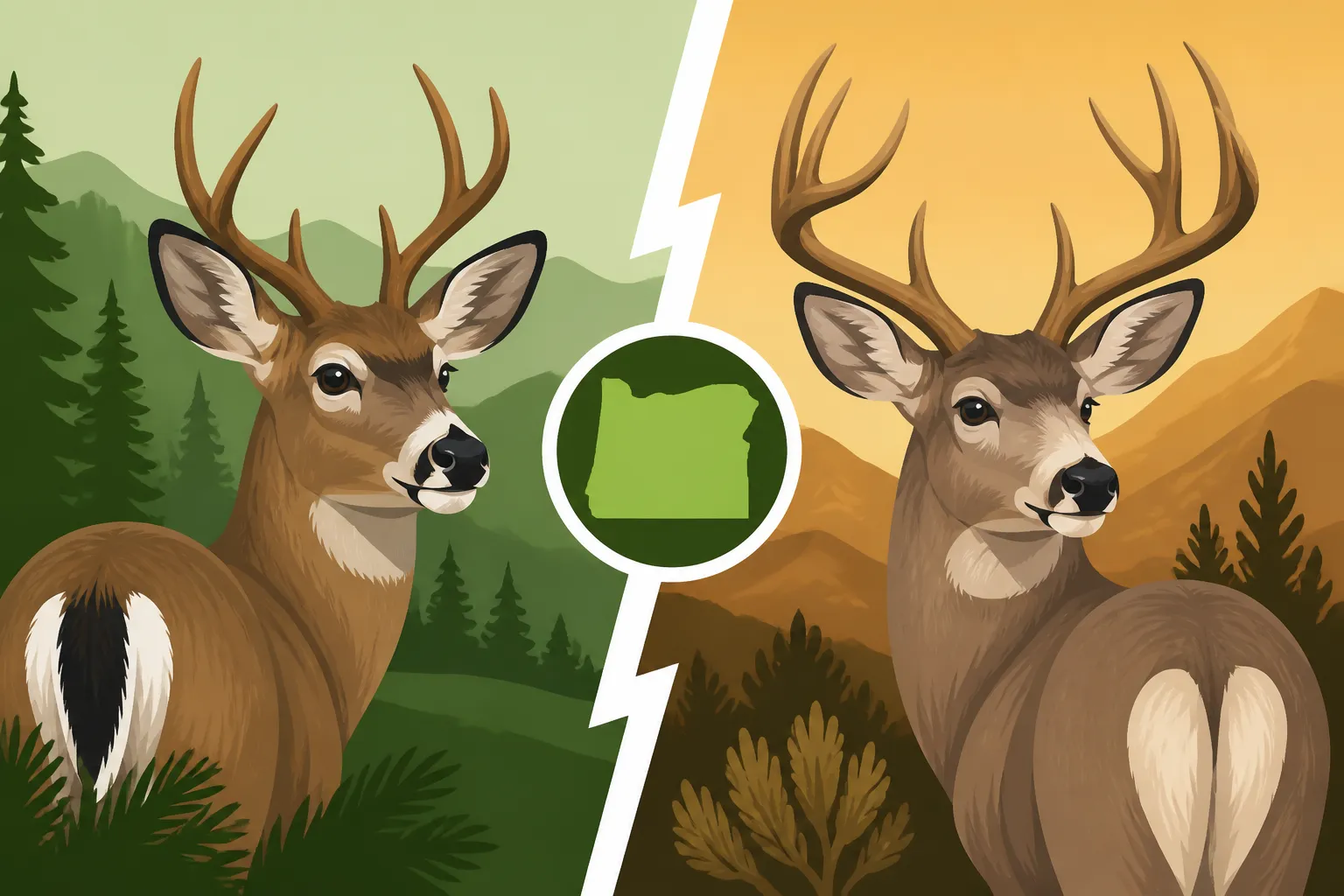
- Mule Deer: True to their name, mule deer possess notably large ears, often disproportionately large compared to their head. These ears can swivel independently and are a key tool for detecting threats across vast, open terrain. Their face tends to be wider, with a more robust muzzle.
- Blacktail Deer: While still having respectable ears, blacktails have ears that are considerably smaller and more proportionate to their head size. They are more subtly shaped, helping them navigate dense brush without snagging. Their faces are generally narrower and more refined, allowing for easier passage through thick cover.
Antler Configuration
The way a buck's antlers grow is a critical identifier. This characteristic is so consistent it's often a primary way to tell them apart, even at a glance.
- Mule Deer: Mule deer antlers are typically "bifurcated," meaning they fork, and then each fork forks again. So, a typical mule deer buck might have two main beams, and each beam will split into two tines, and those two tines will split again, resulting in a series of symmetrical "Y" shapes. It's common to see a 4×4 (four points on each side) where each point developed from a successive fork.
- Blacktail Deer: Blacktail antlers, by contrast, tend to have a single main beam from which tines branch off. While they can have multiple points, they typically don't show the same clean, successive bifurcations as mule deer. A blacktail might have an impressive rack, but the tines will often project upwards from the main beam more directly, or show less consistent forking. You might see more non-typical growth or shorter, thicker beams depending on age and nutrition.
Tail and Rump Patch
This is perhaps the most definitive and visually striking difference, especially when a deer is in motion or spooked. It’s what gives the blacktail its name.
- Mule Deer: A mule deer's tail is relatively narrow, cream-colored, with a distinctive black tip. When a mule deer bounds away, it often carries its tail down, sometimes even tucked between its legs, before flaring it out as a flag. The rump patch is typically white or cream-colored, extending well up the back.
- Blacktail Deer: The blacktail's tail is broader and almost entirely dark brown or black on top, giving it a much darker appearance. When alarmed, a blacktail will often flash its tail, exposing the white underside, but the overall impression is much darker than a mule deer's flag. The rump patch tends to be smaller and less prominent than a mule deer’s, blending more seamlessly with its darker coat. The tail itself is shorter and wider, often looking like a dark, inverted spade.
Body Size and Coloration
While less reliable for a definitive ID due to variations within each species, there are general trends in size and coat color.
- Mule Deer: Mule deer tend to be larger and heavier-bodied than blacktails, especially mature bucks. Their coat color is typically a lighter grayish-tan or light brown, particularly in winter, providing camouflage against the open sagebrush and light-colored rocks of eastern Oregon. Their throats and insides of their legs are often whiter.
- Blacktail Deer: Blacktails are generally smaller and more compact, built for navigating tight spaces. Their coat is usually a richer, darker reddish-brown, often appearing almost black along the back and neck, especially during the fall hunting season. This darker coloration helps them blend into the shadows of the dense conifer forests and wet coastal timber. Their neck and shoulders often have a darker, almost bluish-gray hue.
Habitat Preferences and Geographic Range
Understanding where these deer prefer to live is often the first and best clue to identifying them, even before you get a clear look. Their evolutionary paths have carved out distinct niches in Oregon’s diverse geography. Knowing these ranges and preferred cover types can guide your scouting efforts, whether you're using a tool like GoHunt or exploring on foot.
Western Oregon's Dense Cover: Blacktail Territory
Blacktail deer are quintessential residents of western Oregon, an area defined by its abundant rainfall, dense vegetation, and dramatic elevation changes. From the coastal rainforests to the western slopes of the Cascades, this is their domain.
- Preferred Terrain: Blacktails thrive in thick, regenerating clearcuts, riparian zones, mixed conifer forests, and even agricultural lands adjacent to heavy cover. They seek out areas with dense understory like salal, huckleberry, and sword fern, which provide both food and concealment. You’ll often find them utilizing the edges of recent logging operations, feeding on new growth while remaining close to the sanctuary of un-logged timber. For more insights into these specific areas, read about Blacktail Deer Habitat in Oregon Clearcuts.
- Elevation: They are found from sea level right up into the lower to mid-elevations of the Cascade Range. They don't typically undergo long-distance migrations like mule deer but may move elevationally based on snow depth or food availability within their home range. When winter storms dump heavy snow, they will push down to lower, often private, lands.
- Hunting Implications: Hunting blacktails often involves still-hunting through dense brush, focusing on transitions between cover types, or ambushing them on travel corridors. It's a close-quarters game where stealth and patience are rewarded. If you're hunting in the Siuslaw National Forest Blacktail Country, you're in prime blacktail land.
Eastern Oregon's Open Spaces: Mule Deer Domain
East of the Cascades, the landscape transforms into a high desert, characterized by vast expanses of sagebrush, juniper, rimrock canyons, and scattered ponderosa pine forests. This is the realm of the Rocky Mountain Mule Deer.
- Preferred Terrain: Mule deer prefer open slopes, sagebrush flats, rimrock benches, and scattered timber patches. They rely on their excellent eyesight and the ability to cover ground quickly to avoid predators. While they use timber for bedding and security, they are far more comfortable in open or semi-open environments than blacktails. To truly understand their distribution, it's helpful to know What a Mule Deer Herd Range Is, as these define the key territories for these animals. You can use platforms like GoHunt to visualize these herd ranges and plan your Eastern Oregon adventures.
- Elevation and Migration: Mule deer are known for their seasonal migrations, moving from higher summer ranges to lower winter ranges as snow dictates. These movements can cover significant distances, often following established corridors. Understanding Mule Deer Winter Range in Eastern Oregon is crucial for effective late-season hunting and for comprehending their annual cycle.
- Hunting Implications: Mule deer hunting often involves extensive glassing, covering large areas with optics from elevated vantage points, and then executing strategic spot-and-stalk maneuvers. Long-range shooting opportunities are more common here, and understanding the terrain for stalking is paramount. Places like the Ochoco National Forest Hunting Areas or Hart Mountain and the Antelope Refuge are classic mule deer haunts.
Behavioral Traits and Hunting Strategies
Beyond their physical differences and preferred habitats, the way blacktails and mule deer behave offers significant clues to their identity and dictates vastly different hunting approaches. Their responses to pressure, their social structures, and even their alarm signals are all distinct, reflecting millennia of adaptation to their respective environments.
Movement and Alertness
The contrasting habitats of these two deer species have honed entirely different survival instincts and movement patterns.
- Mule Deer: In their open, expansive habitats, mule deer often move with an almost casual confidence when undisturbed, covering ground with a distinctive "stot" or bounding leap when startled. This four-legged bound is highly efficient for clearing obstacles and putting distance between them and a perceived threat across uneven terrain. They are often less inclined to "bust" through heavy cover immediately but will instead survey from a distance, relying on their keen eyesight and hearing. When spooked, they tend to move to the next ridge or into the nearest cover, often stopping to look back.
- Blacktail Deer: Blacktails, living in dense, shadowy environments, are masters of stealth. Their primary defense is their ability to disappear silently into the thickest brush. When alarmed, they may "sneak" away, using every bit of cover, or burst into a short, explosive dash, crashing through undergrowth to gain cover. They rarely execute the high, bouncy stot of a mule deer. Blacktails are notoriously wary and can be incredibly difficult to spot once they decide to vanish into their tangled homes. Still-Hunting Blacktails in Wet Oregon Coastal Brush is a testament to this behavior, requiring extreme patience and quiet movement. They prefer to stay within dense pockets of timber or clearcuts, moving along game trails rather than open ground.
Rutting Behavior and Timing
While both species experience a rut, the timing and manifestations can vary, impacting hunting strategies.
- Mule Deer: The mule deer rut typically peaks in mid-November through early December, though pre-rut activity can start earlier. During the rut, bucks become less cautious, actively seeking does and often battling rival bucks. They can be found in more open areas, sometimes covering significant ground during daylight hours. This is a prime time for hunters, as bucks are preoccupied and more visible. Scouting for rubs and scrapes, though less pronounced than with whitetails, can also reveal their presence.
- Blacktail Deer: The Blacktail Rut Timing in Western Oregon tends to occur slightly later, often peaking from late October through mid-November, depending on the specific location and environmental factors. Blacktail bucks are generally more secretive during the rut, not as prone to wide-ranging movements in open areas as their mule deer cousins. They will still become aggressive and less cautious, but their movements are often confined to the dense cover they typically inhabit. Calling tactics can be effective during this period, particularly subtle cow calls or grunts to draw a buck out of thick timber.
Tail Signals and Alarm
The tail, as discussed in physical distinctions, also plays a role in how these deer communicate alarm.
- Mule Deer: When a mule deer is alerted or spooked, its tail often acts as a prominent white flag, held erect as it bounds away. This flashing white signal is thought to warn other deer in the area. The black tip is always noticeable against the white background.
- Blacktail Deer: A blacktail's tail, while still used as a flag, is much darker on top. When they spook, the flash of the white underside is still there, but the overall impression is of a smaller, darker signal that quickly disappears into the shadows. They may also wag their tail more subtly when slightly agitated, rather than flaring it fully. This difference in tail presentation reinforces their preference for blending into heavy cover versus flagging across open terrain.
Summary of Key Differences
To help keep these distinctions clear in your mind as you plan your next Oregon hunt, here’s a quick overview of the primary differences. This table can be a handy reference tool, especially when you're preparing for a hunt and want to be sure you're focusing on the right characteristics for the deer species you're pursuing. Utilizing detailed maps, perhaps through a platform like GoHunt, to identify the prevailing species in a specific unit is also a smart pre-hunt strategy.
| Feature | Columbian Blacktail Deer | Rocky Mountain Mule Deer |
|---|---|---|
| Geographic Range | Western Oregon (Coast Range, Western Cascades) | Eastern Oregon (High Desert, Eastern Cascades) |
| Ear Size | Smaller, proportionate to head | Large, "mule-like" |
| Antler Growth | Main beam with tines branching off (less bifurcation) | Bifurcated (forking, then re-forking) |
| Tail | Broad, dark brown/black on top; small rump patch | Narrow, white/cream with black tip; large white rump patch |
| Body Size | Generally smaller and more compact | Generally larger and heavier-bodied |
| Coat Color | Darker reddish-brown, often with dark back/neck | Lighter grayish-tan/light brown |
| Alarm Behavior | Stealthy escape, crashing through brush; dark tail flash | Bounding "stot"; prominent white tail flag |
| Habitat | Dense timber, clearcuts, thick brush | Open sagebrush, rimrock, juniper draws |
Hunting Strategies Tailored to Each Species
Knowing the differences between blacktail and mule deer isn't just academic; it directly influences how you scout, approach, and hunt them. Adapting your techniques to the specific species and their environment is paramount for success in Oregon's diverse hunting opportunities. A good hunting platform, like GoHunt, can often provide habitat overlays that help visualize these distinctions from home.
Approaching Blacktails: The Art of Stealth in the Timber
Hunting blacktails often feels like hunting ghosts. Their uncanny ability to disappear means you need to slow down, pay attention, and master the art of silent movement.
- Still-Hunting: This is a classic blacktail tactic. Moving slowly, stopping frequently to glass and listen, and using the wind to your advantage is critical. Focus on areas where Reading a Two-Year-Old Clearcut for Bucks can provide fresh browse and good bedding cover. Every step should be deliberate, as if you’re trying not to alert an animal just feet away.
- Stand Hunting/Ambush: Setting up near active game trails, pinch points, or feeding areas, especially during the rut, can be effective. Consider elevated stands if local regulations allow, to get above the dense brush. Focus on edges and transitions, such as the line where thick timber meets a clearcut.
- Calling: While less common than for elk, deer calls can work on blacktails, especially during the rut. Soft grunts or doe bleats can sometimes pique a buck's curiosity, drawing him out of dense cover. However, calling requires patience and a good setup, as a blacktail will often circle downwind before committing.
Pursuing Mule Deer: Glass, Stalk, and Patience in the Open
Mule deer hunting is often a game of vast landscapes, powerful optics, and meticulous planning. It’s a completely different rhythm than hunting blacktails.
- Spot-and-Stalk: This is the bread and butter of mule deer hunting. Spend significant time glassing with good binoculars and a spotting scope from high vantage points. Be patient; deer in open country can appear out of nowhere or remain bedded and unseen for hours. Once a buck is spotted, plan your stalk meticulously, using terrain features to stay out of sight and downwind. Learn more about effective techniques by researching Glassing Sage and Juniper for Eastern Oregon Mule Deer.
- Understanding Their Movements: Mule deer in Eastern Oregon often have predictable patterns, especially around water sources in dry conditions or along migration corridors. Utilizing tools like GoHunt can help identify these potential travel routes and watering holes, allowing you to intercept them.
- Patience and Persistence: The sheer size of mule deer country means you might cover many miles and glass countless hillsides before finding a buck. Don't get discouraged. Persistence, combined with a keen eye for deer sign (tracks, droppings, rubs), will eventually pay off. Always be prepared for a long stalk and potential long shots, ensuring your rifle and optics are up to the task.
By understanding these fundamental differences – from their physical appearance to their preferred stomping grounds and the way they behave under pressure – you'll be much better equipped to embark on a successful deer hunt in Oregon, no matter which side of the Cascades you find yourself. Happy hunting!
Disclaimer
This article is for general informational purposes only and does not constitute professional advice. Laws, prices and regulations vary by location and change over time. Consult a qualified professional for guidance on your specific situation.