Clearcut Age and Blacktail Numbers
One of the most perplexing things for any hunter chasing blacktail deer in Oregon's dense timber country is figuring out what a clearcut actually offers. It's not just a big, open patch of ground; its age drastically changes what it means for deer. This guide will peel back the layers of frustration and confusion, helping you understand how the age of a clearcut impacts blacktail numbers and, more importantly, how you can use that knowledge to boost your hunting success.
Understanding the Blacktail's Relationship with Clearcuts: Why Age Matters
For many years, timber harvesting practices in Oregon have created a mosaic of clearcuts across our landscape, especially in western Oregon's Coast Range and Cascades. While a fresh clearcut might look like a desolate moonscape to the untrained eye, it quickly becomes a complex and evolving ecosystem. Blacktail deer, being the adaptable creatures they are, learn to exploit these changes, and their presence, or lack thereof, is often directly tied to how old that clearcut really is. Thinking of all clearcuts as the same is a common pitfall that can leave you scratching your head come hunting season.
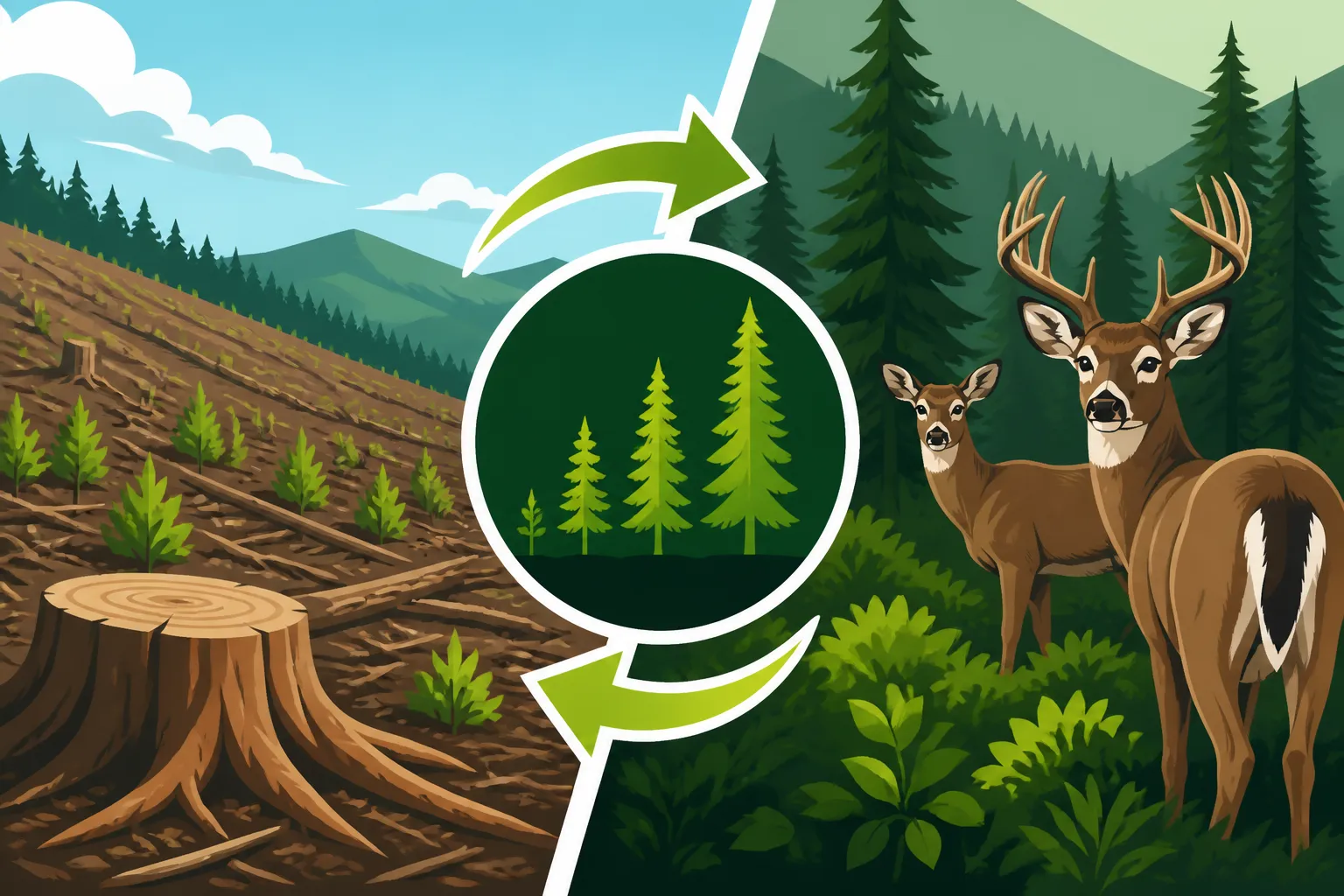
The critical factor here is the vegetation cycle. Immediately after logging, the ground is exposed, and sunlight floods areas that were once shaded. This triggers an explosion of plant growth, creating a banquet for deer. But as those plants grow and the timber companies replant, the cover and food sources shift dramatically. A clearcut isn't static; it's a dynamic environment that offers different benefits at different stages of its life. Understanding this progression is key to anticipating where the blacktails will be and what they'll be doing. Hunters often underestimate the intricate ways these areas provide both sustenance and security for blacktails.
Hunting Strategies Based on Clearcut Maturity: From Seedlings to Saplings
The age of a clearcut directly dictates its utility for blacktail deer, influencing everything from available forage to bedding cover. Breaking down clearcuts by age helps us categorize their potential and develop specific hunting strategies. It's not about finding any clearcut, but finding the right clearcut for the deer's current needs and the season you're hunting. This is where diligent scouting, both in person and through tools like GoHunt's mapping features, can really pay off in identifying these distinct stages.
The Young and Tender: Clearcuts 1-5 Years Old
These are the prime dining spots for blacktail deer, especially in the spring and early summer when fresh growth is exploding. Think of a clearcut that's only 1-3 years old: it's often choked with succulent forbs, grasses, and young browse species that thrive on direct sunlight. Deer absolutely love these areas for feeding. They're rich in nutrients, and the plants are typically short, making them easy to access. However, while food is abundant, cover can be scarce. Deer will often feed heavily in these areas at dawn and dusk, then retreat to the safety of adjacent timber or thicker, older growth during the day.
As these clearcuts mature slightly, into the 3-5 year range, you might start seeing the planted conifer seedlings getting a bit taller, perhaps a few feet high. Native shrubs like salal, huckleberry, and vine maple will also begin to establish more firmly. This still offers excellent browse, but now there's a little more visual cover for a deer to feel comfortable. During hunting season, particularly in the early archery season, focusing on the edges where these young clearcuts meet the dense timber can be incredibly productive. Deer will use that edge cover for concealment while still being able to step out and feed. This is a classic example of Reading Clearcut Edges for Blacktail Bucks.
The Mid-Life Mess: Clearcuts 6-15 Years Old
This stage can be the most challenging for hunters, but also the most rewarding if you know what to look for. In clearcuts aged 6-15 years, the planted conifers are getting taller, often reaching chest to head height, creating a dense, often impenetrable wall of saplings. Beneath these growing trees, the understory can still be rich with browse, but it's much harder for deer to move through, and significantly harder for a hunter to see into. This is where the blacktails find security and thermal cover, especially during colder or wetter weather. They can virtually disappear in these thickets.
Hunting these mid-life clearcuts requires a shift in tactics. Instead of looking for wide-open feeding zones, you're searching for natural deer trails, game paths, or subtle openings within the thick growth. These areas become excellent bedding locations. Deer will often bed down in the densest part of the young timber, feeling secure yet still within easy reach of browse. This is where Still-Hunting Blacktails in Wet Oregon Coastal Brush truly shines. You'll need to slow down to an almost agonizing pace, relying heavily on your ears and looking for tiny glimpses of movement or horizontal lines in a vertical world. Trail cameras, positioned on established trails entering these thick zones, can also be invaluable for scouting.
The Return to Timber: Clearcuts 15+ Years Old
As a clearcut approaches 15-25 years of age, it starts to transition back into what resembles dense, young timber. The conifers are now taller, the canopy is closing, and the forest floor is becoming shaded once again. This reduces the amount of sun-loving browse, and the ground cover begins to thin out. While these areas still provide excellent security cover, their appeal as primary feeding grounds diminishes. Blacktails will still use them, but often as travel corridors or bedding areas that connect to more diverse food sources.
At this stage, these areas often become part of the broader forest landscape, and your hunting strategy should reflect that. You might find deer moving through them to get from an older, more established timber stand to a younger clearcut or a natural opening. Look for signs like rub lines, well-worn trails, and even scrapes during the rut, as bucks will still utilize the cover for breeding activity. Understanding Blacktail Deer Habitat in Oregon Clearcuts at this stage is more about understanding its role as part of a larger ecosystem rather than an isolated deer magnet.
Here's a quick overview of how clearcut age generally impacts blacktail habitat:
| Clearcut Age (Years) | Primary Vegetation | Blacktail Food Source | Blacktail Cover Type | Best Hunting Tactic |
|---|---|---|---|---|
| 1-3 | Grasses, Forbs | Excellent | Very Poor | Edge ambush, Spot & Stalk (early/late) |
| 4-7 | Young Shrubs, Saplings | Good | Moderate (visual) | Edge ambush, Still-hunt perimeters |
| 8-15 | Dense Saplings, Shrubs | Fair-Good (difficult access) | Excellent (bedding) | Slow Still-hunt, Drive (with partners) |
| 15+ | Young Timber, Shaded Floor | Poor | Excellent (travel/thermal) | Find travel corridors, Adjacent habitat focus |
Leveraging Technology and Scouting for Optimal Clearcut Hunts
In today's world, understanding clearcut age isn't just about driving around and guessing. We have incredible tools at our disposal that can give us a significant advantage, especially when trying to decipher the complex patchwork of Oregon's timberlands. These tools allow us to scout effectively from home and make informed decisions long before we ever set foot in the woods. This is particularly crucial when dealing with vast public lands or even the intricate permit systems of Hunting Clearcuts on Private Timber Land.
Satellite imagery is your best friend here. Platforms like GoHunt, for example, offer high-resolution satellite views that often get updated regularly. By carefully scrutinizing these images, you can often infer the age of a clearcut. Very light, bright green patches usually indicate younger, recently replanted areas with short vegetation. As the growth gets taller and denser, the green will deepen, eventually becoming the dark, uniform green of maturing timber. This visual assessment, combined with public land overlays and timber harvest data (if available), can help you prioritize which clearcuts to physically scout. You might use GoHunt's historical imagery features to track changes over several years, confirming your suspicions about a clearcut's age.
Beyond satellite imagery, actual on-the-ground scouting is irreplaceable. You'll want to look for deer sign – tracks, scat, rubs, and beds. Are the tracks entering and exiting the thick stuff to feed on the edges? Are there distinct travel corridors through the dense saplings? Pay close attention to transition zones where a young clearcut meets an older clearcut or mature timber. These "soft edges" are often where deer feel most comfortable moving between food and cover. Don't forget to consider Trail Camera Placement on Public Land strategically, focusing on trails leading into or out of these clearcut boundaries. The more information you can gather about deer movement patterns in relation to the clearcut's age, the better equipped you'll be.
Beyond Clearcuts: Other Factors Affecting Blacktail Numbers
While clearcut age is a huge piece of the blacktail puzzle, it's never the only piece. Blacktail deer are influenced by a multitude of environmental factors, and a truly successful hunter considers the broader context of the habitat and the season. You might be hunting the perfect-aged clearcut, but if other factors aren't aligning, your success might still be limited. Understanding these additional influences can help you refine your strategy and avoid frustrating assumptions.
One significant factor is the overall health and density of the local blacktail population. Herd numbers can fluctuate due to disease, predation (from cougars, bears, and coyotes), and winter severity. If the population in a specific unit is struggling, even the best habitat might not produce many deer. Additionally, the availability of water sources, especially during dry periods, can heavily influence where deer concentrate. A clearcut might offer amazing food, but if the nearest water is a mile away and conditions are parched, deer will alter their patterns. This kind of holistic approach is especially relevant when considering Blacktail Deer Hunting in Oregon's Coastal Clearcuts, where moisture is generally abundant, but other factors like human pressure can play a bigger role.
Weather also plays a massive role. During heavy rain or wind, blacktails will often seek out the densest cover available, which could be the thicker, mid-aged clearcuts or deep timber. During the rut, Blacktail Rut Timing in Western Oregon dictates that bucks will be more active and less cautious, potentially moving through more open areas, including younger clearcuts, in search of does. Always consider the current and forecast weather conditions, and how they might push deer into specific types of cover or feeding areas. Combine your knowledge of clearcut age with an understanding of these other variables, and you'll be well on your way to a more successful Oregon blacktail hunt.
Disclaimer
This article is for general informational purposes only and does not constitute professional advice. Laws, prices and regulations vary by location and change over time. Consult a qualified professional for guidance on your specific situation.