Identifying Cougar Tracks From Dog Tracks
One of the most common challenges for any hunter venturing into the vast wildlands of Oregon is accurately interpreting the stories left behind in the dirt, mud, or snow. It's incredibly frustrating to stumble upon a fresh track, feel that surge of excitement, only to find yourself second-guessing whether it belongs to the elusive cougar you’re after or just a domestic dog out for a walk with its owner. This guide is here to cut through that confusion, helping you confidently distinguish between cougar and dog tracks so you can focus your efforts on genuine big cat sign.
The Core Differences: Cougar Versus Dog Track Anatomy
At first glance, many tracks can look similar, especially if the ground is soft or conditions are less than ideal. But once you know what to look for, the fundamental anatomical differences between a cougar's paw and a canine's foot become quite clear. It's not just about size; it's about shape, symmetry, and the subtle clues left by their unique locomotion.
Toe Pads: Shape, Symmetry, and Presence of Claw Marks
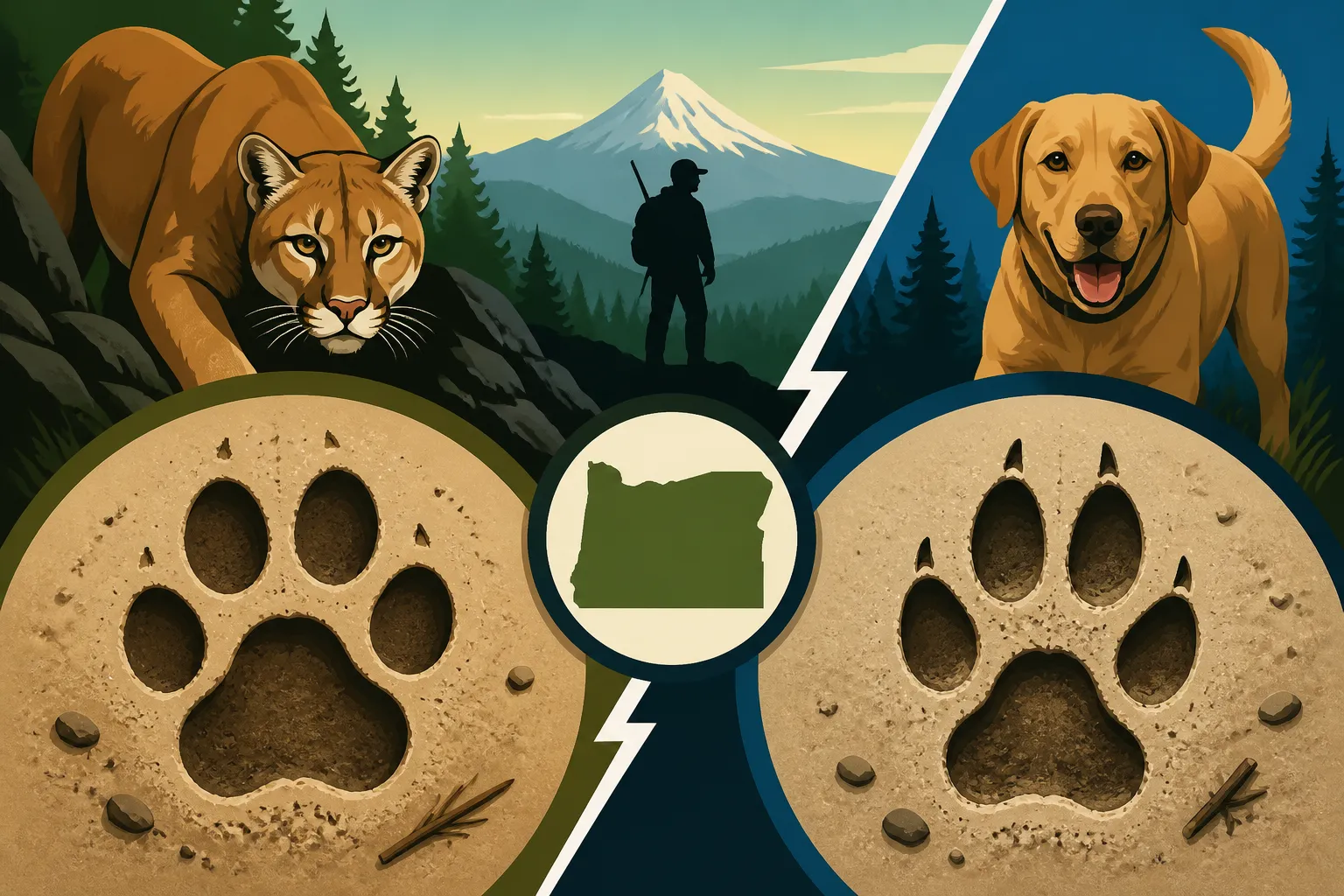
This is often the first place to look. A cougar’s toe pads are distinctly teardrop or almond-shaped and typically show a remarkable symmetry. If you draw an imaginary "X" through the center of a cougar's track, the negative space around the pads will often look fairly even. More critically, cougars, like most cats, have retractable claws. This means that in nearly all circumstances, you will not see claw marks in a cougar track. The only exceptions might be on a very steep incline, when they're pushing off on slippery ice, or if they're severely injured.
Dogs, on the other hand, have non-retractable claws. Their tracks almost always show distinct, blunt claw marks in front of each toe pad. Their toe pads tend to be more oval or rounded, and often appear less symmetrical. The overall shape of the dog's track might seem more splayed out, especially in soft substrates, whereas a cougar track tends to be more compact. This difference in toe and claw impression is perhaps the single most important diagnostic feature to train your eye to see.
Heel Pad: Distinctive Lobes and Size
The heel, or metacarpal/metatarsal pad, offers another critical piece of the puzzle. A cougar's heel pad is large, prominent, and typically has a very clear, distinctive three-lobed appearance at the rear, almost like a kidney bean with a flat top and three humps on the bottom. Sometimes, the leading edge might show two slight indentations. This unique shape is a dead giveaway for a feline.
Compare this to a dog's heel pad, which is generally more triangular or trapezoidal and typically has a single, large lobe at the rear, or perhaps two more rounded lobes. It lacks the distinctive three-lobed structure of a cougar. The relative size of the heel pad to the toe pads can also be a clue; in cougars, the heel pad often seems proportionally larger and more robust compared to the toes, giving the track a powerful, solid appearance.
Overall Track Shape and Size
Beyond the individual pads, the overall shape and size of the track itself provide context. A cougar track tends to be more round or circular, giving it a compact, "pushed together" look. An adult cougar track can range from about 3 to 4.5 inches long, though a large male can sometimes push closer to 5 inches. The front paws are typically slightly larger than the rear paws, which is common among many predators.
Dog tracks, conversely, often appear more elongated than wide, especially in larger breeds, and tend to have a more rectangular or "boxy" appearance. Their tracks are generally narrower than a cougar's of comparable length. While a large German Shepherd or Mastiff might leave a track similar in length to a cougar, the distinct difference in the heel pad, toe shape, and especially the ever-present claw marks will help you differentiate. If you're using a tool like a track measuring card or an app like GoHunt to record track data, paying close attention to these ratios and shapes will greatly enhance your identification skills.
Reading the Story in the Dirt: Stride, Gait, and Sign
Identifying individual tracks is a great start, but the real art of tracking comes from reading the entire story the animal leaves behind. How they walk, where they walk, and what they leave behind them can tell you just as much, if not more, than a single paw print. This is where understanding animal behavior truly comes into play.
Stride Length and Pattern: Direct Registering Versus Random
Cougars are incredibly efficient hunters, and their gait reflects this. They often employ what's called "direct registering," meaning their hind foot steps directly into the print left by their front foot. This creates a tight, single-file trail that can be very difficult to follow unless you're looking closely for overlapping prints. This helps them move quietly and conserve energy, especially in dense undergrowth. The stride length of an adult cougar is typically quite long, reflecting their powerful legs, and they move with a graceful, almost silent purpose. They walk in a relatively straight line, with minimal meandering.
Dogs, particularly domestic ones, tend to have a much less precise gait. They rarely direct register, creating a more erratic, "four-print" pattern where all four paws leave separate impressions. Their stride can vary wildly depending on their mood – trotting, running, or meandering. You'll often see them veer off to sniff things, run circles, or chase scents, leaving a much less linear and much more "random" trail. A dog's prints will often show a shorter, choppier stride compared to a focused cougar's travel, making it look far less deliberate. Understanding Cougar Territory Size and Movement can help you anticipate how far and in what manner a cougar might be traveling.
Trail Consistency and Habitat Preference
Cougars are creatures of habit and stealth. They prefer to travel along game trails, ridgelines, and areas with good cover, like the edge of dense timber or rocky outcrops. Their trails will often lead purposefully from one area of likely prey habitat to another, perhaps skirting the base of a cliff or following a drainage. When they are hunting, their focus is clear, and their trail reflects that. You might find cougar tracks near areas where Blacktail Deer Hunting in Oregon's Coastal Clearcuts is good, or in the timber where Roosevelt elk might be bedding down.
Domestic dogs, on the other hand, often accompany humans and will follow roads, hiking trails, or simply wander through open fields. If you find a track along a well-used hiking path or near a trailhead, and it has dog-like characteristics, it's almost certainly a domestic dog. While cougars certainly use roads and trails occasionally, especially at night, a consistent trail of "dog-like" tracks on a well-traveled human path usually points to Fido, not a feline. This habitat preference helps inform your initial assessment.
Associated Sign: Scat, Scrapes, and Prey
Beyond the tracks themselves, always look for other signs. Cougar scat is usually segmented, tubular, and often contains hair, bone fragments, and sometimes teeth from their prey. It's typically buried or partially covered, especially by males, as a territorial marker known as a "scrape." These scrapes are shallow depressions in the dirt or leaf litter where the cougar has raked its hind feet, often urinating or defecating there. Finding a fresh scrape alongside tracks is a strong indicator of a cougar.
Dog scat, while also tubular, rarely contains large bone fragments or hair (unless they’ve been eating something unusual). It's more often left uncovered and can be found almost anywhere. You might also find other signs of domestic activity, like discarded leashes, human footprints, or even scent markings on trees that aren't typical of a cougar's territorial behavior. If you find signs of a kill, especially a deer or elk carcass that's been covered with leaves and debris (a cougar cache), and nearby tracks show cat characteristics, then you're likely on the trail of a cougar.
Common Misconceptions and Local Variables
Even with a good understanding of the basics, tracking can throw curveballs. The environment, the age of the animal, and even the type of substrate can significantly alter a track's appearance, leading to misidentification. It's vital to be aware of these variables and avoid common pitfalls.
The Myth of the Visible Claw
Many new trackers are taught, or mistakenly believe, that if you see claw marks, it cannot be a cougar. While generally true, it's not an absolute. As mentioned, a cougar's claws can sometimes be visible in specific, unusual circumstances, such as a very slippery surface like ice or packed snow where they need extra traction, or when climbing or descending a steep, muddy bank. They might also show if the cat is pushing off hard for a jump, or if they have an injury preventing full retraction. However, these are the rare exceptions. The vast majority of the time, in typical walking or trotting conditions, a healthy cougar will leave no claw marks. If you're consistently seeing claw marks, it’s far safer to assume it’s a canine.
Confusion with Coyote or Bobcat Tracks
Oregon is home to other canids and felids that can also leave tracks. Coyotes, for instance, are very common. Their tracks are smaller than an adult cougar's, typically around 2-3 inches, and they are definitely canid, meaning they will show claw marks and a more triangular heel pad. However, their tracks are often much narrower than a domestic dog's, giving them a more "squeezed" look. Bobcat tracks are distinctly feline – no claws, symmetrical toes, distinct heel pad – but they are much smaller than a cougar's, usually in the 1.5 to 2.5-inch range. A bobcat's tracks also tend to be rounder and more compact than even a cougar's. Knowing the size ranges for each species, which you can often find in resources from ODFW or by using tools like GoHunt, is crucial. This can help prevent you from getting excited about a bobcat when you're looking for a lion. For tips on distinguishing tracks, you might find more specialized guidance in Finding Cougar Tracks Without Hounds.
Impact of Substrate on Track Clarity
The type of ground an animal walks on dramatically affects how clear and defined a track will be. Soft, damp mud or freshly fallen, damp snow provides the best substrate for clear prints, preserving intricate details like toe shape and pad lobes. Hard-packed dirt, dry sand, or icy conditions, however, can obscure these details, making identification incredibly difficult. A cougar track on hard ground might only show as a faint depression with no discernible pad detail, leading you to second-guess yourself.
Always consider the substrate. If the tracks are on a rocky, uneven surface or heavily leaf-littered ground, you might only get partial prints or displaced debris rather than clear impressions. In such cases, you need to rely more heavily on the overall pattern of travel, stride length, and other associated sign like scat or scrapes. It's often necessary to follow a trail for a bit to find a spot where the animal stepped on better ground, allowing for a more definitive identification.
Practical Field Identification Tips for Oregon Hunters
Alright, so you're out in the field, heart pounding, trying to make that critical identification. What practical steps can you take to ensure you're making the right call and not wasting valuable hunting time on a phantom? It comes down to a systematic approach, using the tools at your disposal, and learning to trust your observations.
Using Measurement and Comparison
The most reliable way to confirm a track in the field is through measurement and direct comparison. Carry a small ruler or a flexible tape measure with you. Measure the length and width of the track, paying attention to the overall dimension of the print itself, not just the disturbed area around it. Record these measurements.
Even better, if you have a tracking guide or app on your phone, compare the actual prints you see to detailed diagrams or photos of known cougar and dog tracks. You can even take a photo of the track next to a ruler or a familiar object (like a coin or your knife) for scale, and then zoom in to analyze the details of the toe pads and heel pad later. Don't just eyeball it; be precise. You'll be surprised how often a track that looks big enough for a cougar turns out to be a really large domestic dog once you measure it. This diligence is key, especially when considering Oregon Cougar Population Estimates.
Here's a quick comparison table to help you in the field:
| Feature | Cougar Track | Dog Track |
|---|---|---|
| Overall Shape | More rounded, compact, wider than long (generally) | More oval or rectangular, often longer than wide |
| Toe Pads | Teardrop/almond-shaped, symmetrical | More rounded/oval, less symmetrical |
| Claw Marks | Rarely visible (retractable claws) | Almost always visible (non-retractable) |
| Heel Pad | Distinctive 3-lobed rear, large and prominent | Triangular/trapezoidal, 1 or 2 rounded lobes |
| Negative Space | Often forms a clear "X" between pads | Less distinct "X" |
| Stride/Gait | Direct registering, single-file, purposeful walk | Four-print pattern, more erratic, often meandering |
Leveraging Digital Tools Like GoHunt
In this modern age, technology can be a huge asset for trackers. Apps like GoHunt provide detailed mapping capabilities that can help you understand the landscape where you're finding tracks. You can use satellite imagery to identify potential travel corridors, pinch points, or areas of dense cover where cougars are likely to frequent. Some apps also include overlay features for game ranges or historical harvest data, giving you a better sense of where cougars are known to exist and hunt.
Beyond mapping, a robust hunting app might offer wildlife identification guides, including track comparisons. You can take photos of tracks and upload them, sometimes even getting community feedback or using AI tools for preliminary identification. It’s also invaluable for marking the location of tracks with GPS waypoints, allowing you to return to the area later, or to share the information with hunting partners. Remember, E-Scouting Oregon Units With Satellite Imagery, combined with boots-on-the-ground track identification, creates a powerful scouting strategy.
What to Do When You're Still Unsure
Let's be honest: sometimes, even with all the knowledge in the world, the tracks just aren't clear enough, or you're operating in an unfamiliar area. If you're genuinely unsure whether a track is from a cougar or a dog, especially when hunting, it’s usually best to err on the side of caution.
- Follow for a while: If the tracks are fresh and the terrain allows, follow them for a short distance. Often, an animal will step on a softer patch of ground, or engage in a behavior (like a scrape or a full run) that leaves more definitive prints. If it's a domestic dog, you might eventually find human tracks accompanying them, or the dog might change its behavior in a way that’s clearly not feline.
- Look for other signs: As discussed, scat, scrapes, or even a partially covered kill will provide crucial corroborating evidence. A lone, ambiguous track isn't enough to build a hunt around.
- Don't burn valuable hunting time: If, after a reasonable effort, you can't make a positive identification, move on. Oregon has incredible hunting opportunities, and there's no sense in chasing what might be a neighbor's golden retriever. Focus your energy where you have clear, undeniable sign. This is especially true if you are spending time trying Cougar Calling Sounds That Draw a Cat In, you don't want to call in someone's pet!
Learning to identify tracks takes practice, patience, and a keen eye for detail. The more time you spend in the field, examining tracks, comparing them, and understanding the behavior of animals, the better you'll become. Each track tells a story, and with these tools, you'll be well-equipped to read them clearly.
Disclaimer
The information provided in this guide is for informational purposes only and is not a substitute for official regulations or professional guidance. Always consult the most current Oregon Department of Fish and Wildlife (ODFW) regulations and seek expert advice when necessary. Hunting is a regulated activity, and it is the responsibility of each individual hunter to ensure compliance with all applicable laws and safety guidelines.