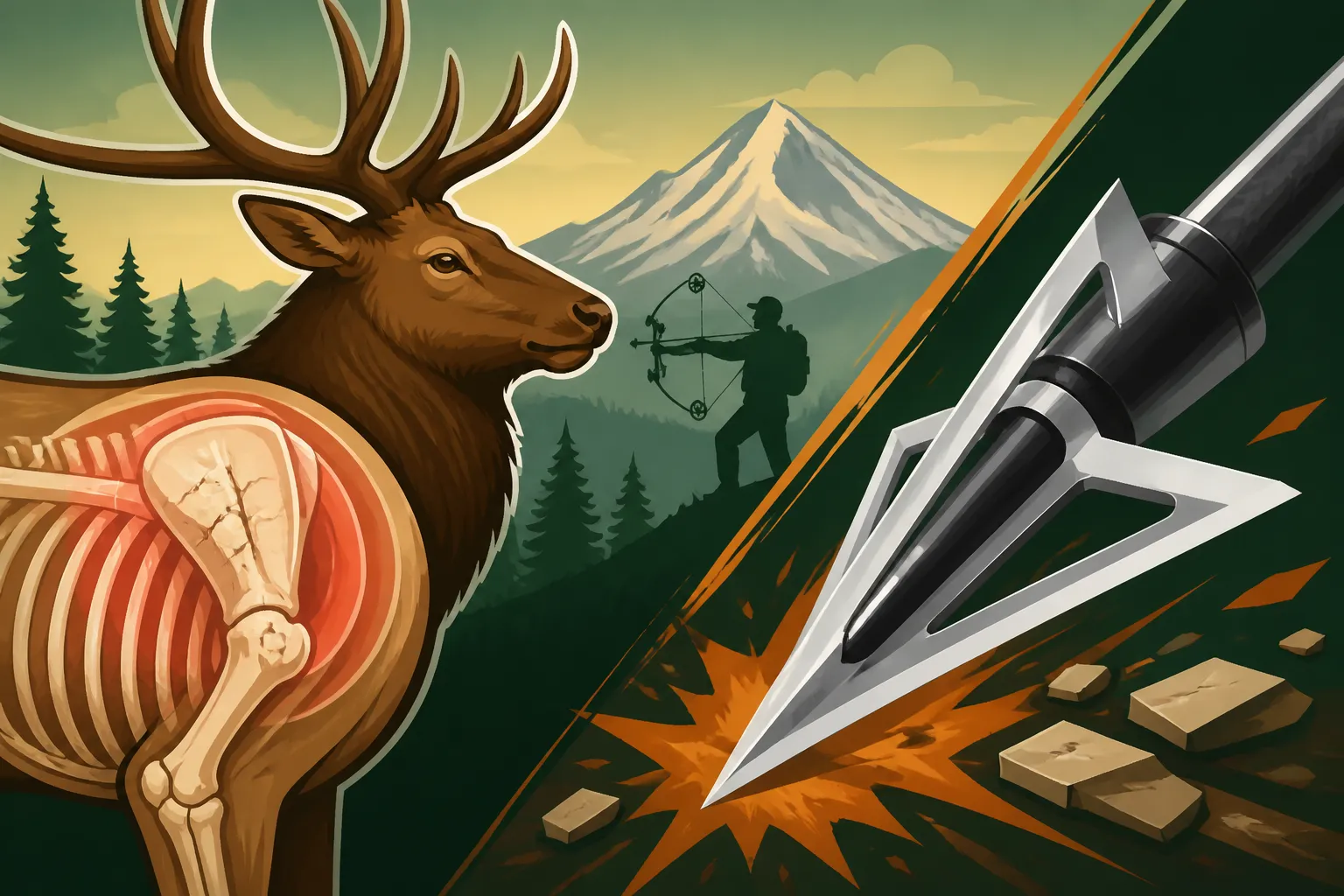
Broadhead Choice for Heavy Bone
The moment of truth arrives quickly in the elk woods. You've drawn back, settled your pin, and released a perfectly executed shot, only to hear that sickening thwack that screams "bone!" instead of the quiet whisper of vitals. It’s a gut-wrenching feeling, and it highlights a critical reality: Oregon’s big game, especially our magnificent elk, come equipped with some seriously heavy bone that can shatter confidence and ruin a hunt if your broadhead isn't up to the task. This guide is all about helping you understand the challenge of heavy bone and choosing a broadhead that gives you the best chance of ethical penetration when it matters most.
The Reality of Heavy Bone in Oregon's Big Game
When you're chasing trophy animals like Roosevelt elk in the Coast Range or Rocky Mountain elk in Eastern Oregon, you're dealing with animals that are built like tanks. Their skeletal structure is incredibly dense and robust, designed to withstand impacts and support massive bodies. A perfectly placed shot through the lungs is ideal, but the reality of hunting is that animals move, angles change, and sometimes, you hit bone.
Where You'll Encounter Dense Bone
Imagine a full-grown bull elk; his shoulder alone is a fortress. The scapula (shoulder blade), humerus, and ribs are all incredibly thick and strong. Even a shot that's slightly off its mark, a few inches forward or low, can encounter these heavy bones.
- The Scapula: This broad, flat bone protects the lungs and heart. It's not usually the primary aiming point, but it often sits in the path to the vitals on quartering-to or slightly quartering-away shots if your entry point isn't precise. It's a notoriously tough obstacle for any projectile.
- The Humerus: The upper leg bone, extending from the shoulder joint. A bull elk's humerus is incredibly dense, designed to bear immense weight and absorb shock. Hitting this bone almost guarantees your arrow will stop or deflect significantly.
- Ribs: While individual ribs might not seem as daunting, hitting multiple ribs, especially on larger animals or if the arrow is losing energy, can prevent full penetration. The cartilage connecting them is also surprisingly resilient.
- Spine: A hit to the spine can be immediately lethal if the spinal cord is severed, but the vertebrae themselves are dense and designed to protect this critical nervous system. Broadheads need to be tough to punch through.
It's not just elk, either. A mature black bear, particularly the larger ones found in the Coast Range, also possesses robust bone structure, especially through the shoulders. Understanding where these bony structures lie is paramount, as is knowing that your broadhead needs to be able to punch through them when the unexpected happens. Many hunters use mapping tools like those from GoHunt to visualize animal anatomy and shot angles in relation to terrain, which can indirectly aid in broadhead selection by understanding likely scenarios.
Broadhead Types Built for Tough Penetration
When it comes to penetrating heavy bone, not all broadheads are created equal. You need a design that prioritizes structural integrity, sharpness, and a profile that can drive deep rather than deflect or break.
Fixed Blade Broadheads: The Bone Crushers
For decades, traditional fixed blade broadheads have been the go-to for hunters seeking maximum penetration on tough game. Their design means the blades are rigid and unmoving, integrated directly into the ferrule. This eliminates moving parts that can fail on impact.
- Durability and Reliability: Fixed blades excel here. Because there are no mechanical parts to deploy, the entire broadhead is a solid unit, transferring all its kinetic energy into forward momentum. This reduces the risk of blade deformation, breakage, or non-deployment that can occur with mechanicals on heavy bone. Brands like Iron Will and GrizzlyStik are often cited by serious elk hunters for their robust fixed blade designs.
- Single Bevel vs. Double Bevel:
- Double Bevel: Most common, with blades sharpened on both sides. They create a cut that’s efficient for general penetration.
- Single Bevel: Blades sharpened on only one side, designed to create a rotational force as they enter tissue and bone. This rotational effect, often referred to as a "planing" or "drilling" action, can help drive the broadhead deeper, especially when encountering bone. They are often favored for very heavy game and are excellent for splitting bone rather than merely punching through it, further enhancing penetration.
- Ease of Tuning: Some fixed blade broadheads, especially those with larger blade profiles, can be a bit more finicky to tune for perfect flight with your specific arrow setup. However, many modern fixed blades are designed to be extremely aerodynamic and fly true with minimal adjustment. A perfectly tuned bow and arrow system is crucial, as any wobble or erratic flight will negate the advantages of even the best fixed blade. This is where consistent practice with your chosen broadhead, not just field points, truly pays off. You'll want to ensure your setup is dialled in, especially when preparing for Archery Setup for Wet Oregon Timber or any challenging hunting conditions.
Mechanical Broadheads: Weighing the Risks
Mechanical, or expandable, broadheads have gained immense popularity for their field point-like flight characteristics and larger cutting diameters. However, when it comes to heavy bone, they present a more complex picture.
- Potential for Failure on Bone: The primary concern with mechanical broadheads on heavy bone is the risk of the blades not deploying correctly or breaking upon impact. If a blade hits bone directly during deployment, it can deform, bend, or snap off. This can drastically reduce penetration and lead to a non-lethal wound or, worse, a wounded animal that can't be recovered. Older designs or those with thinner blades are particularly susceptible.
- Modern Robust Designs: Manufacturers have responded to these concerns by designing more robust mechanical broadheads. Some feature stronger materials, thicker blades, and rear-deploying designs that are less prone to impact-related failures. While these improvements have made mechanicals more reliable, especially for animals like deer, many experienced elk hunters still err on the side of caution when targeting animals with very heavy bone. If you're considering a mechanical for elk, research those specifically designed for large, tough game and understand their limitations. Always prioritize broadheads with a reputation for integrity and blade retention.
- When They Might Work: In a perfect world, where the arrow slips precisely between ribs or finds a clear path to the vitals, a mechanical broadhead can create a devastating wound channel. However, the margin for error on heavy bone is significantly smaller. If you're confident in your ability to consistently hit a very precise, bone-free spot and your bow produces ample Bow Draw Weight for Elk, a heavy-duty mechanical might be an option, but always with a clear understanding of the risks involved.
Factors Beyond Broadhead Design for Penetration
While the broadhead itself is paramount, it's just one piece of the penetration puzzle. Several other critical factors contribute to how well your arrow will drive through tough hide, muscle, and bone. Neglecting these aspects can undermine even the best broadhead choice.
Arrow Weight and Front of Center FOC
It's a common misconception that speed is everything in archery. While faster arrows fly flatter, when it comes to punching through bone, momentum trumps speed.
- Increased Momentum: A heavier arrow carries more momentum. Think of it like a bowling ball versus a tennis ball. Both might travel at the same speed, but the bowling ball has far more force behind it to knock down pins. The same principle applies to an arrow hitting bone. More momentum helps the arrow continue its path through resistance. For elk, many seasoned hunters aim for total arrow weights of 450-550 grains or even heavier, especially when targeting Roosevelt Elk in Western Oregon with their larger frames.
- Front of Center (FOC): This refers to how much of your arrow's weight is concentrated in the front half of the arrow. A higher FOC (generally 12-19% for hunting, some even pushing 20%+) improves penetration because it forces the arrow's weight to drive the broadhead forward, like a dart. It also stabilizes the arrow more effectively, especially after encountering resistance, preventing deflection. You achieve higher FOC by using heavier broadheads, heavier inserts, or by cutting your arrows slightly shorter (if still within safe parameters for your draw length). Websites like GoHunt offer detailed calculators and articles on optimizing FOC for various hunting scenarios.
Kinetic Energy and Tuning Your Bow
Kinetic energy (KE) and momentum are related but distinct concepts. KE is about the destructive power at impact, while momentum is about the ability to overcome resistance. Both are crucial.
- Maximizing Kinetic Energy: Your bow setup dictates your arrow's kinetic energy. This includes your draw weight, draw length, and arrow speed. While you don't necessarily need the absolute fastest bow on the market, ensuring your setup generates sufficient KE is vital. For elk, a minimum of 60-65 ft-lbs of KE is often recommended, but more is always better for maximizing your chances on heavy bone.
- Perfect Tuning: An untuned bow will cause the arrow to oscillate or "fishtail" in flight, even if it looks straight to the naked eye. This erratic flight path robs the arrow of kinetic energy and momentum. When it hits the target, it's not delivering all its force straight forward; some is lost in rotational or sideways motion. A perfectly tuned bow ensures your broadhead flies true and delivers its full potential energy downrange. This involves setting up your rest, nocking point, and cam timing correctly. Don't underestimate the importance of broadhead tuning—making sure your broadheads fly identically to your field points is non-negotiable for ethical hunting.
Shot Placement: The Ultimate Broadhead Enhancer
No matter how robust your broadhead or how heavy your arrow, a poor shot will always be a poor shot. Precision is paramount.
- Aiming for Voids, Not Bone: The ideal shot, of course, avoids heavy bone altogether, focusing on the lung and heart vitals. Understanding elk anatomy and practicing different shot angles will significantly improve your odds. For example, a slightly quartering-away shot can open up a wider path to the vitals, allowing the arrow to enter behind the shoulder and angle forward, minimizing the chance of hitting the scapula directly. Learning about Shot Placement on a Bull at Close Range is critical.
- Patience and Discipline: It takes discipline to wait for the ideal shot. If an animal is angled in a way that presents a high risk of bone impact, it's always better to wait for a better opportunity, even if it means not taking a shot at all. Ethical hunting means doing everything in your power to ensure a quick, clean kill.
- Visualizing the Path: Before you draw, visualize the arrow's path through the animal. Imagine the broadhead passing through hide, muscle, ribs, and into the vitals. This mental exercise can help you refine your aim and decide if the shot is truly ethical. Even a slight adjustment in your anchor point or body angle can make a huge difference in avoiding heavy bone. In the dense timber of western Oregon, where shots can be close and quick, this visualization is even more important.
Testing, Practice, and Confidence in Your Setup
Once you've selected your broadhead and optimized your arrow setup, the work isn't over. The final, and arguably most crucial, step is to test your gear and practice rigorously until you have absolute confidence in your ability to make a precise and lethal shot under hunting conditions.
Broadhead Tuning and Flight
This isn't just about making sure your broadheads hit the target. It's about ensuring they fly exactly like your field points. Any deviation means wasted energy, reduced accuracy, and an increased chance of hitting unintended bone.
- Walk-Back Tuning: This is a fantastic method to ensure your broadheads and field points are flying identically. Start shooting at close range (e.g., 10 yards), then walk back to 20, 30, and 40 yards, aiming at the same spot without adjusting your sights. If your field points and broadheads consistently group together at all distances, your bow is well-tuned. If not, you'll need to make minor adjustments to your rest, nock point, or cam timing. Many local pro shops in Oregon offer tuning services, which can be invaluable.
- Fletching and Helical/Offset: The type and configuration of your fletching play a significant role in broadhead flight. Larger, stiffer fletching (like 3 or 4 fletch, 2-3 inches long) with a strong helical or offset twist can help stabilize broadheads, especially fixed blades, more effectively. This creates drag that forces the arrow to spin, correcting any minor inconsistencies in arrow flight before it reaches the target.
- Repeated Practice: Don't just shoot a few broadheads and call it good. Repeatedly practice with your hunting arrows and broadheads until it feels as natural as shooting field points. Practice from different distances, angles, and even from kneeling or sitting positions, mimicking real hunting scenarios. This builds muscle memory and confidence.
Simulating Real-World Scenarios
True confidence comes from practicing in conditions that mirror what you'll encounter in the field.
- Varied Shot Angles: Animals rarely stand perfectly broadside. Practice shooting at targets placed at various angles—quartering-to, quartering-away, slightly uphill, downhill. This helps you understand how the animal's anatomy shifts and where the vitals lie from different perspectives. Understanding these angles is vital for good Shot Placement on a Bull at Close Range.
- Practice with Layered Targets: While not a perfect substitute for actual animal bone, targets with varying densities (e.g., dense foam, layered carpet, rubber) can give you a rough idea of how your broadhead performs against resistance. Some hunters even incorporate ethically sourced animal scapulas or ribs into their practice regimen to get a direct feel for bone penetration.
- GoHunt Resources: Platforms like GoHunt often have forums and articles where hunters share their experiences with different broadheads and discuss methods for testing them, offering valuable insights from the hunting community.
Mental Preparation and Ethical Responsibility
Ultimately, broadhead choice and physical practice are tools to support ethical hunting.
- Making the Shot Count: When the moment comes in the field, it's about making the best decision for the animal. If the shot isn't perfect, or if you doubt your ability to make a clean hit through potential bone, don't take it. Patience is a virtue in hunting.
- Following Up: Even with the best broadhead and shot, things can happen. Know your plan for Blood Trailing in Oregon Rainforest Understory or Blood Trailing in Sword Fern and Salal, and be prepared for the effort involved in retrieving your animal. Knowing how to Field Dressing an Elk in Warm Early-Season Weather and Quartering and Packing an Elk Alone is also part of your responsibility after a successful shot. Whether you're Packing Out an Elk in Oregon's Wilderness Units or closer to a road, be ready for the work.
By meticulously selecting a broadhead designed for heavy bone, optimizing your arrow setup for maximum momentum, and dedicating yourself to thorough practice, you equip yourself with the best possible chance for an ethical and successful hunt in Oregon's challenging terrain.
| Broadhead Type | Best For | Penetration on Heavy Bone | Key Advantages | Potential Drawbacks |
|---|---|---|---|---|
| Fixed Blade | Large, tough game (Elk, Bear) | Excellent | Maximum structural integrity, no moving parts | Can be harder to tune than field points |
| Mechanical/Expandable | Smaller game (Deer), high speed bows | Variable (Risky) | Field point flight, large cutting diameter | Risk of non-deployment or blade failure on bone |
| Hybrid | Deer, some Elk | Good to Very Good | Fixed blade accuracy with some expandable cutting | More complex than fixed, still has moving parts |
Disclaimer
Always consult the latest Oregon Department of Fish and Wildlife (ODFW) regulations before hunting. Hunting laws and regulations can change, and it is your responsibility to be informed and compliant.