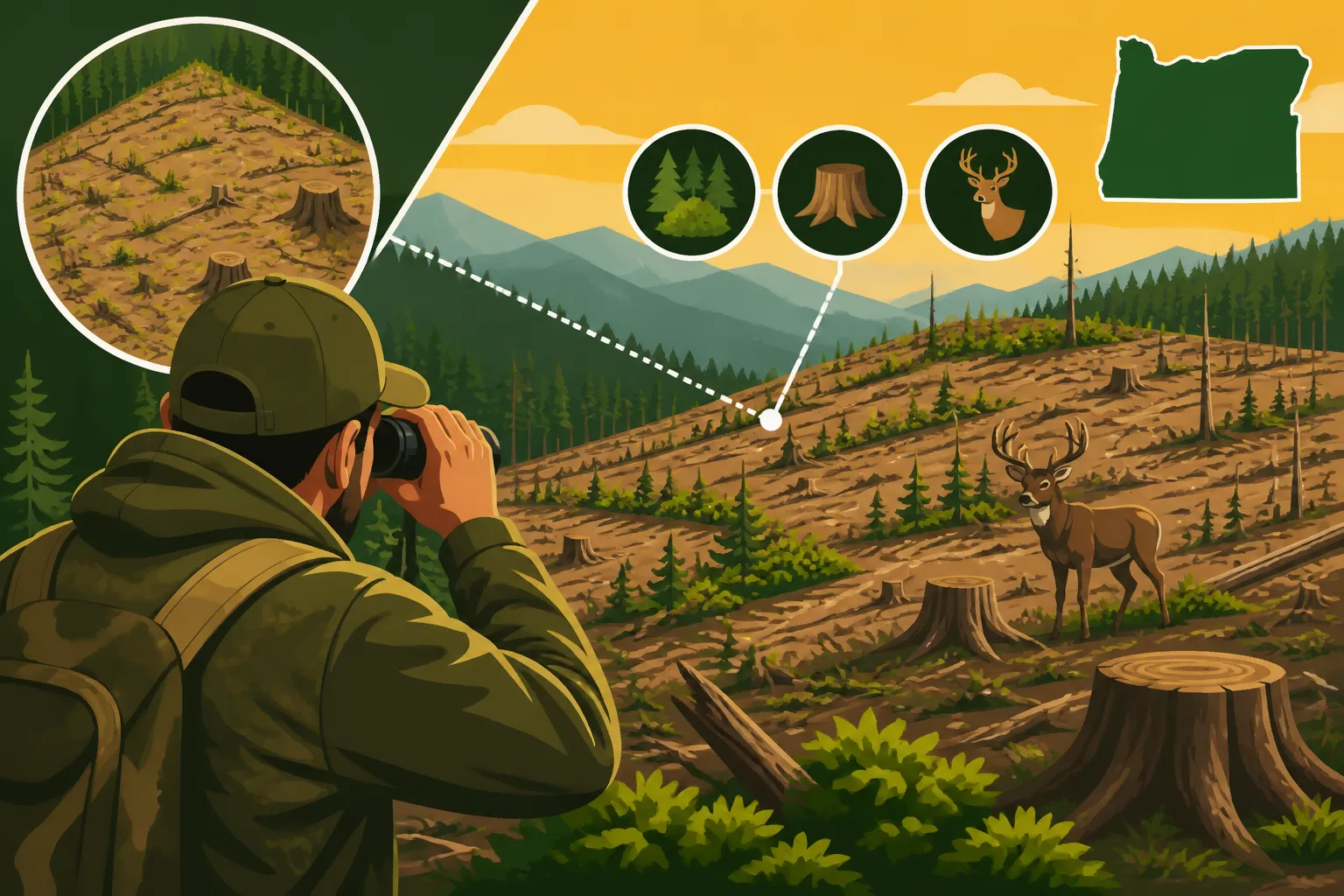
Reading a Two-Year-Old Clearcut for Bucks
Trying to find a mature blacktail buck in the dense, tangled chaos of a two-year-old clearcut can feel like searching for a needle in a haystack—a very thorny, brushy haystack. The transition from a freshly logged area to a haven of regenerating cover happens so fast in Oregon, and it often leaves hunters scratching their heads, wondering where the deer vanished to. This guide is here to unravel the mysteries of these incredibly productive yet challenging landscapes, showing you how to read the subtle signs, understand buck behavior, and ultimately increase your odds of punching a tag in these often-overlooked spots.
Understanding the Ecosystem of a Two-Year-Old Clearcut
When a logging crew finishes their work and the dust settles, a clearcut begins its rapid transformation. Within a year or two, what was once bare ground covered in slash becomes a thick, vibrant nursery of new growth. This stage is absolutely critical for blacktail deer, providing an explosion of food and cover that makes it prime habitat, especially for bucks looking for security and sustenance.
What Defines a Two-Year-Old Clearcut
A two-year-old clearcut in Oregon is typically characterized by rapidly regenerating vegetation that's usually knee-to-waist high, or even taller in some areas. You'll see a mix of aggressive forbs, grasses, and shrubs like salal, huckleberry, and various kinds of brush. Most importantly, the replanted conifer seedlings, often Douglas fir or Western hemlock, are starting to establish themselves. They're usually still quite small, making for a challenging combination of thick undergrowth and scattered, taller saplings.
This isn't the open, easy-to-glass landscape of a freshly cut unit where the slash piles are still dominant and visibility is relatively good. Nor is it the impenetrable jungle of a five-year-old clearcut where the trees are head-high or taller, creating a dense, claustrophobic canopy that's almost impossible to navigate, let alone see a deer in. The two-year mark hits a sweet spot: enough food and cover to attract and hold deer, but still often navigable, albeit slowly and noisily, for a determined hunter. The remnants of logging debris, like stumps and downed logs, also provide natural barriers and hiding spots within this emerging jungle.
Why Bucks Utilize These Areas
Blacktail bucks, especially mature ones, are masters of finding security. They thrive on having dense cover nearby, allowing them to feel safe from predators—including us hunters. A two-year-old clearcut offers precisely this. The burgeoning vegetation provides excellent concealment, allowing them to bed down undetected during the day while still being close to vital food sources.
These clearcuts are essentially giant buffet lines for deer. The sunlight hitting the forest floor after logging stimulates a burst of growth in various browse species, which are often highly nutritious. Deer will move into these areas to feed, particularly during the low-light hours of dawn and dusk, but also throughout the day if the cover is sufficient. For a buck, it's the perfect blend: a place to eat well and grow antlers, coupled with the dense, almost impenetrable cover that allows them to live out their lives largely undisturbed. This habitat also provides critical thermal cover in colder weather, and often some relief from summer heat if there are shaded pockets. Understanding this crucial appeal is the first step in Blacktail Deer Hunting in Oregon's Coastal Clearcuts.
Difference From Fresh Cuts and Older Cuts
The distinction between clearcut ages is vital for effective hunting. A fresh clearcut (0-1 year old) is typically characterized by a lot of exposed earth, heavy logging slash, and stumps. While deer might visit these for a few days immediately after logging to browse on disturbed soil or find dropped cones, they generally lack the persistent cover and diverse browse to hold them long-term. Visibility is often better here, making it easier to spot game, but deer presence can be sporadic.
Two-year-old clearcuts, as we've established, are transitioning into dense, low-level cover with burgeoning browse. They offer a balance of food and security that makes them incredibly attractive. Bucks feel comfortable here, knowing they can disappear into the brush at the slightest hint of danger.
Older clearcuts (3-5+ years old) become progressively thicker. As the replanted trees grow taller, they begin to shade out the understory, reducing the browse diversity and density. These areas can become incredibly difficult to hunt, sometimes forming what locals affectionately call "dog hair thickets"—impenetrable stands where visibility is mere feet. Deer might still use the edges of these older clearcuts or the occasional game trail through them, but the broad-scale feeding opportunities diminish, and the cover becomes almost too thick, even for deer, making travel difficult. For hunting blacktails in these dense environments, understanding How Close You Can Get in Coastal Timber becomes paramount.
Here's a quick comparison of clearcut types:
| Clearcut Age | Primary Characteristics | Deer Behavior & Presence | Hunting Strategy |
|---|---|---|---|
| 0-1 Year (Fresh) | Exposed earth, heavy slash, stumps, minimal new growth. | Transient visits for quick browse; less sustained presence. | Spot-and-stalk from afar; focus on access points. |
| 2 Years (Young) | Knee-to-waist high browse, emerging saplings, dense cover. | High attraction for bucks seeking food and security. | Slow still-hunting, glassing pockets, working edges. |
| 3-5+ Years (Older) | Head-high to 10+ ft saplings, dense canopy, reduced browse. | Use edges, established trails; harder to penetrate. | Focus on perimeters; limited still-hunting in very slow paces. |
Key Features to Scout for in Young Clearcuts
Before you even set foot in a two-year-old clearcut, or as you cautiously navigate its interior, knowing what features to prioritize will save you immense time and dramatically improve your chances. These areas aren't uniform; they have natural irregularities that concentrate deer activity.
Edge Cover Transitions
The most obvious, and often most productive, feature of any clearcut is its edge. For a two-year-old clearcut, the transition zones between the young growth and the older, mature timber are hotspots. Bucks will often stage in the security of the mature timber, then filter out into the clearcut to feed. Conversely, they’ll retreat into the timber at the first sign of danger or to bed down for the day.
Look for subtle fingers of clearcut extending into the timber, or vice versa, where the mature timber forms a point or a bay into the younger growth. These create natural funnels and pinch points that deer use. Pay close attention to these transitional areas; they are often riddled with game trails leading in and out, especially where the new growth offers enough cover to shield their entry and exit. When Reading Clearcut Edges for Blacktail Bucks, it’s not just about the obvious line; it's about the subtle topography and vegetation changes along that line.
Sparse Pockets of Unlogged Timber or Brush
Not all clearcuts are perfectly uniform. Sometimes, loggers will leave small clumps or fingers of mature timber, usually because they're in a wet draw, on a steep slope, or simply considered uneconomical to harvest. These unlogged pockets, no matter how small, are sanctuaries within the clearcut. They offer immediate, dense cover for bedding and shade, and deer will absolutely seek them out.
Similarly, even within the two-year-old growth, you might find areas where the brush grew thicker or different species established themselves more aggressively, creating mini-thickets that offer superior concealment. These dense islands, or "edge cover blacktails bed in," are like magnets for bucks. They provide escape routes, bedding areas, and often the highest concentration of deer sign. Don't be afraid to circle these areas or even push through them if the wind is right, as a buck might be tucked in tight, waiting for you to pass by.
Natural Draws and Contours
Topography plays a huge role in how deer use a clearcut. Swales, draws, and small saddles within the clearcut act as natural travel corridors. Even in dense vegetation, deer prefer the path of least resistance. These low spots often retain more moisture, leading to different vegetation growth that can be more palatable or offer better cover. They also offer thermal advantages, being cooler in hot weather and sometimes warmer in cold.
Before your hunt, utilize tools like GoHunt's satellite imagery to identify these subtle topographical features. E-Scouting Burns and Clearcuts From Satellite can help you pinpoint these areas from the comfort of your home. Once on the ground, confirm these features and look for concentrated deer sign. Game trails running through draws are almost guaranteed to be used by bucks. Additionally, any small streams or wet areas in these draws will draw deer for water, especially in drier parts of Oregon.
Game Trails, Rubs, and Scrapes
The most direct evidence of buck presence comes from their sign. In a two-year-old clearcut, fresh game trails will be evident, worn paths through the brush. Focus on trails that lead from dense bedding cover to feeding areas, or those that parallel the clearcut edges. These are highways for deer movement.
Rubs, where a buck has scraped the velvet off its antlers or polished them on a tree, are definitive signs of a buck in the area. In a young clearcut, bucks will often rub small, emerging trees or even stout brush stems. Look for rubs around the edges of the clearcut, near cover pockets, or along primary travel corridors. The height of the rub can give you an indication of the buck's size, but more importantly, freshness is key. Shiny, exposed wood indicates a very recent rub.
Scrapes, patches of ground pawed clean by a buck, often with an overhanging branch (a "licking branch") above, are less common in general clearcut hunting, but they can appear in the pre-rut or rut, especially on the more mature edges. While perhaps more indicative during Blacktail Rut Timing in Western Oregon, a fresh scrape near a clearcut provides undeniable proof that a buck is active there. Combined, these signs tell a story of where, when, and how bucks are using the clearcut. Utilizing Trail Camera Placement on Public Land in these key areas can give you even more insight into their movement patterns.
Strategies for Hunting Two-Year-Old Clearcuts
Hunting these dense, regenerating areas requires a deliberate and often slow approach. You won't be covering miles quickly, and patience is your most valuable asset. The goal is to maximize your visibility while minimizing your own impact.
Still-Hunting Techniques
Still-hunting is perhaps the most effective method for navigating a two-year-old clearcut. This involves moving incredibly slowly, taking a few steps, then stopping to observe and listen for extended periods. Think of it as stalking, but you're not specifically targeting an animal you've already seen; you're looking for one. In these environments, you're not usually looking for a whole deer, but rather a horizontal line that shouldn't be there, the flicker of an ear, or the glint of an antler.
When Still-Hunting Blacktails in Wet Oregon Coastal Brush, embrace the noise. The brush will be loud. Your goal isn't silence, but controlled noise. Move when the wind rustles the leaves or when a plane flies overhead. Take one slow, deliberate step, pause, and scan every inch of visible cover, from knee-high to head-high. Use your binoculars often. Sometimes, what looks like a shadow is a deer, or a small tree branch is an antler tine. Move against the wind or crosswind to ensure your scent isn't blowing ahead of you, alerting game. Focus on moving from one patch of slightly less dense cover to another, always looking for subtle openings or changes in the vegetation.
Glassing Approaches
While still-hunting is crucial, integrating strategic glassing can also be highly effective, especially if the clearcut has some elevation changes or larger open patches. Find a vantage point, whether it's an old logging road that traverses the clearcut, a high knob, or a stump pile that gives you a few extra feet of elevation.
From this vantage point, systematically glass the entire clearcut, focusing on the edges, draws, and any sparse pockets. Use good quality binoculars, like a pair of 10x42s, or even a spotting scope if the distances are long. Spend at least 15-20 minutes in each spot, letting your eyes relax and looking for movement. Glassing Rimrock at First Light principles apply here: the first and last hours of light are often the most productive. The low angle of the sun can reveal deer tucked into shadows that would otherwise be invisible. Remember to look for pieces of a deer – an ear twitch, a patch of hide, a reflection from an eye – not just an entire animal.
Wind Consideration
Ignoring the wind in dense clearcuts is a recipe for failure. Blacktails, like all deer, rely heavily on their sense of smell. If you're hunting against the wind, your scent is being carried ahead of you, giving every deer in your path a heads-up that you're coming.
Always try to hunt into the wind, or at least with a crosswind that carries your scent away from the areas you expect deer to be. This might mean making a long loop to approach a promising area from the downwind side. Check the wind constantly using a small squeeze bottle of powder or a simple wind checker. Oregon's coastal clearcuts can have notoriously swirling winds, especially in draws and canyons. Be mindful of thermals: in the morning, air typically flows downhill, and in the evening, it flows uphill. Plan your approach accordingly, ensuring your scent doesn't betray your presence. Packing reliable Rain Gear That Actually Stays Dry is also essential, as wind often comes with precipitation in these regions, impacting thermals and deer behavior.
Timing Your Hunt
The time of day can make a significant difference in a two-year-old clearcut. Bucks are most active during low-light conditions.
- Early Morning: Be in position before first light. Deer will often be finishing their nocturnal feeding and might still be in the clearcut, slowly making their way back to dense bedding cover. This is a prime time to catch them feeding or moving.
- Late Evening: Similarly, the last two hours of daylight are crucial. Bucks will start to emerge from their bedding areas in the deeper timber or dense pockets within the clearcut, heading out to feed. Being patient and waiting for these movements can pay off.
- Mid-Day in Inclement Weather: Don't discount mid-day, especially if the weather is cool, rainy, or overcast. Blacktails are known to be more active throughout the day in such conditions, especially if the clearcut offers excellent thermal cover. A light drizzle can also dampen leaf litter, making still-hunting quieter. Remember your Boots for Wet Coastal Hunting are crucial for staying comfortable and quiet in these conditions.
Common Mistakes and How to Avoid Them
Even experienced hunters can make errors in the challenging environment of a two-year-old clearcut. Knowing the pitfalls and consciously working to avoid them will greatly increase your success rate.
Moving Too Fast
This is, without a doubt, the most common mistake. The urge to cover ground, to "see more country," is strong. But in a dense clearcut, moving quickly guarantees you'll bump deer before you ever see them. A buck can hear you, smell you, or see your movement long before you detect it.
How to avoid it: Force yourself to slow down. A good rule of thumb for still-hunting in thick cover is to take no more than 10-15 steps per minute, or even less. Spend 70% of your time scanning and listening, and only 30% moving. Use a timer if you have to. Practice moving with absolute deliberation, placing each foot carefully, and pausing to let the woods settle before moving again. If you feel like you're moving too slowly, you're probably moving at the right speed.
Ignoring the Wind
As mentioned earlier, wind is your nemesis or your best friend, depending on how you use it. Ignoring it is akin to broadcasting your presence with a megaphone.
How to avoid it: Develop a habit of constantly checking the wind. Before you start your hunt, determine the prevailing wind direction and plan your route accordingly. Carry a wind-checker and use it every few minutes, especially when crossing draws or ridges where thermals can shift. If the wind changes adversely, be willing to change your plan, even if it means backtracking or taking a longer route. A few extra minutes or a longer walk is far better than blowing your chance at a buck. You're trying to outsmart an animal whose survival depends on detecting threats; don't give them an easy win.
Focusing Solely on the Edges
While clearcut edges are incredibly productive, exclusively hunting them means you're missing out on the bucks that are deep inside the clearcut, tucked away in security cover. Mature bucks often avoid the obvious edges, especially during hunting season, and prefer the deeper, less-pressured interiors.
How to avoid it: Be willing to penetrate the clearcut. Once you've established the wind, pick a line that takes you into the dense heart of the two-year-old growth. Look for those sparse pockets of unlogged timber, deep draws, or thickest patches of brush within the clearcut itself. These interior sanctuaries are where a buck will often spend his day, only moving out to the absolute edges in the lowest light. You might not cover as much ground, but the quality of the ground you do cover will be much higher, increasing your odds of a close-range encounter. This is especially true when Hunting Clearcuts on Private Timber Land where access might be more limited to key areas.
Underestimating Deer Intelligence
Blacktail deer are incredibly savvy, especially the older bucks that have survived multiple hunting seasons. They've learned what human pressure looks, sounds, and smells like, and they adapt their behavior accordingly. Walking in predictably, making excessive noise, or moving in an exposed manner will quickly educate any buck in the vicinity.
How to avoid it: Approach your hunt with respect for the animal's intelligence. Vary your approach. Don't hunt the same clearcut the same way every time. Use natural cover to break up your silhouette. Think about escape routes from a buck's perspective – where would you run if you were jumped? Always expect a buck to be smarter than you think. Use subtle movements. Avoid bright clothing unless legally required. And most importantly, have patience. A smart buck often waits for you to make a mistake, or simply waits you out. Your best chance is to be even more patient and observant, eventually catching them off guard in their own territory.
Disclaimer
Hunting is an inherently dangerous activity. Always prioritize safety, understand and follow all local, state, and federal hunting regulations, and ensure you have the necessary licenses and tags. This guide is for informational purposes only and does not substitute for proper training, experience, or professional guidance. Be aware of your surroundings, know your target and what is beyond it, and hunt responsibly.