Flying Into Eastern Oregon Airports
The thought of planning an Oregon hunting trip to the vast, rugged expanses of Eastern Oregon can be daunting. For many, the idea of a 10-hour drive from home, hauling all your gear, isn't just exhausting—it’s a non-starter. But flying into the region introduces a whole new set of logistical puzzles, from managing firearms to finding a rental truck that can handle those backcountry roads. This guide aims to demystify the process of flying into Eastern Oregon airports, helping you navigate the complexities so you can spend less time worrying about travel and more time scouting those high desert ridges or timbered canyons.
The Eastern Oregon Airport Landscape for Hunters
Eastern Oregon is a massive area, stretching from the dramatic Wallowa Mountains in the northeast to the high desert plains near the Nevada border. Unlike the denser population centers of the Willamette Valley, access here is often about distance and local infrastructure. Understanding which airports best serve your specific hunting destination is the first, crucial step in planning a successful fly-in hunt.
Key Regional Airports and Their Reach
While Portland International Airport (PDX) might be your initial thought for flying into Oregon, it's often hundreds of miles from many prime Eastern Oregon hunting grounds. While it offers the most flight options and rental car variety, you're still looking at a significant drive—often 4 to 8 hours or more—to get into the heart of elk or mule deer country.
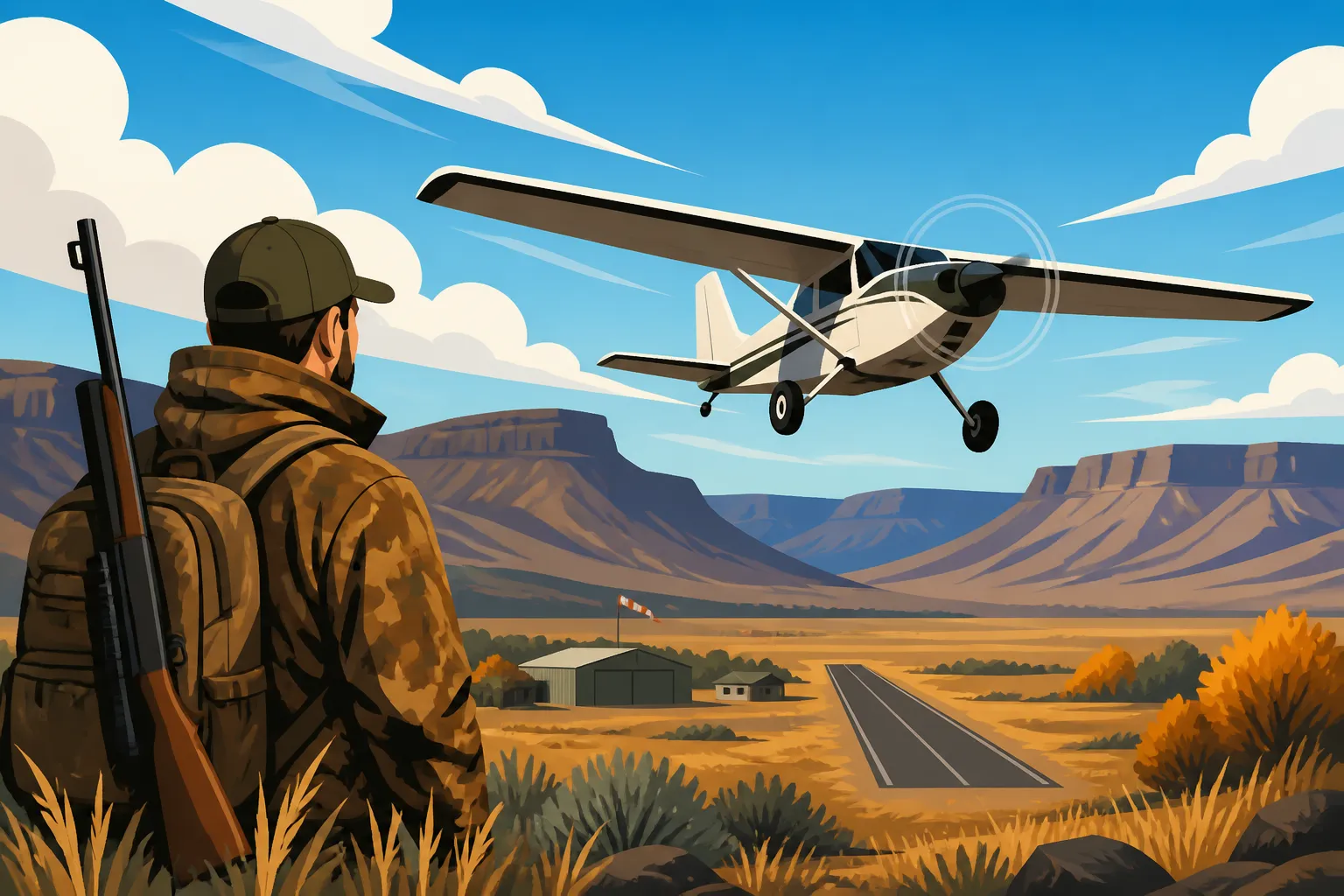
For more direct access, you’ll want to look at regional airports. Redmond (RDM), for instance, serves the Bend/Central Oregon area and is a fantastic gateway for hunts in the Ochoco, Maury, Paulina, or Fort Rock units. It has decent commercial service, typically requiring a connection from a larger hub, but the rental car options tend to be more robust than smaller regional fields. It puts you right on the edge of the high desert and closer to many Rocky Mountain elk and mule deer populations. For hunters targeting the Blue Mountains, airports like Pendleton (PDT) and La Grande (LGD) offer closer proximity. Pendleton has a few commercial flights daily, often connecting through Portland, while La Grande usually sees smaller, commuter-style flights. Baker City (BKE) and Ontario (ONT), near the Idaho border, are even smaller, with limited commercial service, if any, often catering more to private aircraft or charter services. However, if you're hunting nearby units like the Keating, Pine Creek, or Beulah, these small airports could be invaluable, cutting down hours of driving time. The trade-off is often fewer flight times, potentially higher costs, and a much more limited selection of rental vehicles or other services upon arrival. Researching these smaller options thoroughly can sometimes shave significant time off your trip, allowing you to get into the field faster. Before you commit, it's always wise to call ahead to these smaller FBOs (Fixed Base Operators) to understand what services are truly available.
Considering Your Destination Unit and Game
The choice of airport should directly correlate with your chosen hunting unit and the species you're pursuing. Are you drawing a coveted Oregon Pronghorn Controlled Hunts tag for the vast sagebrush flats of the Hart Mountain area? Redmond or even Boise, Idaho (a major regional hub just across the border), might make the most sense, despite being a few hours' drive. If you're chasing Rocky Mountain Elk in Eastern Oregon in the Wenaha or Sled Springs units up near the Washington border, flying into Spokane, Washington (GEG), might surprisingly be more practical than even Portland, followed by a 2-3 hour drive.
Conversely, if you've got a general season Oregon Buck Deer General Season Dates tag for a unit in the Ochoco National Forest, landing in Redmond puts you practically on the doorstep. For hunts deeper in the far southeastern corner of Oregon, near the Steens Mountain, you're looking at a serious drive from any commercial airport, even Redmond. In these scenarios, flying into a more central location like Redmond and then driving allows you to consolidate supplies and rental needs. It's really about balancing the time you save flying directly to a tiny airport with the potential headaches of limited ground transportation and services once you land. Sometimes, the slightly longer drive from a larger regional airport with better services ends up being less stressful overall. Leveraging tools for E-Scouting Oregon Units With Satellite Imagery can also help you pinpoint your exact hunting area and then work backward to determine the closest, most practical airport.
Navigating Gear and Logistics
Once you've narrowed down your airport choices, the next hurdle is figuring out how to get all your hunting gear, especially firearms and ammunition, from your home to Eastern Oregon. This is where meticulous planning and strict adherence to airline and TSA regulations become absolutely critical.
Firearm and Ammunition Transport Rules
Transporting firearms and ammunition on commercial flights requires careful attention to detail. First and foremost, always check your specific airline's current policies, as they can vary slightly and change without much notice. The general rule from the TSA is that firearms must be declared to the airline at the check-in counter and transported in a locked, hard-sided container as checked luggage. The case must be capable of being locked and can only be opened by you. A common mistake is using a soft case or one that isn't truly "hard-sided" enough to prevent manipulation when locked. It's also important that the firearm is unloaded.
Ammunition has its own set of rules. It generally must be transported in its original manufacturer's packaging or in a securely designed container that protects the cartridges from shock and accidental discharge. There are often weight limits (typically 11 pounds per passenger) and specific rules about how the ammunition can be packed – often not in the same case as the firearm. Some airlines prefer it separate, some allow it in the same locked case if properly packaged. Trying to sneak ammo through in a loose baggie or an unapproved container is a surefire way to get held up at the airport, or worse, have your ammunition confiscated. You'll need to allocate space in your regular checked bags for it. For those considering their ideal setup, knowing Rifle Choice for Oregon Elk and Deer or which Rifle Calibers That Suit Oregon Elk will influence how much ammo you need to carry. Always remember, declaring your firearm is not a suggestion; it's mandatory. Don't be shy about it, just be prepared and follow the rules precisely.
Luggage Limitations and Packing Strategies
Beyond your firearm, all your other hunting gear needs to fit within airline luggage limits, both in terms of weight and dimensions. This can be a real challenge for hunters who are used to simply throwing everything into the back of a truck. Standard checked bags are typically limited to 50 pounds, with additional fees for overweight bags. Oversized baggage, which might include things like large external frame packs or bow cases, also incurs extra charges.
Strategic packing is key. Think about versatile clothing layers to handle Oregon's unpredictable weather, rather than packing bulky, single-purpose items. Quality Rain Gear That Actually Stays Dry is non-negotiable for many parts of Oregon, but it can be surprisingly lightweight. Consider compressing items with vacuum bags or rolling clothes tightly. For items like sleeping bags, tents, or bulky camp supplies, evaluate whether it's more cost-effective to ship them ahead to your destination (perhaps to a local outfitter, lodge, or post office if available) or to buy them locally upon arrival. The cost of an extra checked bag or oversized fee can sometimes be comparable to shipping, but the convenience might be worth it. Also, consider investing in lighter-weight versions of essential gear, especially optics. A compact set of Optics for Dark Timber Versus Open Sage could save you precious pounds. Carefully laying out all your gear and making a strict packing list, then weighing each bag before you leave for the airport, will save you a lot of stress (and potentially money) at the check-in counter.
| Airport Code | Primary City Served | Common Hunt Regions Served | Typical Commercial Flights | Rental Car Availability |
|---|---|---|---|---|
| RDM | Redmond / Bend | Central Oregon, Ochocos, High Desert | Several daily connections | Good, but 4x4s limited |
| PDT | Pendleton | Blue Mountains, NE Oregon | Limited daily connections | Moderate, often sedans |
| LGD | La Grande | Wallowas, Blue Mountains | Commuter/regional only | Very limited |
| BKE | Baker City | Eagle Cap Wilderness, Elkhorn Mtns | Private/Charter focused | Extremely limited |
| ONT | Ontario | Malheur County, Idaho border | Limited, smaller aircraft | Limited |
| PDX | Portland | Statewide access point | Frequent, direct | Excellent, but long drive |
| GEG | Spokane, WA | Wallowas, NE Oregon (via drive) | Frequent, direct | Excellent |
Ground Transportation from the Airport
Once you've successfully landed and retrieved your bags and firearms, the next challenge is getting from the airport to your actual hunting grounds. This part of the journey can often be the most logistically complex, especially in rural Eastern Oregon.
Rental Vehicles and Hunter Needs
Renting a vehicle that's suitable for hunting in Eastern Oregon is paramount. A small sedan, while cheap, simply won't cut it for the vast majority of forest service roads, BLM routes, or private timberland access roads you'll encounter. You'll almost certainly need a high-clearance 4×4 truck or SUV, especially if you're venturing off pavement even slightly. The problem is, these types of vehicles are often in limited supply, particularly at smaller regional airports like Pendleton or La Grande. Even at Redmond, securing a true 4×4 pickup, rather than a front-wheel-drive SUV, requires booking far in advance, sometimes months out, especially during peak hunting seasons.
Expect to pay a premium for a 4×4, and be prepared for potential limitations on mileage or off-road use, depending on the rental agreement. Always check the fine print. When you pick up the vehicle, do a thorough walk-around and note any existing damage. You don't want to be held responsible for a scratch or dent you didn't cause on some remote logging road. Consider where your hunt takes you; if it's primarily Reading Green Roads on an Oregon Travel Management Map, a solid AWD might suffice, but if you're hitting gnarly two-tracks, a true 4×4 is essential. Factor in ample space for your gear, the possibility of packing out game meat, and potentially other hunters.
Alternative Transport for Remote Access
For hunters flying into very small, regional airports or those heading into particularly remote areas, traditional rental cars might not be an option, or they might be unsuitable. In such cases, you need to think creatively about your "last mile" transportation. Ride-sharing services like Uber or Lyft are virtually non-existent in much of rural Eastern Oregon. Shuttle services might exist to specific towns or resorts, but rarely directly to trailheads or forest camps.
This is where coordinating with an outfitter or a local contact becomes incredibly valuable. If you've booked a Hiring a Registered Oregon Hunting Guide, discuss airport pickup as part of your package. Many outfitters offer this service, saving you the headache of rental car logistics. If you're going DIY, consider connecting with local friends or family who live in the area, if that's an option. Otherwise, you might need to arrange for a pre-booked taxi or private shuttle service from the nearest town, understanding that these services will likely come at a higher cost. For hunts in truly roadless areas, even after driving to the trailhead, you'll still have to pack in. In those situations, exploring What It Costs to Hire a Packer With Stock or a drop camp service might be the final piece of the puzzle, getting you and your gear into the remote wilderness. Don't underestimate the distance and ruggedness once you leave paved roads; cell service often disappears, leaving you reliant on your detailed planning and backup communication methods.
Disclaimer
This article is for general informational purposes only and does not constitute professional advice. Laws, prices and regulations vary by location and change over time. Consult a qualified professional for guidance on your specific situation.