Optics for Dark Timber Versus Open Sage
Choosing the right optics for your Oregon hunt can feel like trying to solve a riddle, especially when you consider the state's incredibly diverse terrain. One moment you're peering into the deep, dark shadows of a dense Douglas fir forest, and the next you're squinting across miles of sun-drenched sagebrush. The frustration is real: gear optimized for one environment often fails miserably in the other, leaving you wondering if you need two complete setups. This guide is here to help you navigate those choices, ensuring your optics enhance, rather than hinder, your hunting success, whether you're chasing elk in the Coast Range or mule deer in the high desert.
The Unique Demands of Dark Timber Hunting Optics
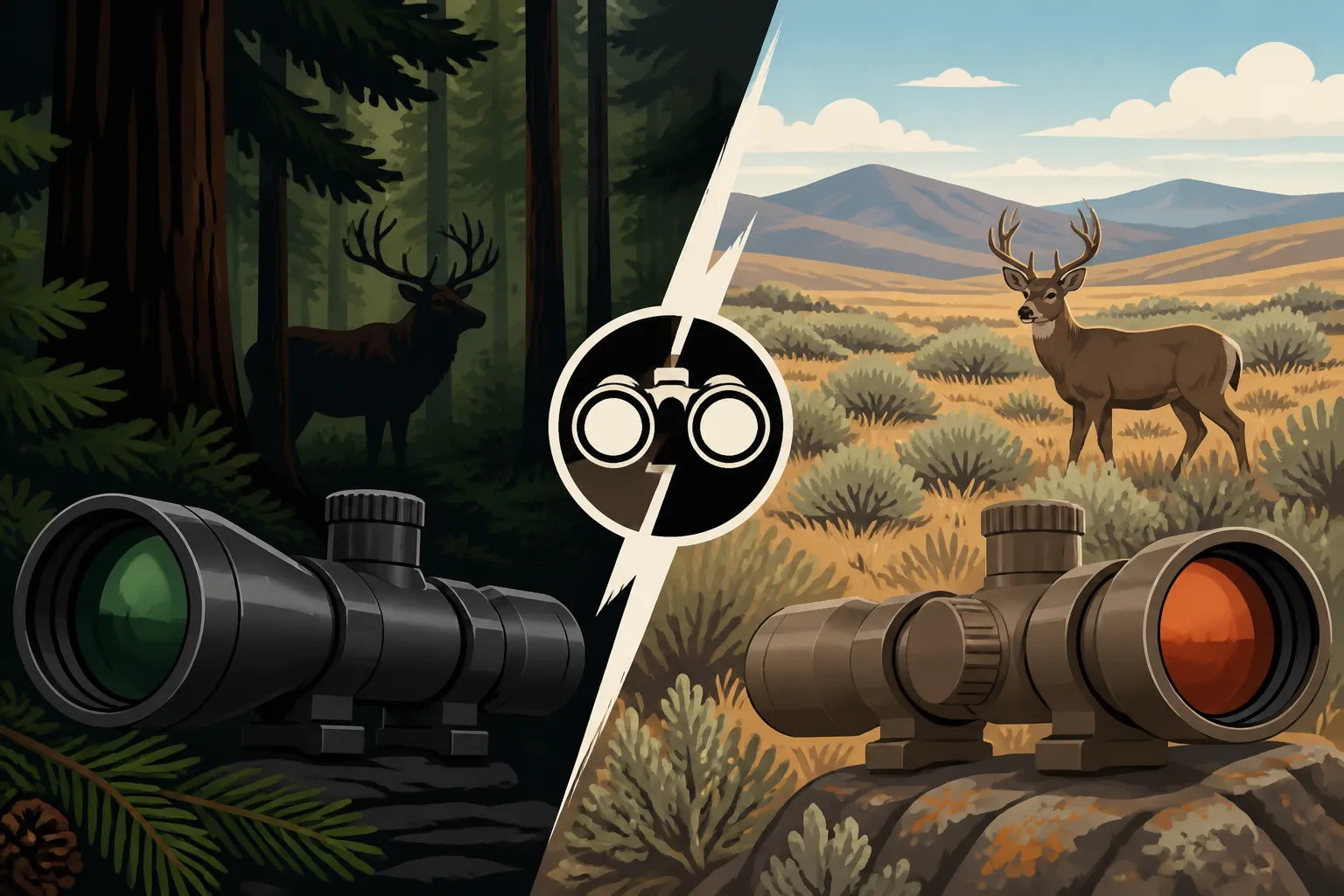
Hunting in Oregon's dark timber, whether it's the towering rainforests of the Coast Range or the thick conifer stands of the Cascades, presents a specific set of optical challenges. Light is scarce, visibility is limited, and opportunities can arise and vanish in mere seconds. Your optics need to be designed to perform under these dim, often wet, conditions.
Prioritizing Light Gathering and Exit Pupil
In the perpetual twilight of dark timber, your number one priority for optics should be their ability to gather as much available light as possible. This isn't just about objective lens size, though that's a big part of it. It's about how efficiently the light passes through the entire optical system to your eye. When you're trying to pick out the dark outline of a bull elk against an equally dark background just before legal shooting light ends, or even at high noon under a dense canopy, superior light transmission is paramount.
Binoculars in the 8×42 to 10×50 range are often ideal for timber. The larger objective lens (the "42" or "50") collects more light, and when combined with a reasonable magnification, it creates a larger "exit pupil." The exit pupil is the little circle of light you see when you hold the binoculars away from your eyes. A larger exit pupil, generally 5mm or more, allows your eye's pupil to receive more light, making the image appear brighter in low-light conditions. You'll truly appreciate this when you're trying to discern a branch from an antler tine while you're Still-Hunting Blacktails in Wet Oregon Coastal Brush or trying to get a read on a bull that’s just stepped out into a small opening in the deep canyons. Forget trying to make out details with cheap, small-objective glass here; you'll just be frustrated.
Magnification and Field of View in Tight Spaces
It's a common misconception that more magnification is always better. In dark timber, too much magnification is actually a significant liability. When an elk or deer appears suddenly at 30 yards in dense cover, you need to acquire that animal instantly. A high-power binocular or riflescope will give you such a narrow field of view that you might struggle to even find the animal, let alone track its movement or assess its size. Imagine a bull ghosting through a thick patch of vine maple and trying to find him in a 15x power binocular – it’s nearly impossible.
For binoculars, an 8x or 10x magnification offers a much wider field of view, allowing you to scan broader areas and quickly locate animals that might only present themselves for a moment. For riflescopes, a 1-6x, 2-10x, or even a classic 3-9x variable power scope is perfect. You can dial it down to its lowest setting for close-range, quick target acquisition, and then bump it up slightly if a shot presents itself at a slightly longer distance or in a clearer lane. The key is balance: enough magnification to make a precise shot, but not so much that you lose the ability to see what's happening around your target. This philosophy often plays a crucial role in How Close You Can Get in Coastal Timber before spooking game.
Durability and Waterproofing for Wet Environments
Oregon's timber country, especially on the west side, is synonymous with moisture. Rain, fog, dripping trees, and damp undergrowth are the norm, not the exception. Your optics absolutely must be fully waterproof and fog-proof. There's nothing more disheartening than having your lenses fog up internally just as a Roosevelt elk steps into view during a November rifle season. Most quality modern optics are nitrogen or argon purged to prevent internal fogging, but don't skimp here.
Look for optics with robust, rubber-armored exteriors. This not only provides a better grip when your hands are cold and wet but also offers crucial protection against bumps and drops that are inevitable when hiking through rough terrain. Brands like Leupold, Vortex, and Maven generally offer excellent weather sealing and durability that can stand up to the rigors of an Oregon timber hunt. Investing in a good set of lens caps and a durable harness for your binoculars will also go a long way in protecting your investment and keeping your lenses clear. This often ties into your overall Archery Setup for Wet Oregon Timber, where every piece of gear needs to perform flawlessly in damp conditions.
Optics for Expansive Open Sage Country
Contrastingly, hunting in Eastern Oregon's vast sagebrush flats, rimrock canyons, and juniper-dotted hills demands a completely different optical strategy. Here, you're often glassing for miles, trying to locate a patch of hide or an antler tine on a distant hillside. The challenges are not about cutting through gloom but about resolving detail at extreme distances under varying light conditions, often with significant heat shimmer.
High Magnification for Long-Range Observation
When you're perched on a ridge overlooking an enormous basin in the Steens Mountain country, you need optics that can bring distant objects into sharp focus. This is where higher magnification truly shines. For binoculars, 10x42s are a solid starting point, but many serious Eastern Oregon hunters opt for 10×50, 12×50, or even 15×56 binoculars. These allow you to pick apart distant hillsides, identifying subtle movements or shapes that indicate the presence of mule deer or pronghorn.
Even more critical in open country is a quality spotting scope. A 65mm or 85mm objective spotting scope with 20-60x or 25-75x magnification becomes an indispensable tool for confirming species, judging antler size, and even counting points on a buck that might be a mile or more away. Companies like Swarovski, Zeiss, Kowa, and Vortex produce exceptional spotting scopes that offer the clarity and resolution needed to make those critical decisions from afar. This intensive glassing is foundational to Glassing Eastern Oregon Rimrock for Mule Deer and can make or break your hunt.
Clarity and Resolution Across Distances
In open country, the air itself can become a factor. Heat waves, or mirage, can distort images, especially on warm, sunny days. This is where the quality of the glass and the advanced coatings on the lenses truly pay off. Premium optics use ED (Extra-low Dispersion) or HD (High Definition) glass elements that reduce chromatic aberration (color fringing) and provide a crisper, truer-to-life image. Fully multi-coated lenses maximize light transmission and reduce glare, which is crucial when the sun is reflecting off rock and sage.
The ability to resolve fine detail – distinguishing a branch from an antler, or spotting a slight movement that indicates an animal feeding – at extreme ranges is a testament to superior optical clarity. You might spend hours behind your glass, and eye fatigue from poor quality optics can significantly reduce your effectiveness. Paying for better glass means less eye strain and more confident identification of game. When you're spending days trying to locate a trophy buck, every bit of clarity counts, especially when you are Glassing Rimrock at First Light.
Weight and Tripod Compatibility
While you need powerful optics for open country, weight is still a consideration, especially if you plan to cover a lot of ground on foot. There's always a trade-off between optical performance (which often means larger lenses and more robust construction) and portability. However, for serious glassing sessions, a good, stable tripod is non-negotiable for any high-magnification binocular (10x and up) and certainly for any spotting scope. Trying to hand-hold 12x or 15x binoculars for more than a few minutes is a recipe for shaky images and extreme eye fatigue.
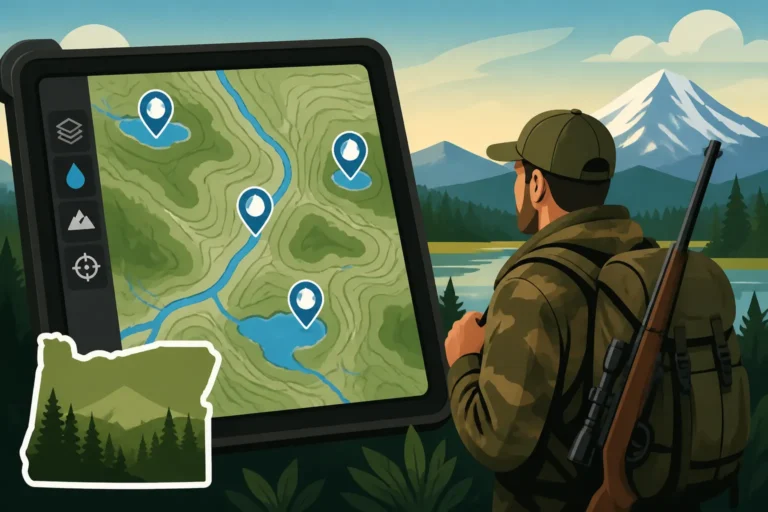
A lightweight yet sturdy tripod, paired with a solid binocular adapter or a spotting scope head, allows you to comfortably glass for extended periods, reducing fatigue and allowing you to pick up subtle details that would be missed with a shaky image. This setup is crucial for effective long-range glassing, whether you're covering vast expanses or trying to pinpoint specific features using mapping tools like those found on GoHunt.
Bridging the Gap: Versatile Options and Key Considerations
While specialized optics offer peak performance in their respective domains, many hunters need gear that can perform reasonably well across Oregon's varied landscapes. It’s not always feasible or financially viable to own two full sets of top-tier optics.
Variable Power and Crossover Capabilities
A good variable power riflescope is often the best compromise for hunters who traverse both dark timber and open country. A scope like a 2.5-15×44 or 3-18×50 can be dialed down for wide field-of-view and bright low-light performance in the timber, and then cranked up for longer shots or detailed viewing in the open. Similarly, a 10×42 binocular is often considered a "do-it-all" option, offering a good balance of light-gathering, magnification, and field of view for most scenarios. It might not be as bright as a 10×50 in deep timber, nor as powerful as a 12x or 15x in wide-open sage, but it will perform adequately in both.
When considering a crossover rifle scope, pay attention to the eye relief and eye box at different magnifications. Some scopes become finicky at their highest powers, making quick target acquisition difficult. A generous, consistent eye box across the magnification range is a huge advantage, especially when you're quickly shouldering your rifle in an unexpected encounter. This versatility can be a game-changer when you're hunting in units that transition from dense forest to open clearcuts, a common scenario for Oregon Elk Hunting Tactics for the November Rifle Seasons.
Understanding Glass Quality and Coatings
Regardless of the environment, the underlying quality of the glass and its coatings remains the single most important factor. You can have the perfect magnification and objective size, but if the glass is poor, the image will be dim, fuzzy, or riddled with aberrations. Always look for "fully multi-coated" optics, meaning all air-to-glass surfaces have multiple layers of anti-reflective coatings. This maximizes light transmission and enhances contrast and color fidelity.
Premium glass, often referred to as ED, HD, or APO (apochromatic), takes this a step further by using specialized elements to correct color fringing and improve sharpness. While these come at a higher price point, the difference in clarity, brightness, and resolution, especially in challenging light, is undeniable. When you're Hunting a Recent Burn for Elk, cutting through the smoke haze or spotting an animal against a charred backdrop, the quality of your glass will truly shine. Popular brands known for their optical excellence include Swarovski, Leica, Zeiss, and even more accessible options like Vortex, Leupold, and Maven, which often deliver exceptional value for their price.
The Role of Rangefinders
No matter where you hunt in Oregon, a reliable rangefinder is an essential piece of equipment. In open sage, judging distances can be incredibly deceptive due to the lack of reference points, and a rangefinder is crucial for making ethical, accurate shots. In the timber, while shots are generally closer, understanding the exact distance through brush or knowing how a steep angle affects bullet drop can be the difference between a clean kill and a missed opportunity.
Many hunters opt for standalone rangefinders, while others prefer the convenience of rangefinding binoculars (often called "bino-rangefinders"). Brands like Leupold, Vortex, and Sig Sauer offer excellent bino-rangefinder options that combine two essential tools into one, reducing bulk and improving efficiency. When planning your hunt, consider using tools like GoHunt that integrate mapping with rangefinding capabilities, helping you visualize shot opportunities and plan your stalks more effectively. Understanding how to use your Rangefinders in Steep Country is a skill worth practicing before opening day.
| Feature / Environment | Dark Timber Hunting | Open Sage Hunting | Versatile Crossover |
|---|---|---|---|
| Binoculars | 8×42, 10×42 (large exit pupil, wider FOV) | 10×42, 12×50, 15×56 (higher magnification, fine detail) | 10×42 (good balance of light & power) |
| Riflescopes | 1-6x, 2-10x, 3-9x (low end for quick target, generous eye box) | 3-15x, 4-16x, 5-25x (high magnification for precision at range) | 2.5-15x, 3-18x (wide variable range) |
| Spotting Scope | Generally not essential (limited use) | Highly recommended (20-60x, 65-85mm objective) | Not typically primary crossover gear |
| Key Priority | Low-light performance, wide field of view, weatherproofing | High resolution, magnification at distance, cutting mirage | Adaptability, good glass quality |
| Essential Accessory | Lens covers, rain gear, bino harness | Tripod, sun shade, wind meter | Rangefinder, protective covers |
Disclaimer
Hunting laws and regulations in Oregon are subject to change. Always consult the official Oregon Department of Fish and Wildlife (ODFW) regulations before planning any hunt.