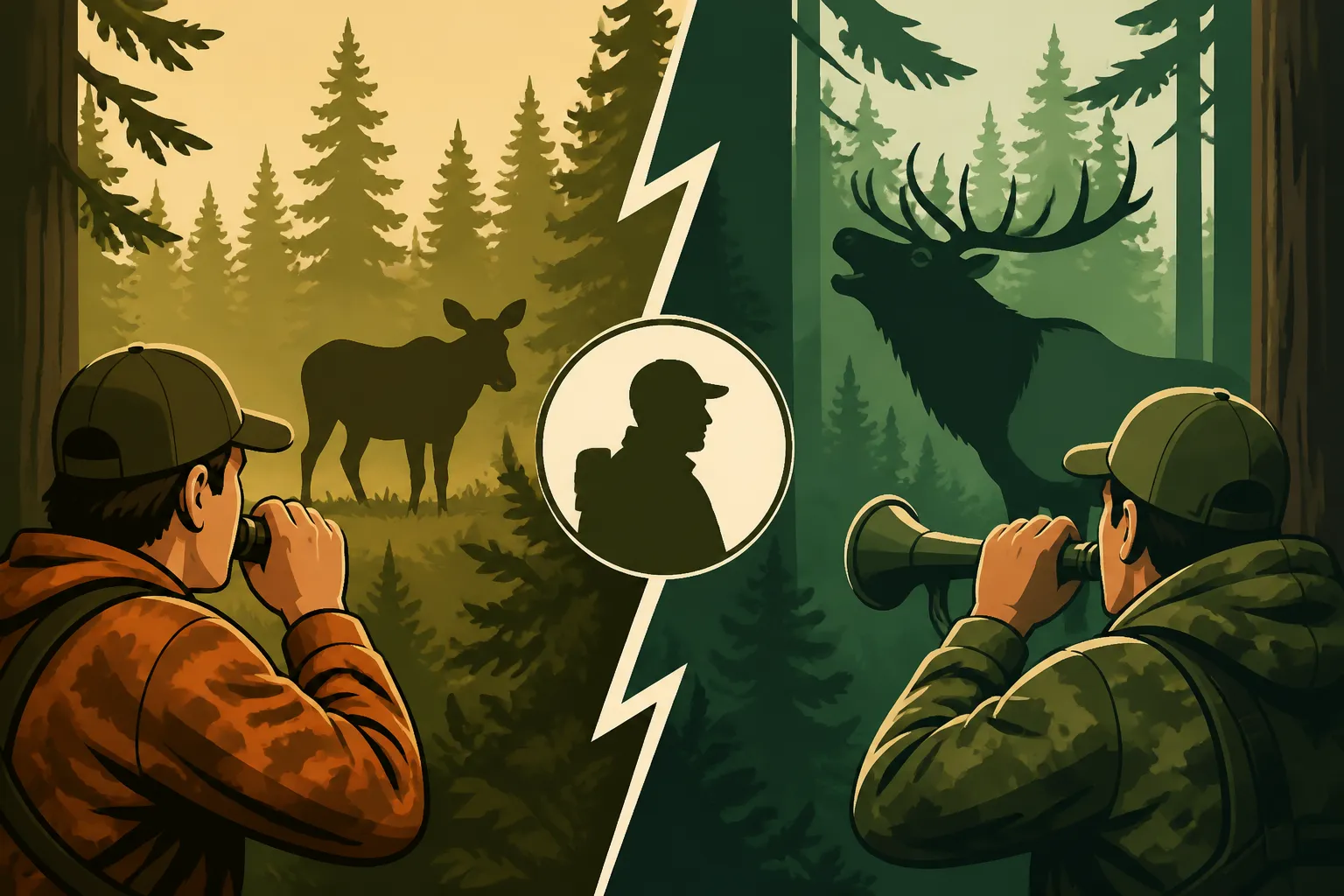
Cow Calling Versus Bugling in Heavy Timber
There's nothing quite as frustrating as stepping into that thick, dark timber, full of hope, only to have your carefully planned calling sequence disappear into the canopy without a peep from an elk. It's a common dilemma, feeling like your calls are either too aggressive or not aggressive enough, and knowing when to use a soft cow call versus a roaring bugle can make or break your hunt in Oregon's dense forests. This guide is here to unravel the mysteries of effective elk calling in heavy timber, helping you understand how to communicate with these magnificent animals when visibility and sound transmission are at their most challenging.
Understanding the Timber's Challenge for Elk Calling
Hunting elk in heavy timber presents a unique set of obstacles that hunters need to understand and respect. The dense foliage, undulating terrain, and constant dampness characteristic of much of Oregon's elk habitat fundamentally change how sound travels and how elk perceive their environment. It’s not like calling across open sagebrush where sounds carry for miles. Here, every decision about your call, its volume, and its frequency is amplified in importance.
Sound Travel and Attenuation
In a dense forest, sound doesn't travel the way it does in open country. The endless layers of trees, brush, and uneven ground absorb and deflect sound waves, causing them to "attenuate" or diminish rapidly. This means your bugle that might echo for a mile in Eastern Oregon's high desert might only carry a few hundred yards, if that, in the thick timber of the Coast Range or Cascades. The dampness, especially prevalent during Western Oregon's archery and rifle seasons, can further dampen sound, creating an almost suffocating acoustic environment where subtle calls are easily lost. Hunters often overestimate how far their calls are reaching, leading to frustration when elk don't respond from distances they might in other habitats.
It's not just about distance; it's about directionality too. Sound can bounce off ridge lines, get muffled by deep draws, or simply get swallowed by a patch of particularly thick firs. This makes pinpointing an elk's location, or even determining if a response came from a bull or a cow, incredibly difficult. You might hear a faint chuckle that sounds directly in front of you, only to find the elk was actually a hundred yards to your left, in a dip in the terrain. This auditory deception makes relying solely on sound problematic and forces a different approach to calling than what might work in more open areas. The sheer density also means that what might be a loud, attention-grabbing bugle in one spot, could sound like a tiny chirp just a short distance away to an elk.
Visual Limitations and Close Encounters
Heavy timber severely restricts visibility, often limiting your sightlines to mere yards. This isn't just a challenge for spotting elk; it’s a massive factor in how you set up your calling sequences and anticipate elk reactions. When you're calling blind, you're always operating with a degree of uncertainty. An elk could be 50 yards away and you'd never know until it steps out. This dynamic necessitates a "ready for anything" mindset, as close encounters are far more common and sudden in the timber than in open country.
This lack of visibility makes setting up a shooter and caller strategically even more critical. You need to consider escape routes, shooting lanes (however narrow), and background safety before you even make a sound. Often, the ideal setup involves the shooter positioned slightly ahead and to the side of the caller, allowing the shooter to have a better angle on an approaching elk that is focused on the sounds of the caller. The surprise factor is huge; an elk could appear silently, almost magically, from behind a veil of ferns or a cluster of blowdown, requiring instant readiness. This environment often rewards patience and a slower approach, rather than aggressive, loud calling designed to bring an elk in from afar.
Elk Movement Patterns in Heavy Timber
Elk navigate dense timber with an incredible stealth that often surprises new hunters. Unlike deer, who might crash through brush, elk can ghost through the thickest cover almost silently, especially when they are suspicious or approaching cautiously. Their movements are often dictated by subtle changes in topography, faint game trails, and the wind, making them incredibly difficult to predict. In heavy timber, elk often move slower, taking advantage of every bit of cover, making them harder to pinpoint even when they are vocal.
They also tend to feel safer in thick timber, using it as bedding areas during the day and often feeding in pockets of denser cover, especially if hunting pressure is high. This means that when you're calling, you're often calling into their sanctuary. They might not be in a hurry to leave it, or they might be extremely cautious about approaching an unknown sound. Understanding that elk use timber for security changes your calling strategy; you're not just trying to attract them, you're trying to make them feel safe enough to reveal themselves or move towards you. Their inherent wariness in these secure zones means your calling needs to be authentic and unthreatening to be effective.
The Art of Cow Calling in Close Quarters
When you're trying to entice an Oregon bull out of his cozy, dark timber hidey-hole, sometimes the most aggressive bugle is actually counterproductive. Think about it: a raging bull blast might just confirm his suspicions that there's another bull looking for a fight, and if he's feeling safe and secure in his timber haven, he might decide it's not worth the risk. This is where the subtle, yet incredibly powerful, language of cow calls shines. It taps into a different instinct altogether, one of curiosity, companionship, or even an urge to breed, making it a hero move when you're in close quarters.
Mastering the Basic Cow Mews and Chirps
The foundational building blocks of effective cow calling are the basic mews and chirps. These are the everyday sounds of a contented herd, the little "chups" and "mews" that cows use to communicate with their calves and each other. They're non-threatening, natural, and incredibly effective at sparking curiosity in a bull, or even another cow. Your goal isn't to blast these out; it's to create the illusion of a small, relaxed group of elk going about their business.
Start with soft, single mews. Practice making them sound like an actual cow, with a slight nasal quality and a natural start and end. Avoid making them too sharp or too loud. Think of the sound a cow might make when she's simply letting her presence be known to her calf nearby. Interject a few short, soft chirps—these are often used by cows to locate each other in dense cover or when a calf is searching for its mother. Vary your sequence: a mew, a pause, two chirps, a longer pause, another mew. Don't overdo it. In the quiet of the timber, these subtle sounds can travel farther than you might think, and more importantly, they sound incredibly authentic. Remember, you're trying to paint a picture with sound, and an authentic, relaxed picture is often the most inviting for a wary bull.
Using Estrus Whines to Draw Bulls
Once you've established some basic cow sounds, you can introduce the estrus whine—a more urgent, pleading sound that signals a cow in heat. This call is a direct appeal to a bull's breeding instinct and can be incredibly potent, especially during the peak of the rut in Oregon. However, it's a call to be used judiciously, as it can also attract other bulls or even put off a dominant bull if he perceives you as a subordinate challenge.
An estrus whine is typically a longer, more drawn-out sound than a basic mew, often with a slight rise and fall in pitch, ending with a breathy quality. It conveys longing and availability. When using it in heavy timber, keep the volume moderate. You're not trying to shout your availability across a canyon; you're trying to sound like a cow just out of sight, yearning for a bull. Combine it with some soft mews to make it sound like a real cow preparing for or in the midst of estrus. A common sequence might be a few soft mews, followed by a subtle estrus whine, then another pause. This can be especially effective when you suspect there's a bull nearby who might be "locked up" with his cows but could be tempted by a new, receptive cow.
Situational Cow Calling: Feeding, Lost, and Contentment Calls
Beyond the basic mews and estrus whines, mastering a range of situational cow calls can elevate your success significantly. Elk are complex social animals, and their vocalizations reflect a wide array of emotions and situations. By mimicking these, you can create a more believable scenario and appeal to different aspects of an elk's behavior.
- Feeding Calls: These are soft, almost guttural grunts or murmurs that cows make while feeding contentedly. They convey safety and a lack of threat. In thick timber, where visibility is low, these calls can be incredibly effective. Make soft "urrps" or "chuff-chuff" sounds. Combine them with the sound of breaking twigs or rustling leaves (which you can often do with your foot or a stick) to simulate a feeding elk. This can bring a bull in close, thinking he's just stumbling upon a peaceful meal.
- Lost or Calf Calls: A series of slightly more urgent, plaintive mews can mimic a lost calf or a cow searching for its herd. This plays on a bull's protective instincts or general social curiosity. These calls are a bit louder and more insistent than contentment mews, with a slight rise in pitch at the end. An old bull, especially, might respond to a lost calf call, sometimes even letting out a soft grunt in response.
- Contentment Calls: These are the softest, most relaxed mews and chirps, almost whispers. They suggest a completely unthreatened animal. Use these sparingly, almost as background noise, to create an atmosphere of calm. They're great for setting up an ambush or encouraging a bull that's "hung up" to take those last few steps into view.
The key to all these situational calls is realism and subtlety. In heavy timber, being too loud or too aggressive with any cow call can break the illusion you're trying to create, or worse, sound unnatural and spook an alert elk.
When and How to Bugle in Dense Cover
While cow calls are your bread and butter in tight timber, there are definitely times when a bugle is the right tool for the job. Knowing when to uncork a bugle and, more importantly, how to do it effectively in a sound-muffling environment is crucial. It’s not about screaming at the top of your lungs; it’s about strategic communication that leverages the timber, rather than fights against it.
Soft Bugles and Grunts: The Subtle Approach
Forget the ear-splitting, canyon-echoing bugles you see on TV for open country. In heavy timber, a soft, subtle bugle, often paired with grunts, is your most potent weapon. These aren't challenge bugles; they're locator calls, or sounds a bull makes when he's just cruising, letting his presence be known to cows, or maybe checking in with a satellite bull. They're less aggressive and more inquisitive.
A soft bugle can be a short, low-volume "eep" sound, or a series of quiet grunts that trail off. Think of a bull waking up from his bed, letting out a soft sound as he stretches. It might just be a "chuckle" or a "growl" that an elk makes when it's moving through the woods. These sounds don't travel far, but that's the point – they indicate close proximity. If you hear a distant bull, a soft bugle in response can pique his interest without spooking him or announcing your precise location to every elk in the drainage. You're trying to mimic a bull that's simply being present, not necessarily looking for a fight. This approach is particularly useful in areas with high hunting pressure, where bulls are often more cautious.
Challenging Bugles: Knowing When to Be Aggressive
There are moments in the timber when you do need to challenge a bull, but even then, it's often a calculated risk. A full-on, screaming bugle should be reserved for specific situations: when a bull has already responded aggressively, when you know his location precisely, or when you're trying to break up a herd. The goal isn't just to make noise, but to evoke a specific response.
If a bull is bugling consistently and seems responsive, but won't commit, a well-timed, slightly aggressive bugle can often be the catalyst. This might involve a slightly louder, more drawn-out bugle, perhaps with some "chuckles" and "grunts" at the end, mimicking a bull getting fired up. Crucially, position your shooter in a good spot before you make this call, as it can cause a bull to charge in or swing wide. Pay close attention to his response. If he comes in silent, or circles, he's probably cautious. If he immediately fires back with a hot, aggressive bugle, you know you've got his attention and he's ready to engage. This is where having a good understanding of Setting Up a Caller and Shooter on a Bull really comes into play. Never challenge a bull you don't intend to engage, as you might run him off for good.
Locating Bugles and Herd Dynamics
Locator bugles are your sonar in the timber. These are quick, sharp bugles designed to provoke a response without committing you to a full-blown calling sequence. Often, a single, moderately loud bugle, followed by silence, is enough. You're not looking for a conversation; you're looking for an answer. This is especially useful when you're still-hunting or moving through dense areas, trying to pinpoint where elk might be bedded.
Consider the dynamics of the herd you're trying to locate. If you hear a single bull bugling, it might be a lone bull, or the herd bull trying to keep his cows together. If you hear multiple bugles, you might be near a larger herd with satellite bulls. Your bugle can often get cows to mew or calves to chirp, which gives you even more clues about herd size and composition. When using a locator bugle, always be ready for an immediate response. Bulls can sometimes be right on top of you, seemingly appearing out of nowhere. It's also worth noting that in certain areas, particularly with Roosevelt elk, you might encounter situations where Why Roosevelt Bulls Bugle Less Than Rocky Mountain Bulls, making cow calls even more critical.
Reading Elk Behavior and Adapting Your Calls
The timber is a dynamic environment, and elk are constantly communicating, even if it's not always with loud vocalizations. Being successful in calling these magnificent animals in close quarters requires more than just making the right sounds; it demands an acute ability to read their subtle cues and adapt your strategy on the fly. It's like a nuanced conversation where you're not just speaking, but truly listening and adjusting your tone.
Interpreting Silence and Vocalizations
One of the hardest things for a new elk caller to grasp in heavy timber is how to interpret silence. It's tempting to think that if an elk isn't bugling or mewing back, there's no elk around. This couldn't be further from the truth. Often, silence is an indicator of an approaching animal, especially a wise old bull that has learned to be cautious. An elk might come in completely silent, trying to pinpoint the source of your calls without giving away its own position.
On the flip side, interpreting vocalizations isn't always straightforward either. A soft chuckle might mean a bull is content, or it could be a sign of a bull cautiously moving towards you. A cow mew could be a genuine response, or it could be a warning call. The key is to listen to the cadence, the tone, and the frequency of the sounds. Are they getting closer? Do they sound more urgent or more relaxed? Are there subtle sounds of movement accompanying the calls, like snapping twigs or rustling leaves? Integrating tools like the hunting maps from GoHunt can help you analyze terrain and wind directions which influence how an elk might approach, helping you interpret those subtle sounds in context. Remember to keep the wind in mind; a silent approach often means the elk is trying to get downwind of you to catch your scent.
Body Language and Responses to Calling
Once an elk does decide to show itself, even fleetingly, its body language is a goldmine of information. Since visibility is so limited in the timber, you might only get a glimpse, so make it count. Is the elk facing directly towards you, with ears swiveled, trying to locate the sound? Is it pacing back and forth, indicating nervousness or indecision? Is its head high, looking over obstacles, or is it sneaking low through the brush?
A bull that steps out, even for a moment, and then disappears, might be circling downwind. This is a classic elk maneuver that hunters often miss. If you see this, be prepared to reposition quickly, as they will try to get your scent. If an elk stops and rakes a tree, it's a sign of aggression and interest, indicating it's still engaged. If it just stares intently, then slowly turns and walks away, it's likely losing interest or has figured something out. Being able to read these subtle cues, even if it's just a flicker of movement or a brief glance, allows you to adjust your calling to either increase the intensity, back off to build curiosity, or reposition for a shot.
Adjusting Strategy Based on Elk Mood
Elk have moods, just like people, and your calling strategy needs to reflect that. An aggressive bugle that works on a hot bull in one situation might send a more wary bull fleeing in another. This adaptability is paramount in timber hunting, where you can't see the elk's initial reaction from a distance.
- Hot & Responsive: If a bull is bugling back consistently and seems eager to engage, maintain a lively conversation. Use a mix of cow calls and moderate bugles, perhaps even raking a tree to simulate a rival bull. Keep him talking and moving towards you.
- Hung Up & Hesitant: If a bull stops responding or gets "hung up" just out of sight, switch to softer, more seductive cow calls, or even go silent for a while. Sometimes, leaving him wondering is the best tactic. A slow, quiet mew or an estrus whine might be enough to coax him the last few yards. This is where patience is truly a virtue, as pushing too hard will almost always send him running.
- Wary & Silent: If you suspect an elk is present but completely silent, lean heavily on soft cow mews and feeding sounds. Create the illusion of a peaceful, unaware herd. Stay still, keep the wind in your favor, and let curiosity slowly draw him in. A well-placed How Close You Can Get in Coastal Timber can dictate the whole setup.
The ability to quickly assess the elk's mood and adjust your calling accordingly is a skill that only comes with experience, but consciously thinking about it will speed up your learning curve.
Gear and Tactics for Effective Timber Calling
Success in heavy timber isn't just about knowing what calls to make, but also how to make them count. The right gear and a solid understanding of tactical setups can turn close encounters into opportunities. Oregon's timber is unforgiving, so preparation is key.
Selecting the Right Calls for Close-Range
When you're calling in heavy timber, your choice of call matters. While diaphragm calls are versatile, they can be tough for beginners. External reed calls or bugle tubes with specific features for timber calling often prove more user-friendly and effective.
- Diaphragm Calls: These are great for realism and versatility, allowing for a wide range of cow and bull sounds without moving your hands. For timber, practice making soft mews and chirps, as well as subtle grunts and chuckles. The ability to make sounds without large movements is invaluable when an elk is within sight.
- External Reed Calls: Often called "mouth reeds" or "bite calls," these are excellent for producing realistic cow sounds, especially estrus whines and mews. They are generally easier to learn than diaphragms and can be operated with minimal hand movement. Look for calls designed for softer, more subtle tones.
- Bugle Tubes: For bugling in timber, choose a shorter, more compact bugle tube. These often produce a less piercing, more muffled sound, which is exactly what you want. Some tubes have a fabric cover to help dampen sound, or internal baffles to create a more realistic, throaty sound that doesn't carry too far. Practice soft grunts and chuckles through the tube, not just loud bugles.
- Locator Calls: A small, compact locator call, often a grunt tube or a short bugle, can be very useful for quick, non-committal sounds to pinpoint elk. Remember, the goal is not to impress but to provoke a response.
Ultimately, the "right" call is the one you can operate most realistically and consistently at varying volumes. Always carry a couple of different types to adapt to changing situations and elk moods.
Caller and Shooter Setup in Dense Cover
The setup of your calling team in dense timber is absolutely critical, and it's where many hunts fall apart. With limited visibility, an elk can appear silently and be on top of you before you realize it. The classic setup involves the caller positioned 30-50 yards behind and slightly to the side of the shooter.
- The Shooter's Role: The shooter needs to be in a position with shooting lanes, even if they are narrow, and with a clear line of sight where an elk is most likely to appear. They should be focused solely on scanning for movement and getting ready for a shot. Their job is not to call, but to be absolutely ready. Consider natural obstacles the elk might use for cover, and position yourself to intercept them.
- The Caller's Role: The caller's job is to create the illusion that the sounds are coming from an actual elk. Being behind the shooter helps draw the elk's attention past the shooter's position, focusing on the source of the sound. This often gives the shooter precious extra seconds to get a clean shot. The caller should also be aware of potential escape routes for the elk and be ready to adapt. The terrain in Oregon's timber can be steep and rugged, so picking a setup spot that offers good concealment for both parties, while also providing decent visibility (as much as the timber allows) for the shooter, is paramount. This strategic positioning is a core component of Calling Bull Elk During Oregon's Archery Season.
- Solo Hunter Tactics: If you're hunting solo, the challenge is even greater. You need to call, drop your call, and be ready to shoot instantly. In this scenario, patience is your best friend. Make a few soft calls, then wait, silently, for an extended period. Use natural cover to your advantage, and always be prepared for a close-range shot as the elk might try to pinpoint the source of the sound. A good resource for solo hunting considerations is Archery Setup for Wet Oregon Timber, which offers insights into dealing with the challenging environment alone.
Understanding Wind and Thermals in the Timber
Ignoring wind and thermals in heavy timber is a sure-fire way to get busted. Elk rely heavily on their sense of smell, and they will almost always try to circle downwind of a perceived threat or potential mate to get a whiff. In timber, wind can be notoriously unpredictable, swirling and eddying due to the broken terrain and dense canopy.
- Constant Monitoring: Always carry a wind checker (a small squeeze bottle with powder or a piece of light string). Use it constantly, checking not just the general wind direction, but also subtle shifts and eddies at different elevations. What the wind is doing at ground level might be different than 20 feet up.
- Anticipate the Circle: Assume any approaching elk will try to get downwind of your calling position. When setting up, position yourself and your shooter to intercept the elk before it gets to your scent cone. This often means calling from an advantageous position (e.g., on a bench, or at the edge of a small clearing) where you can see a broader area.
- Thermals and Time of Day: Thermals are air currents created by temperature changes. In the morning, as the sun heats the ground, thermals rise. In the evening, as the air cools, thermals fall. This means scents will generally rise uphill in the morning and fall downhill in the evening. Understanding these patterns is crucial, especially when setting up for a morning or evening hunt. If you're calling uphill in the morning, your scent is rising and less likely to blow down to an elk below. Conversely, in the evening, your scent will fall, so being above the elk you're calling is advantageous. Using mapping applications with detailed topographical lines can help you visualize these thermal currents.
Common Mistakes and How to Avoid Them in the Timber
Even the most experienced elk hunters can make mistakes in the heat of the moment, especially when faced with the unique challenges of heavy timber. Understanding these common pitfalls and actively working to avoid them can dramatically increase your success rate. It's often the little things that make the biggest difference.
Over-Calling and Under-Calling Pitfalls
Finding the right balance in your calling frequency and volume is an art form in itself. In heavy timber, both over-calling and under-calling can be detrimental.
- Over-Calling: This is perhaps the most common mistake. Hunters get excited, and they blast calls too often and too loudly. In dense timber, this can sound unnatural, like an agitated or overly aggressive animal. An elk might perceive this as a threat and disappear, or simply dismiss it as not genuine. It can also give away your exact location too quickly, allowing a wise bull to circle downwind and bust you.
- Solution: Practice patience. Make a few soft calls (cow mews, chirps, or soft grunts), then shut up and listen for a good 5-10 minutes. Let the woods "breathe." Elk have excellent hearing; they don't need a constant barrage of sound. Let curiosity build. If nothing responds, move 100-200 yards and try again, changing your call sequence or type.
- Under-Calling: While less common, under-calling can also be an issue. If you're too subtle or don't call enough, an elk that's just out of earshot might never hear you, or might lose interest if your "conversation" dies out too quickly. You need to project enough to cut through the timber, but not so much that it's overwhelming.
- Solution: If you're confident there are elk nearby and you're not getting a response, try increasing the volume slightly or adding a little more urgency to your cow calls (like a lost calf call). Vary your calls to keep the elk engaged, but always with a pause in between to listen. Sometimes, a subtle change in call type (from cow to a soft bugle, or vice-versa) is all it takes to get a hung-up bull to commit.
Improper Setup and Wind Awareness
As discussed earlier, proper setup is critical. Improper setup is a primary reason hunters get busted. This includes everything from poor concealment to neglecting the wind.
- Poor Concealment: In heavy timber, you need to be invisible. Elk have incredible eyesight, especially for detecting movement. Many hunters get too focused on calling and forget to blend into their surroundings.
- Solution: Use the natural terrain and vegetation to break up your silhouette. Sit down whenever possible. Position yourself against a thick tree or a patch of dense brush. Avoid skyline positions. Minimize movement, especially when an elk is approaching. A great strategy for this is found in Still-Hunting Blacktails in Wet Oregon Coastal Brush, which emphasizes careful movement and concealment.
- Ignoring Wind Direction: Elk will use their nose to confirm what their ears are telling them. If your scent drifts into their path, the game is over. This is a common and often preventable mistake.
- Solution: Always hunt with the wind in your favor. If the wind shifts, you need to be prepared to move and reposition. Don't take chances. Use a wind checker constantly. Think about how thermals are affecting your scent plume throughout the day. If an elk hangs up, always assume it's trying to get downwind.
Ignoring Subtle Clues and Getting Busted
In the quiet, dense world of the timber, elk provide many subtle clues that often go unnoticed by the hurried hunter. Missing these can lead to getting busted or simply failing to capitalize on an opportunity.
- Not Listening Critically: Beyond obvious bugles and mews, listen for subtle sounds: a distant branch snap, a faint rustle of leaves, the crunch of a hoof on a rock. These are all signs of elk movement.
- Solution: Take frequent pauses in your calling to listen intently. Use your ears as much as your calls. If you hear something, no matter how faint, be ready.
- Assuming No Response Means No Elk: As mentioned, elk often come in silent. Don't assume silence means an empty woods.
- Solution: Be patient. Give your calls plenty of time to work. Continually scan for movement, especially when you've just called. An elk could be moments away from stepping into view.
- Lack of Readiness: When elk come in close in timber, it happens fast. Fumbling with your bow, dropping your rifle, or not being ready for a shot will cost you.
- Solution: Always hunt ready. Your bow should be in your hand, or your rifle should be shouldered and ready to swing. Know your shooting lanes. Practice quick, silent movements. If you're on a multi-day hunt, fatigue can set in, so maintaining readiness is a continuous effort. Ensure your Rain Gear That Actually Stays Dry and your Boots for Wet Coastal Hunting are up to the task, so discomfort doesn't distract you from being alert.
| Calling Type | Best Use in Heavy Timber | Advantages | Disadvantages | When to Use |
|---|---|---|---|---|
| Cow Calling | Drawing curious, non-aggressive, or hung-up bulls | Sounds non-threatening, natural, builds curiosity | Can be ignored by aggressive bulls, doesn't carry far | When you suspect elk are nearby, when bulls are "hung up," trying to locate cows, during peak rut to attract breeding bulls. |
| Soft Bugles | Locating elk, challenging cautiously, indicating presence | Less aggressive, less likely to spook | May not carry far enough to reach distant elk | Initial locator calls, responding to distant soft bugles, trying to entice cautious bulls to reveal themselves. |
| Challenging Bugles | Provoking aggressive bulls, breaking up herds | Can quickly draw in hot, dominant bulls | Can spook wary elk, signals your exact location | When a bull is actively bugling back aggressively, after establishing proximity, to challenge a herd bull directly. |
| Feeding Calls | Creating a sense of calm, drawing in curious elk | Very natural, signals safety, non-threatening | Very subtle, may not be heard from far distances | When elk are bedded, in high-pressure areas, when trying to create a realistic herd scenario for close-range drawing. |
| Estrus Whines | Appealing to a bull's breeding instinct, drawing them in | Highly attractive to bulls during the rut | Can attract unwanted competition, less effective pre/post-rut | During the peak of the rut when bulls are seeking cows, to coax a bull away from his cows, or to test a bull's receptiveness. |
Disclaimer
The information provided in this guide is for educational and informational purposes only and should not be considered legal advice. Hunting regulations and conditions in Oregon can change rapidly. Always consult the most current Oregon Department of Fish and Wildlife (ODFW) regulations pamphlet and any in-season updates before planning or engaging in any hunting activities. Adherence to all local, state, and federal laws is the responsibility of the individual hunter. Hunting carries inherent risks, and safety should always be your top priority.