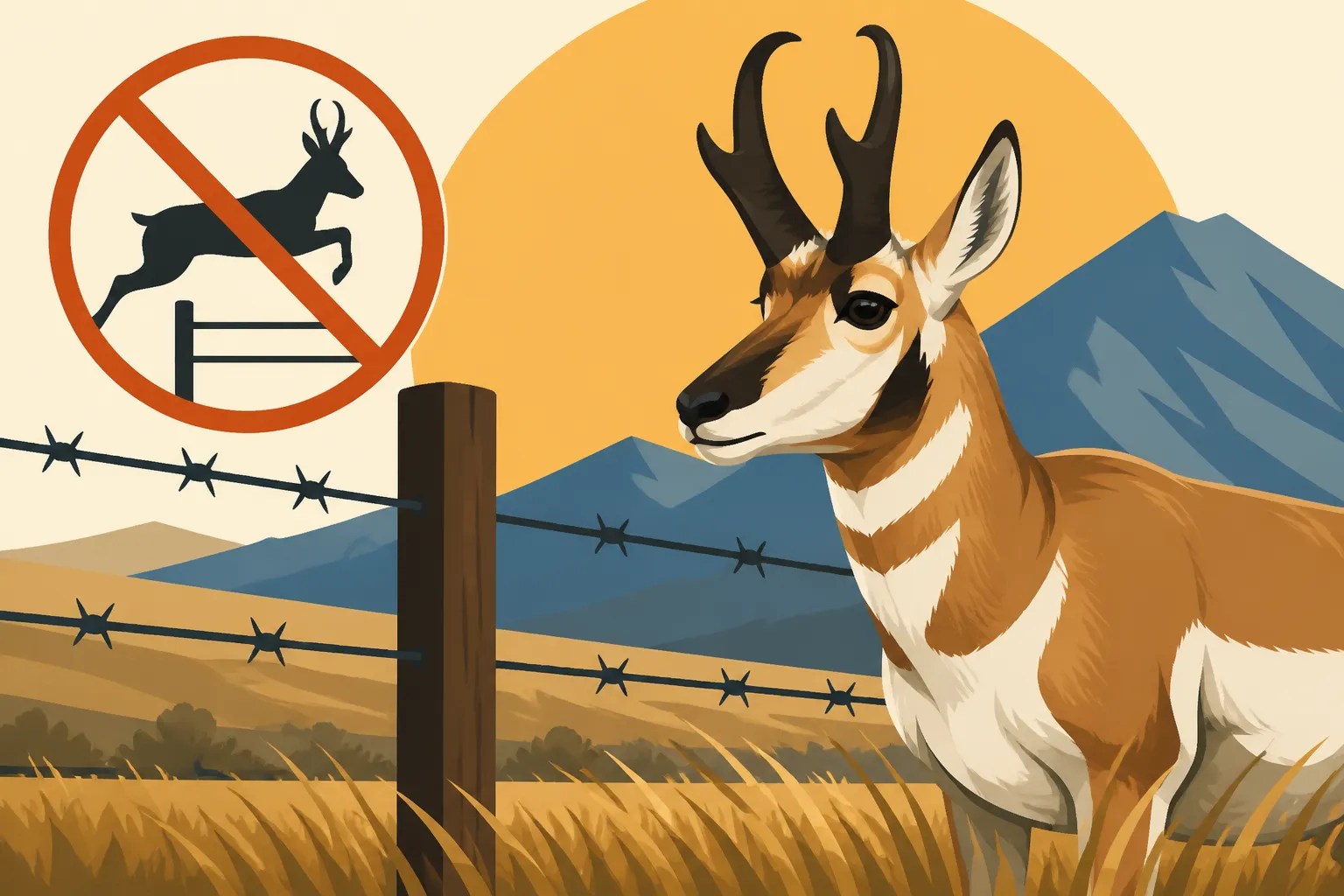
Why Antelope Do Not Jump Fences
It's a common observation that leaves many scratchin' their heads: pronghorn, these incredible sprinters of the high desert, capable of hitting speeds that would leave most vehicles in the dust, simply refuse to jump over a fence. Why, with all that athletic prowess, do they seem so utterly defeated by a simple strand of barbed wire or a woven-wire barrier? This guide will dive deep into the fascinating biology, evolutionary history, and behavioral quirks of the pronghorn that explain this peculiar trait, especially as it relates to Oregon's diverse landscapes.
The Evolutionary Roots of a Ground-Dweller: Why Pronghorn Run, Not Leap
To truly understand why a pronghorn doesn't jump fences, we have to travel back in time, way back, to when their ancestors roamed vast, open grasslands free of man-made barriers. Pronghorn evolved on wide-open plains, where their primary predators were fast-running beasts like the now-extinct American cheetah. Their survival depended entirely on their ability to outrun danger over long distances, not to clear vertical obstacles. This is a crucial distinction that shaped their physical and behavioral traits.
Surviving the Open Plains Through Speed
Imagine being a pronghorn thousands of years ago. Your world is flat, endless, and teeming with predators that want to make you their next meal. You can see for miles, and so can they. There's no dense forest to hide in, no steep canyons to navigate for a quick escape. Your only real defense is pure, unadulterated speed, and the endurance to keep that speed going.
Pronghorn developed an incredible set of adaptations for this kind of existence. Their lungs are massive, their windpipes huge, allowing them to take in vast amounts of oxygen. Their bones are lighter, their muscles are built for rapid contraction, and they possess a unique stride that maximizes ground cover. They can accelerate almost instantly and maintain speeds upwards of 50-60 miles per hour for extended periods. This isn't just a burst; it's a marathon sprint. They are the ultimate escape artists of the horizontal plane. This evolutionary pressure meant that any energy spent developing muscles or behaviors for vertical clearance would have been wasted, or worse, detrimental to their primary survival strategy.
The Contrast with Deer Species
Now, let's think about deer, like the Columbian Blacktail Deer of Western Oregon or Oregon mule deer. They evolved in environments with more varied topography, including forests, brush, and broken terrain. Their predators, historically, included wolves and cougars, animals that could ambush and pursue them through dense cover. For deer, the ability to jump over fallen logs, brush piles, or even small ravines was a critical survival skill.
Deer have a different body structure, with powerful hindquarters designed for explosive vertical leaps. Their center of gravity is different, and their musculature supports upward movement. While they can run fast, their top speed and endurance typically can't match a pronghorn's. Their strategy often involves short bursts of speed, sudden changes in direction, and clearing obstacles to break the line of sight and escape. This fundamental difference in evolutionary strategy—horizontal speed for pronghorn versus agile jumping for deer—is at the heart of why fences are such a problem for one and a minor inconvenience for the other. It’s not that pronghorn can't lift their legs high; it's that their entire being is optimized for going around things, not over them.
The Anatomy and Physiology Behind the Phenomenon
The pronghorn's body is a marvel of adaptation for speed, but it comes with tradeoffs. Every aspect of their physical design, from their vision to their leg structure, is geared towards efficient, high-speed travel across open terrain. This specialization leaves them ill-equipped for vertical obstacles.
Legs Built for Running, Not Jumping
Take a close look at a pronghorn's legs. They are long, slender, and incredibly powerful, but their joints are designed for forward motion and absorbing the impact of repeated high-speed strides. Their shoulder structure doesn't allow for the extreme upward flexion needed to clear obstacles with the grace of a deer. While a pronghorn can lift its legs, it struggles to coordinate the powerful, simultaneous push-off from all four limbs required for a significant vertical jump.
Their hooves, too, are adapted for speed. They are relatively small and hard, excellent for gripping dry, open ground, but not ideal for generating the leverage needed for a powerful leap from a standing start. Imagine trying to high-jump in running shoes versus specialized jumping spikes; it’s a similar principle. Their bone structure, particularly in the lower leg, is optimized for absorbing impact and transferring power for propulsion, not for the sudden, explosive, upward force required to clear a tall fence. When you observe a pronghorn, especially in a stressful situation, their instinct is always to find an open path or a way to crawl under an obstacle, rather than attempt to go over.
Sensory Adaptations for Wide-Open Spaces
Pronghorn possess incredible eyesight, often compared to that of a hawk, able to spot movement from miles away. This acute vision is perfect for detecting predators or other hazards across vast, flat landscapes. They rely on this early detection to initiate their escape, which, as we've established, means running away horizontally.
Their brains are wired for this, too. When a threat appears, the immediate neurological response is to flee across the plains. There's no programmed "jump high" response because, for millennia, there was no evolutionary advantage to it. When they encounter a fence, their advanced vision tells them it's a solid, impassable barrier, and their instincts, honed over countless generations, tell them to find an opening at ground level or a way around it, not to try and clear it. This behavioral hardwiring is so strong that even a low, single-strand wire fence can act as an effective barrier, simply because it disrupts their expected escape route. When you're using tools like GoHunt to scout Oregon High Desert Hunting Country, understanding these behaviors can help you predict how pronghorn will react to man-made structures.
Fences: A Modern Obstacle to an Ancient Migration
The introduction of fences across the American West, especially in states like Oregon, has presented a significant challenge to pronghorn populations. What was once an uninterrupted landscape for their seasonal movements is now fragmented by barriers that they are simply not equipped to cross.
The Impact on Migration and Habitat Use
Pronghorn are nomadic animals, often undertaking seasonal migrations to find food and water, or to reach wintering grounds. These movements can cover significant distances, especially in areas like Oregon's high desert. Oregon Pronghorn Range and Numbers are directly impacted by the ability of these animals to access critical habitats throughout the year. Fences, even low ones, disrupt these ancient migration routes.
When a fence blocks their path, pronghorn will often attempt to crawl under it. This can lead to injuries, entanglement, or simply exhaustion as they search for a passable gap. If no such gap exists, they may be forced to turn back, missing out on crucial forage or being cut off from vital water sources. This fragmentation of habitat can lead to increased competition for resources, reduced breeding success, and overall declines in herd health. It's a stark example of how human infrastructure can clash with deeply ingrained natural behaviors. For anyone interested in Pronghorn Fawn Survival in Dry Years, the ability of does to access good forage unhindered by fences is absolutely critical.
Types of Fences and Their Severity
Not all fences are created equal in terms of their impact on pronghorn. Here’s a quick breakdown:
| Fence Type | Description | Impact on Pronghorn |
|---|---|---|
| Barbed Wire | Multiple strands of wire with sharp barbs, typically 3-5 strands high. The bottom strand is often 12-18 inches off the ground. | Can be deadly. Pronghorn often try to crawl under the lowest strand, risking severe cuts, entanglement, and eventual death. Even low strands can prevent passage. |
| Woven Wire | A mesh-like fence, often called "hog wire" or "field fence." Can be short or tall, with varying mesh sizes. | Very difficult. Pronghorn cannot crawl through the mesh and rarely attempt to jump. They are often completely blocked, forced to find a gate or turn around. Fawns can sometimes squeeze through larger mesh if low enough. |
| Net Wire | Similar to woven wire but usually taller and stronger, often used for livestock like sheep and goats. | Presents an almost absolute barrier. Pronghorn have no way to get over or through it, leading to significant habitat fragmentation. |
| Smooth Wire | Single or multiple strands of smooth wire, usually without barbs. Often used as electric fence. The bottom strand is often higher than barbed wire. | Less injurious if they attempt to crawl under, but still a psychological and physical barrier if too low. If the bottom wire is high enough (18-24 inches), they may be able to pass under without injury. |
| Wildlife-Friendly | Bottom wire is smooth and at least 18-20 inches off the ground, top wire is no more than 40-42 inches high, and all wires are visible. Sometimes uses wood posts without sharp corners. | Allows for easier passage. Pronghorn can usually crawl under the high bottom wire, and the lower top wire prevents deer from attempting to jump over unnecessarily. Considered the best option for maintaining connectivity for pronghorn and other wildlife. |
As you can see, the design of a fence plays a huge role. A well-designed "wildlife-friendly" fence prioritizes the needs of animals like pronghorn by offering a clear path beneath the lowest wire. When scouting for Oregon Pronghorn Controlled Hunts, especially in areas with a mix of public and private land, noting fence types can give you an edge in understanding how herds move. Many private landowners are becoming more aware of wildlife needs, and agencies like ODFW work with them to implement wildlife-friendly fencing solutions.
Conservation Implications and Solutions for Oregon's Pronghorn
Understanding why pronghorn don't jump fences is more than just a piece of interesting trivia; it's vital for their long-term survival and for effective wildlife management, especially in a state like Oregon where habitat connectivity is crucial.
The Role of Fence Modification and Removal
Conservation efforts increasingly focus on making existing fences more permeable for pronghorn and other wildlife. This often involves retrofitting barbed wire fences by replacing the lowest strand with smooth wire and raising it to at least 18 inches off the ground. In some critical migration corridors, entire sections of fence may be removed and replaced with virtual fences (using GPS collars and auditory cues) or simply left open where livestock grazing isn't a primary concern.
These projects are often collaborative efforts between state wildlife agencies, ranchers, private landowners, and conservation groups. The goal is to balance the needs of agriculture and ranching with the imperative to maintain healthy, migratory wildlife populations. For hunters who rely on tools like GoHunt for their E-Scouting Oregon Units With Satellite Imagery, understanding where these fence modifications are happening can illuminate movement patterns you might not otherwise discern. It's a significant investment of time and resources, but essential for the future of species like the pronghorn.
Public Awareness and Hunter Involvement
Hunters play a crucial role in pronghorn conservation. By understanding these unique behavioral traits, we can advocate for and participate in projects that improve habitat connectivity. Reporting problematic fences, volunteering for fence modification work, or simply choosing to hunt in a way that minimizes disturbance to pronghorn migrations can make a real difference. Groups like Oregon Hunters Association often organize fence-friendly initiatives.
When planning your hunt, consider researching the area for known migration corridors. Programs designed to help you analyze Oregon Pronghorn Application Odds or pinpoint prime habitat areas often take into account factors like fencing, even if implicitly. The health of Oregon's pronghorn populations depends on our collective understanding and action. After all, what's a high desert hunt without the sight of these incredible animals gracefully traversing their ancestral lands, unimpeded?
Disclaimer
This article is for general informational purposes only and does not constitute professional advice. Laws, prices and regulations vary by location and change over time. Consult a qualified professional for guidance on your specific situation.