How Far a Cougar Travels in a Week
There's nothing quite as frustrating as trying to understand an animal that you rarely, if ever, actually see. For many Oregon hunters, especially those of us fascinated by the elusive cougar, figuring out their movements can feel like trying to track a ghost through a hurricane. This guide is here to shed some light on the incredible distances these solitary predators can cover in a week, helping you piece together the puzzle of their lives and perhaps even improve your chances of encountering one in the vast Oregon wilderness.
The Elusive Nature of Oregon Cougars and Why Their Movement Matters
Oregon's cougars are masters of stealth. They glide through the dense timber of the Coast Range or melt into the juniper and sage of Eastern Oregon, often without leaving a trace. This makes understanding their behavior, particularly how far they travel, incredibly challenging for hunters and wildlife enthusiasts alike. We often hear anecdotal stories of a cat crossing multiple drainages, but what does that actually mean for their weekly routine? Knowing this isn't just a matter of curiosity; it's vital for effective hunting strategies, especially in a state where methods like baiting and hounds are not permitted.
The Hunter's Challenge: Understanding a Ghost
Imagine spending days still-hunting through thick clearcuts, meticulously searching for tracks or other signs, only to feel like you're chasing nothing. The cougar's ability to cover vast distances silently is exactly what makes them such a formidable and frustrating quarry. You might find fresh tracks one day and then nothing for miles, leading you to wonder if that cat just vanished into thin air. It’s this unpredictability that makes every sign, every broken twig, every faint scrape on a log feel like a massive clue. Hunters dedicated to the pursuit of these cats know that patience and a deep understanding of their habits are paramount. It’s not about finding a stationary target; it’s about intercepting a constantly moving phantom.
Factors Driving Daily and Weekly Travels
A cougar's travel itinerary isn't a fixed schedule; it's a dynamic response to a complex web of environmental and biological factors. What might make a cougar settle into a small area for a few days, only to embark on a marathon journey the next week? Think about the availability of prey, for starters. If a cougar makes a kill, it might spend several days feeding on that carcass, minimizing its travel until the food source is depleted. However, if prey is scarce, or if they've been unlucky for a while, they might start covering serious ground, pushing across ridges and down into new valleys in search of their next meal. Weather also plays a role; heavy snow might push deer and elk down to lower elevations, and cougars will often follow. Their natural inquisitiveness, driven by the need to patrol territory and seek out mates, also contributes to their extensive weekly travels. It's a continuous balancing act between energy conservation and the demands of survival.
Understanding Cougar Home Ranges and Patrols
To grasp how far a cougar travels in a week, we first need to understand the concept of a home range. This isn't just a casual stomping ground; it's a vital piece of real estate that provides everything a cougar needs: food, water, shelter, and breeding opportunities. These ranges are often vast, a reflection of the cougar's solitary nature and the sheer amount of space required to support a top-tier predator. Oregon's varied landscape, from the dense coastal rainforests to the sprawling eastern deserts, means that home ranges can look quite different depending on the specific habitat and prey density. Understanding the general size and characteristics of these territories gives us a baseline for their potential weekly movements.
Typical Home Range Sizes in Oregon
Cougar home ranges in Oregon can be surprisingly expansive, with males typically claiming larger territories than females. For a male cougar, a home range might span anywhere from 50 to 150 square miles, sometimes even larger in areas with sparse prey. Think about that: an area roughly the size of a small county! Females, especially those with cubs, tend to have smaller, more concentrated ranges, often between 20 to 60 square miles. These are averages, of course, and the actual size is highly fluid. A young, dispersing cougar looking for its own territory might cover even greater distances than an established adult. These massive home ranges mean that even if a cougar is just "patrolling" its territory, it's inherently covering significant mileage over a few days, let alone a full week. The vastness of these areas truly underscores the challenge of consistent sightings or tracking. To learn more about Cougar Territory Size and Movement, you might find another one of our articles helpful.
Prey Density and Topography: Key Influencers
The sheer size of a cougar's home range, and therefore how far it travels, is heavily influenced by two major factors: prey density and topography. In areas rich with prey, like a healthy blacktail deer population in a western Oregon forest or abundant mule deer in an eastern Oregon unit, a cougar doesn't need to travel as far to find its next meal. Its movements might be more concentrated, circling a productive clearcut or a known deer bedding area. Conversely, in areas where prey animals are more scattered, such as arid high desert regions, a cougar will naturally have to cover much more ground to ensure a consistent food supply.
Topography also plays a critical role. Steep, rugged canyon country, like that found in parts of the Wallowa-Whitman National Forest, can restrict movement paths, funneling animals through specific drainages or along ridge lines. A cougar might travel fewer linear miles but expend far more energy navigating challenging terrain. In contrast, flatter, more open sagebrush flats in Eastern Oregon might allow for more direct, expansive travel. Consider how you might use a tool like GoHunt's mapping features to analyze terrain and potential travel corridors for these animals. Understanding these landscape features helps hunters anticipate where a cougar could be and, by extension, how far it might be traveling between those spots.
Day-to-Day vs. Weekly Movement Patterns
It's easy to think of an animal's movement as a straight line from point A to point B, but for a cougar, it's far more nuanced. Their daily movements are typically driven by immediate needs, like hunting or resting after a kill, while their weekly patterns reveal the broader scope of their territorial patrols and seasonal shifts. Distinguishing between these scales helps us understand the true extent of their travels.
The Pursuit of Prey: Short Bursts and Hiding
On a daily basis, a cougar's movements are often characterized by bursts of intense activity interspersed with long periods of rest and observation. They might stalk for hours, moving slowly and deliberately through cover, or make a sudden, explosive dash to capture prey. Once a kill is made, especially a large one like an elk or a mature deer, the cougar will often drag the carcass to a secluded spot and spend several days feeding, rarely moving far from it. This period of feasting and resting can significantly reduce their daily travel distances. They're masters of camouflage, and even when they're close to a kill, they're incredibly difficult to spot. This is why when you're Blood Trailing in Oregon Rainforest Understory, you're not just looking for blood, but also for disturbed ground or matted vegetation that might indicate a cougar's resting spot near a cached meal.
However, if hunting is unsuccessful, or if they're simply on the prowl, a cougar can cover remarkable distances in a single night. Imagine a cougar weaving through thick timber or silently navigating rocky outcroppings, moving several miles from its daytime bed to a prime hunting ground and then back again. These nightly excursions, while significant, might not seem like much on a single day, but they add up quickly over a week, contributing to the overall impression of a wide-ranging, elusive animal.
Marking Territory and Seeking Mates: Broader Movements
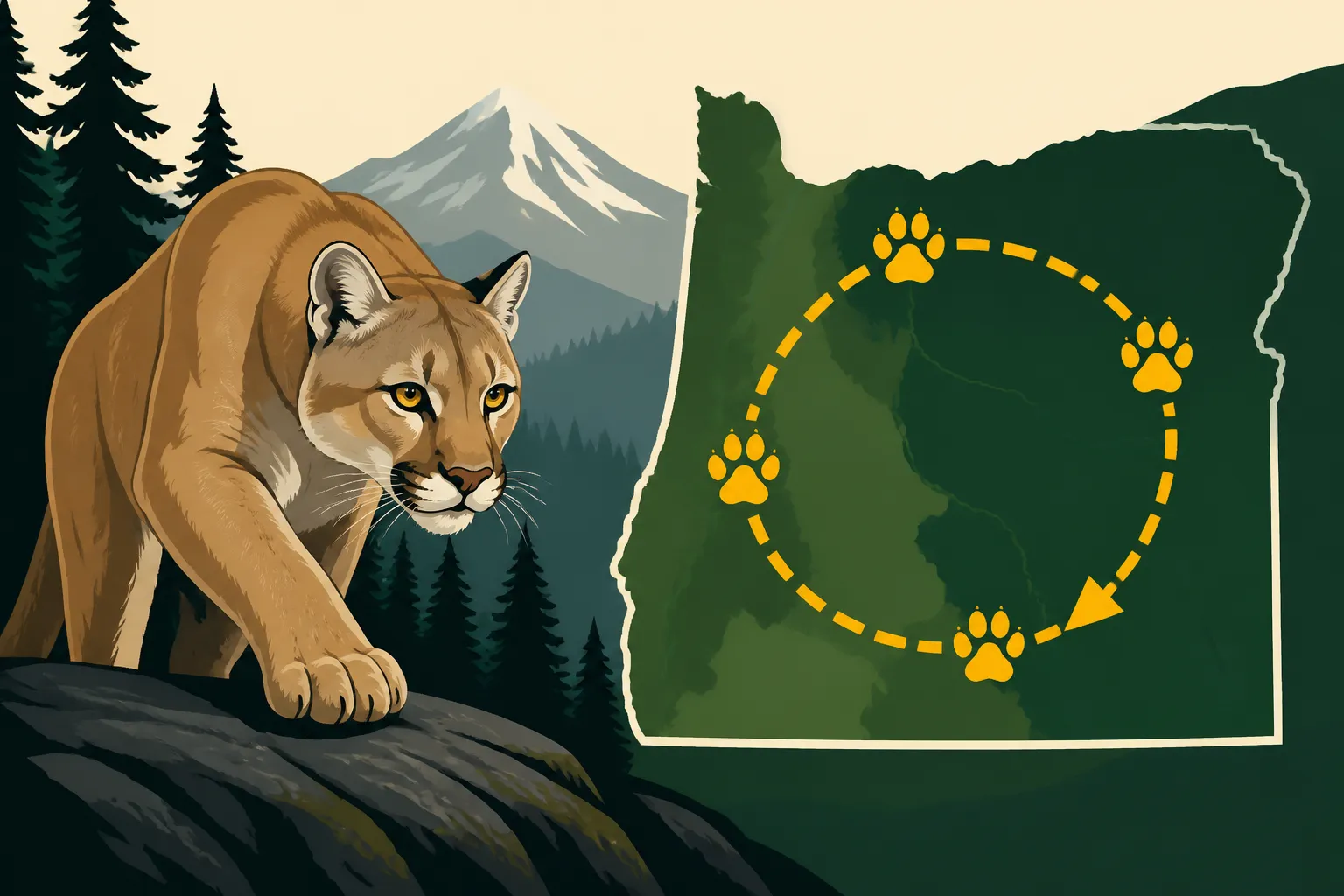
While daily movements are primarily about survival (eating and avoiding detection), the weekly picture reveals a cougar's broader life strategy. Over seven days, a cougar will often make a substantial circuit of its home range, checking for intruders, refreshing its scent marks, and, during breeding season, seeking out potential mates. These are the journeys that truly illustrate how far a cougar travels in a week.
Male cougars, in particular, are driven to patrol the boundaries of their extensive territories. They'll scratch trees, leave scat, and urinate in prominent locations, essentially leaving "messages" for other cougars. This isn't just a leisurely stroll; these are purposeful journeys that can take them across entire mountain ranges or through multiple watersheds. During the breeding season, these patrols become even more extensive and urgent, as males seek out females in estrus. A male might travel dozens of miles in a few days just to investigate a female's scent marking. Female cougars, while generally having smaller ranges, also undertake these patrols, though perhaps less frequently, to defend their space, especially if they have cubs. The cumulative effect of these daily hunts and territorial patrols means that a cougar can easily cover 20-50 miles in linear travel within its home range over a week, and sometimes even more if it’s a young cougar dispersing or an older cat pushed out by competition.
| Cougar Movement Type | Typical Distance/Pattern | Primary Driver | Duration |
|---|---|---|---|
| Hunting/Stalking | Short bursts (hundreds of yards), then rest/observe | Securing a meal | Hours |
| Post-Kill | Very minimal movement from carcass (hundreds of feet) | Feeding, resting, protecting kill | 2-5 days |
| Nightly Patrol/Prowl | 3-8 miles (linear) in search of prey | Hunting, checking familiar areas | Overnight |
| Territorial Circuit | 20-50+ miles (cumulative, within home range) | Marking territory, checking for intruders | Over several days to a week |
| Dispersal (Young Cats) | Potentially 100s of miles over weeks/months | Establishing new territory, avoiding competition | Long-term (weeks to months) |
| Mating Season | Increased travel to locate mates, often beyond usual routes | Reproductive drive | Weeks |
Tools and Techniques for Tracking Cougar Movements (and How Hunters Can Leverage Them)
Given the stealth and expansive nature of cougar movements, it's no wonder that hunters often feel like they're looking for a needle in a haystack. But even without the use of hounds, there are still effective ways to piece together clues about where cougars are traveling and what they might be doing. Modern technology, combined with traditional woodsmanship, can significantly enhance your understanding of these secretive animals. You just need to know how to interpret the signs they do leave behind and use the right resources to put yourself in the right places.
Modern Scouting and E-Scouting for Cats
In today's hunting world, effective scouting extends far beyond simply walking the woods. E-scouting, using satellite imagery and mapping software, has become an indispensable tool. Before you even set foot in the field, you can begin to analyze potential cougar habitat. Look for areas with dense cover, steep terrain, and especially pinch points or natural corridors that would funnel deer and elk—cougars are never far from their primary food source. Identifying these areas is crucial for understanding where a cougar might be traveling through in its weekly patrols. Platforms like GoHunt offer detailed mapping layers that can highlight topography, vegetation types, and even historical game movement data, giving you a serious edge in your pre-hunt planning.
Once you hit the field, Scouting With Trail Cameras on Oregon Public Land can provide invaluable insights. Place cameras on game trails, near fresh tracks, or overlooking a potential kill site. While a cougar might only pass by a camera once every few days or even weeks, those captures can tell you a lot about its travel patterns. Is it a lone male? A female with cubs? Is it using a particular ridge or drainage consistently? These snippets of information, compiled over time, begin to paint a picture of a cougar's weekly routine within its home range. Remember, it's not about immediate gratification with trail cameras; it's about collecting data points that reveal long-term patterns.
Reading the Landscape for Sign
Beyond technology, good old-fashioned tracking and sign reading remain paramount. Every scrape, track, and partially covered kill tells a story. When you're out looking for a cat, you're not just looking for a cat; you're looking for the story of its movements. Fresh tracks in mud or snow can tell you how recently a cougar passed through and its direction of travel. Pay attention to the size and stride of the tracks; a longer stride might indicate a cougar on the move rather than just casually meandering. Scrapes on the ground, often near prominent features like fallen logs or ridge tops, are territorial markers and signal that a cougar is actively patrolling that area. The more fresh sign you find, the higher the probability that a cougar is actively working that part of its home range, and therefore, covering that ground in its weekly travels.
Finding a fresh kill, especially a deer or elk that's been partially consumed and then carefully cached with leaves and debris, is perhaps the strongest indicator of recent cougar activity. A cougar will typically stay within close proximity to its kill for several days, feeding periodically. If you find a fresh kill, it dramatically narrows down the area where that cougar is likely to be for at least the next few days. Understanding Cougar Prey and Deer Herd Impact helps you anticipate these scenarios. By combining the vast overhead view provided by e-scouting with the boots-on-the-ground detective work of reading sign, you can start to form a comprehensive understanding of how far a cougar travels in a week and where its current priorities lie within that impressive range.
Disclaimer
This article is for general informational purposes only and does not constitute professional advice. Laws, prices and regulations vary by location and change over time. Consult a qualified professional for guidance on your specific situation.