Oregon Turkey Subspecies and Range
Understanding the various turkey subspecies in Oregon and knowing where to find them can feel like solving a complex puzzle, especially when planning your spring or fall hunt. Hunters often struggle to distinguish between the different types, and knowing their preferred habitats is key to locating those elusive gobblers. This comprehensive guide will break down Oregon's turkey populations, their distribution, and how to use this knowledge to increase your success in the field.
Oregon's Turkey Story: A Quick Overview
It's easy to take Oregon's vibrant wild turkey populations for granted today, but believe it or not, these magnificent birds weren't always a widespread fixture in our landscapes. Their current abundance is actually a testament to some incredibly successful wildlife management efforts over the past several decades. For a long time, the only turkeys you'd find in Oregon were domestic ones on a farm. The wild ones, the ones that make our hearts pound when they gobble, weren't here naturally.
From Absence to Abundance
The historical record suggests that wild turkeys were either absent or extremely rare in Oregon before the 1960s. Imagine a springtime in Oregon without the resonant "gobble-gobble-gobble" echoing through the timber—it's hard to conceive now, isn't it? Our diverse ecosystems, from the dry eastern ponderosa pine forests to the oak savannas of the Willamette Valley, seemed ideal, yet the birds simply weren't present. This absence meant that generations of Oregon hunters never experienced the thrill of a wild turkey hunt, a stark contrast to today's opportunities. The early efforts to introduce turkeys were exploratory, trying to see if these birds could even survive in our varied climate and terrain.
The real shift began in the latter half of the 20th century. Wildlife biologists recognized the potential and started looking at successful reintroduction programs in other states. The goal wasn't just to have turkeys, but to establish self-sustaining populations that could thrive and provide recreational hunting opportunities. This involved careful planning, selecting suitable release sites, and monitoring the initial cohorts closely. Without these foundational steps, the rich turkey hunting we enjoy today wouldn't exist. It took a long-term vision and commitment to get us where we are.
The Role of Relocation Programs
The explosion of wild turkey populations across Oregon is largely due to strategic relocation programs spearheaded by wildlife agencies. These programs primarily focused on introducing the Rio Grande subspecies, chosen for its adaptability to a wide range of habitats, particularly the drier, more open woodlands and agricultural edges found in many parts of Oregon. Birds were trapped from healthy populations in states like Texas and Kansas, then released into carefully selected areas within Oregon deemed to have suitable habitat, food sources, and protective cover. These initial releases were meticulously planned, often involving multiple small groups of birds to ensure genetic diversity and increase the chances of successful breeding.
These early efforts weren't without their challenges. Biologists had to monitor the turkeys closely, track their dispersal, and assess their reproduction rates. Sometimes, a release site might not have been as ideal as initially thought, or the birds faced unexpected pressures from predators or harsh weather. However, the overall success was phenomenal. The Rio Grandes quickly established themselves, expanded their range, and began to fill an ecological niche that had been vacant for centuries. This success paved the way for the robust turkey hunting seasons we have now. You can see the fruits of these labor every spring when the woods come alive with gobbling, a sound that was once entirely foreign to Oregon's forests. To truly understand the history and current status of these birds, it's helpful to review resources on Oregon Turkey Population Growth.
The Main Players: Rio Grande Turkeys in Oregon
When you talk about wild turkeys in Oregon, you're almost exclusively talking about the Rio Grande subspecies. They are the most dominant and widespread of the wild turkeys found here, making up the vast majority of the population you'll encounter in the field. Their success is a testament to their hardiness and ability to adapt to diverse environments, from the vast open spaces of eastern Oregon to the patchy timber and agricultural interfaces of the west.
Identifying Rio Grandes
Rio Grande turkeys are perhaps best identified by their distinctive plumage compared to other subspecies. Their tail feathers and tail coverts typically have buff-colored tips, rather than the white or chestnut tips seen on Merriam's or Eastern turkeys, respectively. The body feathers generally have a coppery-bronze sheen, and the primary wing feathers are boldly barred with black and white. While individual birds can show some variation, that buff-colored band on the tail is usually a dead giveaway that you're looking at a Rio Grande. They tend to be a bit more leggy than some other subspecies, built for covering ground quickly in more open terrain.
Physically, a mature Rio Grande gobbler is an impressive bird. They typically weigh between 18 to 22 pounds, though larger specimens certainly exist. Their spurs can be formidable, often exceeding an inch in length on older birds, and their beards can be quite long, often 9 to 10 inches or more. When you're glassing a field or a distant hillside, look for that characteristic dark body contrasting with the lighter, buffy tail tips, especially when they fan out their tail during a strut. Knowing these identification markers helps a hunter confirm they're in traditional Rio Grande territory, which is crucial for tailoring your hunting approach.
Preferred Habitats and Behaviors
Rio Grande turkeys are incredibly adaptable, but they certainly have their preferred hangouts. In Oregon, you'll find them thriving in areas characterized by a mosaic of open woodlands, especially those with ponderosa pine, oaks, and juniper, interspersed with open grasslands, agricultural fields, and riparian zones. They absolutely love river bottoms and stream corridors that provide a dependable water source and dense roosting trees, often large cottonwoods or pines. These areas offer excellent foraging opportunities for seeds, insects, and berries, along with crucial escape cover.
Their behavior is also heavily influenced by their environment. In more open country, Rio Grandes tend to be nomadic, covering large distances throughout the day as they forage. They can be incredibly wary and will often spot a hunter from a long way off, requiring a keen eye and disciplined movement. Unlike some other subspecies that might stick to dense timber, Rio Grandes often utilize open fields for feeding and strutting, making them visible but also challenging to approach. Their calls are robust, and they respond well to a variety of turkey calls, making for an exciting hunt if you can get them to commit. Understanding these preferences and habits is a huge part of being successful, as they directly inform where you scout and how you plan your approach.
Where the Western Wild Turkeys Roam
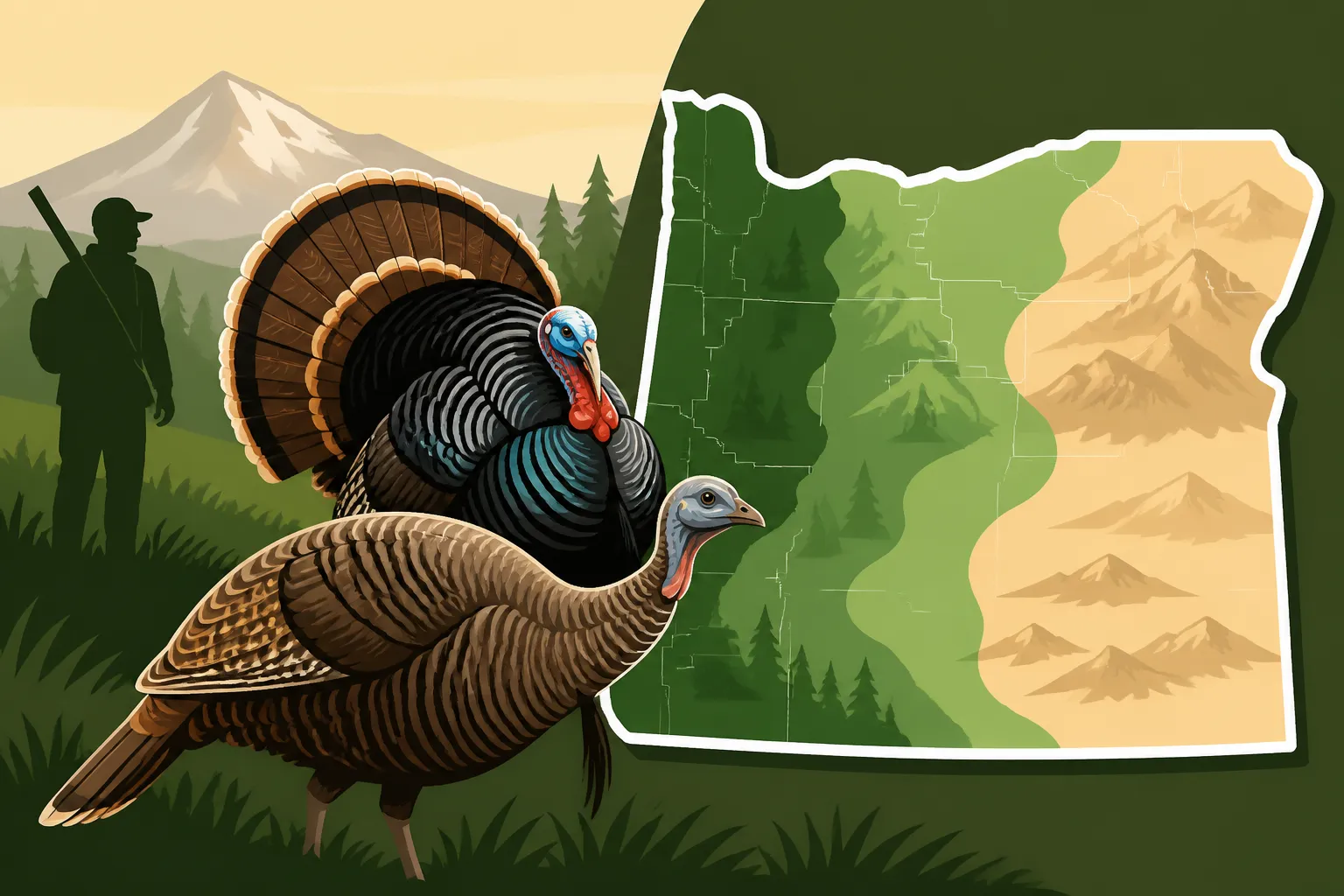
Oregon's turkey populations are not uniformly distributed across the entire state. While Rio Grandes are the dominant subspecies, their concentrations vary significantly from east to west and even within specific regions. Knowing these general distribution patterns is foundational for any turkey hunter hoping to connect with a gobbler. It helps narrow down your focus and can save you countless hours of scouting in unproductive areas.
East of the Cascades: Prime Rio Grande Country
Without a doubt, the region east of the Cascade Mountains is Oregon's turkey hunting powerhouse, dominated by robust populations of Rio Grande turkeys. This vast landscape, characterized by rolling hills, juniper and ponderosa pine forests, sagebrush flats, and expansive agricultural lands, provides ideal habitat. Units like the John Day, Heppner, and White River are often mentioned when serious turkey hunters talk about prime spots. Here, you'll find turkeys utilizing a mix of timber for roosting and thermal cover, often large pines along drainages, and adjacent cultivated fields or open grasslands for feeding.
The key to success in eastern Oregon is understanding the landscape's diversity. Turkeys will often roost in the same trees, but then disperse widely to feed, sometimes traveling several miles. Early mornings are about listening for that first gobble from the roost, and then strategically trying to get between the birds and their feeding areas. As the day progresses, they might move into timbered draws for shade or seek out watering holes. Public lands, particularly National Forests and BLM parcels, offer extensive access, but don't overlook private timberlands or the myriad of private agricultural properties where permission might be granted. Leveraging tools like GoHunt can provide invaluable insights into land ownership and historical turkey activity in these eastern units, giving you a serious edge in your scouting efforts.
Scattered Flocks in Western Oregon
While not as dense or widespread as their eastern counterparts, western Oregon does hold huntable populations of Rio Grande turkeys. These birds are generally found in the foothills of the Cascades, the Coast Range, and particularly in the oak savannas and mixed timber-agricultural lands of the Willamette Valley. However, hunting them here can present a different set of challenges. The habitat is often more fragmented, with smaller, more isolated pockets of suitable turkey country surrounded by dense development or impenetrable coniferous forests.
Successful turkey hunting in western Oregon often requires a hyper-local approach. You're not usually looking at vast tracts of continuous turkey habitat; instead, you're seeking out those specific niches. Look for areas with a good mix of mature oak trees (for roosting and acorns), clearings, pastures, and proximity to water. Often, these birds are found on private lands where gaining permission is paramount. Public land opportunities exist, but they can be tougher to locate and might hold lower densities of birds. Don't be discouraged if you don't hear gobbling everywhere you go; focus on those specific habitat types, and when you find sign, dedicate your efforts there. Checking out resources on Hunting the Willamette Valley Open Fields Properties can be particularly helpful for western Oregon hunters.
Overlap with Agricultural Lands
A significant portion of Oregon's turkey range, especially for Rio Grandes, overlaps with agricultural lands. This is particularly true in eastern Oregon's wheat country and the Willamette Valley's diverse farming regions. Turkeys are opportunistic feeders, and the abundance of waste grain, insects, and green shoots in agricultural fields makes them highly attractive feeding grounds. They'll often roost in timbered draws or riparian corridors adjacent to these fields and then pitch down at first light to feed.
This close proximity to agriculture creates both opportunities and challenges for hunters. On one hand, turkeys are often easier to locate and pattern when they're using open fields. On the other hand, accessing these lands usually requires landowner permission, which can be difficult to obtain. Building relationships with landowners well in advance of the season is often the most effective strategy. Always remember to ask permission, respect their property, and follow all rules they set. When scouting these areas, look for tracks in the mud along field edges, droppings in stubble fields, and strut marks where gobblers have been displaying.
The Other Guys: Merriam's and Hybrids
While Rio Grandes reign supreme in Oregon, it would be incomplete not to mention the historical presence of Merriam's turkeys and the undeniable reality of hybridization within our flocks. These elements add an interesting layer to Oregon's turkey story, though they don't represent the primary hunting opportunity for most.
The Merriam's Influence
Merriam's turkeys, distinguished by their pure white or very light buff tail feather tips and more pronounced black barring on their wings, were among the first wild turkeys introduced to Oregon, primarily in the Blue Mountains and some eastern Cascade foothills, back in the 1960s. These birds are traditionally associated with ponderosa pine forests at higher elevations, preferring rugged, mountainous terrain. For a time, they established populations and provided hunting opportunities in these specific areas. Their calls tend to be slightly higher-pitched than Rio Grandes, and their overall appearance is striking.
However, over the years, the more adaptable Rio Grande subspecies began to expand its range, eventually moving into areas where Merriam's had been established. This led to an interesting dynamic. While pure Merriam's are now rare, if not entirely absent, in most parts of Oregon, their genetic legacy persists. You might still encounter birds with some Merriam's characteristics in areas of the Blue Mountains or other high-elevation eastern Oregon ranges, hinting at their past presence. It's a bit like finding a rare antique; you know its history, even if its original form has evolved.
Hybridization: A Blending of Traits
The convergence of Rio Grande and Merriam's turkeys in certain areas led to an inevitable outcome: hybridization. When two different subspecies share overlapping ranges and breeding grounds, they will often interbreed, creating hybrid offspring that exhibit a mix of traits from both parents. In Oregon, this means you might occasionally encounter turkeys that don't quite fit the classic Rio Grande description, showing some lighter buff or even whitish tail feather tips combined with the overall body coloration of a Rio Grande.
These hybrid birds are perfectly legal to hunt, and they add a unique element to the turkey hunting experience. From a hunter's perspective, it mostly means that identification isn't always textbook perfect. You might see a bird with a tail that has some buff and some white, or a body that seems a bit darker than a typical Rio Grande. This blending is a natural ecological process and highlights the adaptability of wild turkeys. For those truly interested in the nuances of turkey populations, understanding this hybridization helps paint a more accurate picture of Oregon's diverse wild turkey resource.
Understanding Oregon's Turkey Range and Habitat
Pinpointing the exact range of Oregon's wild turkeys requires a good understanding of their habitat preferences and how these birds utilize the land throughout the year. It's not just about drawing a line on a map; it's about recognizing the key components that make a piece of ground suitable for turkeys, allowing them to thrive, breed, and survive the seasons. This knowledge is crucial for effective scouting and strategic hunting.
Key Habitat Components
Wild turkeys, like all wildlife, require a specific set of habitat components to flourish. First and foremost, they need reliable food sources. This includes a mix of hard mast (acorns, pine nuts), soft mast (berries, fruits), seeds from grasses and forbs, and a healthy insect population. These foods vary seasonally, so a diverse habitat that offers different options throughout the year is ideal. Secondly, good cover is essential. This means dense understory for nesting hens, thickets for escape cover from predators, and open woods for strutting and foraging. Lastly, and critically, turkeys need large, mature trees for roosting. These are often ponderosa pines, cottonwoods, or oaks, typically near water or along prominent ridges, where the birds can safely spend the night away from ground predators.
A prime turkey habitat in Oregon will feature a mosaic of these elements. Imagine a rolling landscape with pockets of mature timber, interspaced with open meadows, agricultural fields, and brushy draws. This diverse environment allows turkeys to move between feeding, resting, and breeding areas without traveling too far, making them feel secure and allowing them to meet all their daily needs. Areas lacking one or more of these components will typically hold fewer, if any, turkeys.
Seasonal Movements and Food Sources
Turkey behavior and their use of the landscape change dramatically with the seasons, largely driven by available food sources and breeding cycles. In spring, during the breeding season, gobblers are focused on attracting hens, and hens are seeking secure nesting sites. You'll find birds more concentrated around traditional strutting grounds and nesting cover, often in brushy edges or dense undergrowth. After the hatch, hens with poults will move to areas rich in insects, which provide critical protein for the growing young.
As summer progresses into fall and winter, turkeys transition to foraging for hard mast, like acorns from Oregon white oaks or pine nuts in eastern Oregon. They'll also feed heavily on waste grain in agricultural fields after harvests. During colder months, their focus shifts to finding dependable food sources that provide sufficient energy, and they often gather in larger flocks. Snowfall can push them to lower elevations or south-facing slopes where food is more accessible. Understanding these seasonal shifts helps you predict where turkeys will be at different times of the year, making your scouting efforts more efficient, whether you're targeting the Oregon Spring Turkey Season Dates or contemplating Oregon Fall Turkey Hunts.
Scouting for Success: Using Range Data
Knowing about turkey subspecies and their general range is the theoretical foundation, but applying that knowledge in the field is where the rubber meets the road. Effective scouting combines digital tools, traditional woodcraft, and a deep understanding of how turkeys interact with their environment.
Leveraging Resources for Turkey Hunting
In today's hunting world, we have an incredible array of tools at our disposal to help us find turkeys. Start with the Oregon Department of Fish and Wildlife (ODFW) website. Their game bird hunting regulations often include maps or descriptions of general turkey distribution, and their annual reports can offer insights into population trends in different units. Beyond state resources, platforms like GoHunt provide detailed mapping layers, including public land boundaries, habitat types, and even historical harvest data in some cases. This allows you to digitally scout potential areas from the comfort of your home, identifying promising public land access points and private land parcels that might be worth investigating for permission.
Another excellent resource is topographical maps and satellite imagery. Look for the mosaic habitat described earlier: timbered ridges for roosting, open fields or clearings for feeding and strutting, and water sources. Identify prominent features like creek bottoms, saddles, and timber edges where turkeys are likely to travel. By combining these digital tools, you can formulate a strategic plan, marking potential roosting sites, travel corridors, and feeding areas before you ever step foot in the woods. This is especially helpful when looking at E-Scouting Oregon Units With Satellite Imagery to narrow down your focus.
Reading the Landscape for Turkey Sign
Once you've done your digital homework, it's time to hit the ground and read the actual landscape. Nothing beats on-the-ground scouting for confirming turkey presence and activity. Start by looking for physical sign:
- Tracks: Turkeys have three prominent toes pointing forward and one smaller hind toe. Look for them in soft dirt, mud along creek beds, or dusting bowls.
- Droppings: Gobbler droppings are typically J-shaped or elongated, while hen droppings are more coiled or blob-like. Fresh droppings indicate recent activity.
- Feathers: Finding primary wing feathers or body feathers can confirm a turkey's presence, especially around dusting areas or roosts.
- Dusting bowls: Turkeys love to dust themselves in dry, loose soil to clean their feathers and rid themselves of parasites. These depressions in the ground are clear indicators of their presence.
- Scratchings: Turkeys are constantly scratching the ground with their feet to uncover food. Look for V-shaped disturbances in the leaf litter, often in a systematic pattern.
- Roosting areas: Beneath large trees, especially pines or cottonwoods, look for a concentration of droppings and possibly feathers. This indicates a consistent roost site.
TABLE: Oregon's Wild Turkey Subspecies Characteristics
| Feature | Rio Grande Turkey (Dominant in Oregon) | Merriam's Turkey (Historical/Hybrid influence) |
|---|---|---|
| Tail Tips | Buff or tan colored on both tail feathers and upper tail coverts. | Pure white or very light buff tips. |
| Wing Bars | Distinct black and white barring on primary wing feathers. | More prominent white barring on primary and secondary wing feathers. |
| Body Sheen | Coppery-bronze iridescence. | Bluish-purple and bronze iridescence, often appearing darker. |
| Leg Color | Usually pinkish-red to dull red. | Typically pinkish to reddish. |
| Preferred Habitat | Open woodlands, riparian areas, agricultural fields, oak savannas. | Ponderosa pine forests, mountainous terrain, higher elevations. |
| Distribution in OR | Widespread across eastern and western Oregon (dominant population). | Limited pure populations, genetic influence mainly through hybridization. |
By diligently looking for these signs and combining your field observations with your digital scouting, you can build a comprehensive picture of where turkeys are active. This is the ultimate key to putting yourself in a position to call in a gobbler when the season opens, ensuring that your hunt is built on solid, informed preparation. You might even consider using Scouting With Trail Cameras on Oregon Public Land to monitor areas for turkey activity before the season.
Disclaimer
This article is for general informational purposes only and does not constitute professional advice. Laws, prices and regulations vary by location and change over time. Consult a qualified professional for guidance on your specific situation.