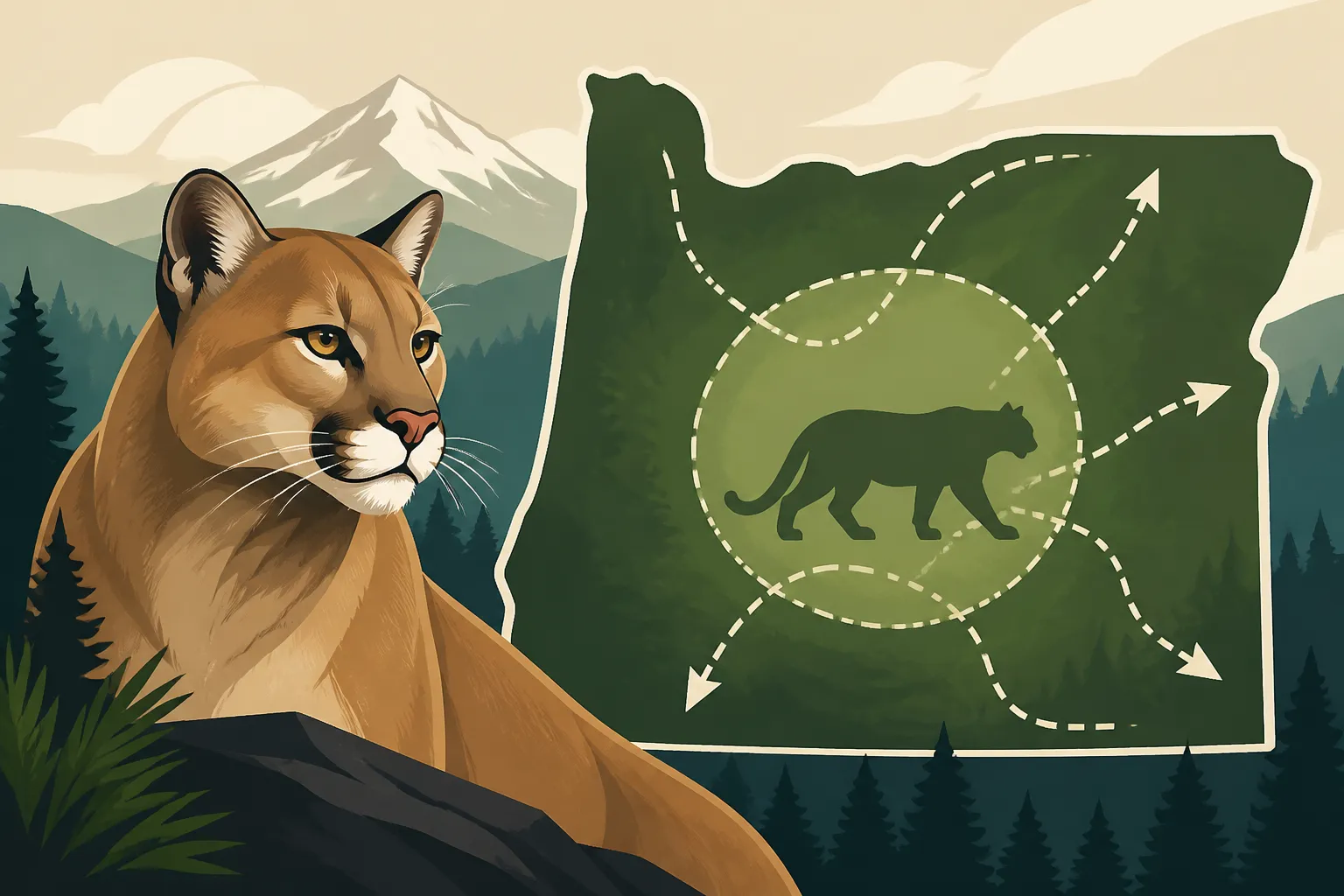
Cougar Territory Size and Movement
One of the trickiest aspects of pursuing cougars in Oregon, especially after the ban on hounds, is wrapping your head around where these incredible animals live and how they move. It’s not like deer that might stick to a particular clearcut or elk that predictably use specific wallows. Cougars are ghosts, often leaving you feeling like you're chasing shadows. This comprehensive guide aims to pull back the curtain on cougar territory size and movement patterns, giving you a better understanding of their habits to improve your chances in the field.
Understanding Cougar Territories: The Basics
When we talk about a cougar's home, it's not a static place. It's a dynamic area defined by their needs for survival, reproduction, and hunting. Grasping this distinction between a broad home range and a more intensely defended territory is key to predicting where you might find one of these elusive predators.
Defining Home Range vs. Territory
Think of a home range as the entire area an individual cougar utilizes over a period, often a year or more, for all its life activities. This includes where it hunts, sleeps, seeks mates, and raises young. It’s a vast, often overlapping space with other cougars, especially females. A cougar’s home range isn't necessarily exclusive. You might find tracks from several cats passing through the same drainage or across the same ridge over time.
A territory, on the other hand, is a more exclusive, actively defended part of that home range. This is particularly true for dominant male cougars who will actively mark and defend core areas from other adult males. Females, especially those with dependent kittens, also have core areas they will defend, though their territories often overlap more freely with those of other females and even some males. For hunters, recognizing that a cougar isn't just randomly wandering, but moving within a structured and often predictable home range, is a huge step forward in figuring out where to concentrate your efforts. Understanding these subtle differences is paramount for effective Cougar Hunting While Deer Hunting on the Same Trip, as their patterns can influence both pursuits.
Average Territory Sizes in Oregon
Cougar home range sizes in Oregon are quite variable, largely dependent on the availability of prey and habitat type. On average, adult male cougars in Oregon tend to utilize larger home ranges, often between 150 to 300 square miles. They roam far and wide, constantly scent-marking and patrolling their boundaries to assert dominance and seek out females. It's a demanding life, covering vast distances in search of both food and companionship.
Female cougars, especially those with kittens, usually maintain smaller, more stable home ranges, typically ranging from 50 to 150 square miles. Their movements are often more concentrated around den sites when they have young, and they'll utilize areas with high prey density to minimize travel and maximize hunting efficiency. These are not exact figures, of course, as individual cougars can and do deviate from these averages based on their specific circumstances. Research has shown that a healthy prey base allows cougars to maintain smaller home ranges because they don't have to travel as far to find their next meal.
Why Sizes Vary Across the State
The sheer diversity of Oregon’s landscape plays a massive role in how large a cougar's territory needs to be. You’re not going to see the same territory sizes in the dense, wet forests of the Coast Range as you would in the vast, open sagebrush country of Eastern Oregon. In areas with abundant prey and thick cover, like the coastal mountains, cougars can afford to have smaller territories because food and shelter are readily available. A cat doesn't need to travel 20 miles to find a blacktail buck if there are plenty close to its core area.
Conversely, in the more arid, open, and rugged landscapes of Eastern Oregon, where prey might be more dispersed and cover less continuous, cougars have to cover significantly more ground to make a living. Think about areas like the Owyhee Breaks or parts of the Blue Mountains; a cougar might need a sprawling territory to ensure consistent access to mule deer or Rocky Mountain elk herds. Human development, road networks, and recreational pressure also factor in, often pushing cougars into more remote, less fragmented habitats, which can naturally lead to larger territories as they seek solitude and undisturbed hunting grounds.
Factors Influencing Cougar Home Range
Cougars are highly adaptable, and their range isn't just about the numbers; it's deeply influenced by a complex interplay of biological and environmental factors. From their own intrinsic characteristics to the outside world, everything shapes their movements.
Sex and Age Differences
The most significant factors influencing a cougar's home range size are its sex and age. As mentioned, adult males generally require and defend much larger territories than females. This isn't just a matter of size; it's about reproductive strategy. A male’s larger territory allows him to overlap with the home ranges of multiple females, increasing his breeding opportunities. These large males are the undisputed kings of their domain, constantly patrolling and marking.
Young, dispersing cougars, often sub-adult males, represent another extreme. After separating from their mothers, these young cats embark on what can be incredibly long and dangerous journeys to find unoccupied or less contested territories. Their movements are highly erratic and often cover immense distances, sometimes hundreds of miles, until they can establish their own stable home range. This period is incredibly challenging for them, as they face higher mortality rates from vehicle collisions, conflicts with established cougars, and even starvation. Females, while also dispersing, tend to settle closer to their natal areas, often within or adjacent to their mother's range, which can lead to overlapping territories within a matrilineal line.
Habitat Quality and Topography
The quality of the habitat and the underlying topography are paramount in determining how a cougar utilizes an area. Ideal cougar habitat in Oregon typically includes dense forest cover for stalking prey and resting, rugged terrain with cliffs or steep canyons for denning and escape, and consistent water sources. Areas with these features, like the unlogged portions of the Coast Range or the deep river breaks of the Imnaha Unit, can support higher densities of cougars with smaller individual home ranges. The cats don't need to travel as far to find everything they need.
Conversely, in more open country or areas with fragmented habitat due to logging or agricultural conversion, cougars must expand their movements. They'll use linear features like riparian corridors, forested drainages, or rock outcrops as travel routes and cover, often moving between larger blocks of suitable habitat. These movements are strategic; they are always looking for the path of least resistance or the most concealed route to their next hunting ground. Hunters using tools like GoHunt to analyze topography and vegetation layers can often predict these travel corridors, which is crucial for Cougar Calling Techniques That Work in Oregon.
Human Presence and Disturbance
Cougars, like most large predators, generally exhibit a strong aversion to human activity. Roads, residential development, recreational trails, and intensive logging operations can all influence a cougar's movement patterns and territory use. In areas with high human presence, cougars tend to become more nocturnal, moving primarily under the cover of darkness to avoid encounters. They might also shift their home ranges away from heavily used areas, or simply use smaller, more secluded pockets of habitat within a larger disturbed landscape.
The ever-increasing network of roads, particularly in places like the Tillamook and Clatsop State Forests, can fragment cougar habitat, forcing them to cross these dangerous corridors or to simply avoid them altogether. This often means they’ll be pushed into deeper wilderness areas or utilize areas adjacent to human activity only during periods of low disturbance, such as late at night or during the off-season. Understanding these human-induced shifts can be a game-changer for hunters trying to pattern these elusive predators.
Cougar Movement Patterns and Hunting Strategies
Deciphering cougar movement isn't just academic; it's a practical skill for any hunter hoping to encounter one. Knowing where they live is one thing; understanding how they move through that landscape is where the real challenge lies.
Daily and Seasonal Movements
Cougars are primarily crepuscular and nocturnal, meaning they are most active during dawn, dusk, and throughout the night. This is when their primary prey, like deer and elk, are also often most active, making it an efficient time to hunt. During daylight hours, cougars typically rest in dense cover, on rocky ledges, or in hidden patches of timber, especially after a successful kill. However, don't mistake this for complete inactivity; a hungry cougar or one with active kittens might be on the prowl at any time of day.
Seasonally, cougar movements are largely dictated by the movements of their prey. If deer and elk migrate to lower elevations for winter range, expect cougars to follow suit. In the spring, as fawns and calves are born, cougars will concentrate their efforts in areas where young prey is vulnerable. For instance, in parts of Eastern Oregon, if you're looking for Mule Deer Winter Range in Eastern Oregon, you're likely also in prime cougar country. Understanding these seasonal shifts in prey behavior is crucial to predicting where a cougar might be spending its time.
Reading Cougar Sign and Travel Corridors
Finding cougar sign is often the first step to finding a cougar. They are masters of stealth, but they do leave clues. Tracks are perhaps the most common and informative sign. Identifying Cougar Tracks From Dog Tracks is a skill worth developing; cougar tracks typically lack claw marks (unless in soft mud or during a sprint), have a distinct M-shaped heel pad, and are generally rounder than a dog's. Look for these tracks along game trails, old logging roads, riparian zones, and ridge lines – these are typical cougar travel corridors.
Another key sign is scrapes. Cougars, especially males, will scrape dirt and debris into small mounds, often urinating or defecating on them, to mark their territory and communicate with other cats. These are usually found along well-used travel routes or at the edges of their territory. Kill sites are also invaluable. Cougars typically make a kill, feed, then cache the carcass by covering it with leaves, dirt, or snow to protect it from scavengers. Finding a fresh kill, especially a deer or elk, can tell you that a cougar is likely in the immediate vicinity and will return to feed over several days. The depth of detail that mapping platforms like GoHunt provide can help you identify these critical travel corridors and potential ambush points by highlighting terrain features that cougars naturally favor.
Adapting Hunting Methods to Cougar Behavior
Given their elusive nature, adapting your hunting methods to cougar behavior is essential. Still-hunting, moving slowly and deliberately through prime cougar habitat, pausing frequently to observe and listen, can be highly effective. Focus on areas with dense cover, steep terrain, and abundant prey sign. Remember, cougars are ambush predators; they rely on surprise. You need to turn the tables and try to surprise them.
Calling is another powerful strategy. Various calls, including distress calls from prey animals (like fawns or rabbits), or even some of the specific Cougar Calling Techniques That Work in Oregon, can draw in a curious or hungry cat. The key is setting up strategically, often in a position with good visibility and a clear shooting lane, and being patient. Sitting still for extended periods, especially in areas with fresh sign or a recent kill, can also pay off. Remember, Oregon prohibits the use of hounds, so your success hinges on your ability to outsmart them on their terms.
The Impact of Prey Availability on Movement
A cougar's life revolves around food, and the availability of prey is the ultimate driver of its movements, territory size, and overall health. Without a robust prey base, cougar populations simply cannot thrive.
Deer and Elk as Primary Food Sources
In Oregon, deer (both mule deer and blacktail deer) and elk (Roosevelt and Rocky Mountain) form the cornerstone of a cougar's diet. These large ungulates provide the caloric energy necessary to sustain such a powerful predator. Cougars are incredibly efficient hunters, capable of bringing down animals much larger than themselves. Their movements are often inextricably linked to the seasonal and daily patterns of these herds. If the elk are moving to higher elevations in the summer, the cougars will follow. If deer are wintering in a particular basin, you can bet cougars will be there too.
Studies on Cougar Prey and Deer Herd Impact consistently show that cougars will concentrate their hunting efforts where deer and elk are most abundant and most vulnerable. This includes winter ranges where animals are stressed and gathered, or calving/fawning grounds in the spring where young, inexperienced prey are easy targets. This strong predator-prey relationship means that by understanding deer and elk movements, you’re already halfway to understanding cougar movements.
Scarcity and Range Expansion
When primary prey becomes scarce in a particular area, cougars face a stark choice: expand their home range or starve. A decline in deer or elk populations, perhaps due to harsh winters, habitat loss, or disease, will force cougars to travel farther and wider in search of food. This often leads to increased range overlap with other cougars, potentially resulting in more territorial disputes and conflict.
Expanded ranges can also mean cougars venturing into areas they might normally avoid, including closer to human habitation or agricultural lands, increasing the likelihood of livestock depredation. It's a tough existence, and every decision a cougar makes, from where to bed to where to hunt, is ultimately driven by the need to find its next meal. This interconnectedness is why wildlife managers closely monitor both predator and prey populations, knowing that a shift in one will inevitably affect the other.
Opportunistic Predation
While deer and elk are primary targets, cougars are opportunistic predators and will take advantage of whatever food source is available. This can include smaller mammals like coyotes, bobcats, raccoons, and even porcupines. In some instances, if game populations are particularly low, or if easy targets present themselves, cougars may even resort to preying on domestic livestock or pets. This behavior, while problematic for ranchers and homeowners, is a clear indicator of prey dynamics in the wild.
For hunters, recognizing the signs of opportunistic predation can still be helpful. If you’re seeing an abundance of Coyote Density in Eastern Oregon or rabbit tracks in an area, and there’s also cougar sign, it might indicate a cougar that’s working harder for its meals, possibly due to a lack of larger game. This flexibility in diet allows cougars to survive in diverse environments and through periods of fluctuating prey abundance, but it always comes back to energy expenditure versus caloric gain.
Navigating Cougar Movement Data for Hunters
While cougars are inherently secretive, modern resources and observation techniques can provide invaluable insights into their movements, making the hunting experience more informed and potentially more successful.
Utilizing ODFW Resources
The Oregon Department of Fish and Wildlife (ODFW) is a treasure trove of information for hunters. While they don't provide real-time cougar locations (for obvious reasons), they do publish extensive research, population estimates, and management plans that can help you understand general cougar distribution and abundance. For example, reports on Oregon Cougar Population Estimates for various units or regions can give you an idea of where densities are higher. They also track harvest data, which can indirectly show areas of higher cougar activity.
Regularly checking the ODFW website for new publications or updates on cougar research, especially studies related to radio-collared animals, can provide insights into average territory sizes and dispersal patterns within specific geographic areas of Oregon. Though these studies are often scientific in nature, the data within them can be translated into actionable intelligence for a hunter trying to understand the nuances of cougar presence in their chosen hunting grounds.
Mapping Tools and E-Scouting for Cats
In today’s hunting world, digital mapping tools are indispensable, and this is especially true for cougar hunting. Platforms like GoHunt, onX Hunt, or Garmin BaseCamp allow hunters to meticulously E-Scout Oregon units with satellite imagery, identifying key terrain features that cougars favor. Look for areas with dense timber adjacent to open feeding grounds, steep canyons, rocky outcroppings, and critical water sources. Analyzing these features from your computer screen can save you countless miles of walking.
You can mark potential travel corridors, ambush points, and bedding areas. The ability to layer public land boundaries, private timber access (like Weyerhaeuser or Hancock properties), and topographical maps helps you visualize the entire landscape from a cougar's perspective. Identifying potential choke points, saddle crossings, or benches where cougars might travel or rest can narrow down vast amounts of territory into manageable, targetable zones. This strategic use of technology is key when you're pursuing an animal that masters stealth.
Interpreting Tracks and Kills
While technology is powerful, nothing beats boots-on-the-ground observation. Learning to accurately interpret tracks is a skill that takes time and practice. Beyond just identifying a cougar track, assessing its freshness—how crisp the edges are, if leaves have blown into it, or if it has begun to dry—can tell you how recently a cat passed through. A very fresh track means the cougar could still be very close.
Similarly, investigating kill sites can reveal a wealth of information about cougar movement. A fresh deer or elk kill, cached and covered, suggests the cougar will return. Observing the size of the animal, the method of kill (cougars typically bite the neck or back of the skull), and the surrounding tracks can tell you if it's a dominant male, a female with kittens, or a lone sub-adult. These insights help you understand the specific cougar in your area and predict its next move, ultimately helping you to develop effective cougar hunting tactics without hounds.
Cougar Interactions and Dispersal
Cougars are solitary animals for the most part, but their lives are not lived in isolation. Interactions with other cougars, especially during dispersal, are critical aspects of their population dynamics and movements.
Intra-Species Dynamics
While generally solitary, cougars interact with each other in various ways. Dominant males will actively avoid direct confrontations where possible, but they aggressively defend their large territories against other adult males through scent marking, vocalizations, and, if necessary, physical combat. These territorial battles can be fierce and sometimes fatal. Females, however, are more tolerant of overlap, particularly with related females or with a known breeding male.
During the breeding season, interactions increase significantly. Males will follow females, sometimes for days, advertising their presence with vocalizations and scent marks until the female is receptive. Once mating occurs, the male usually moves on. Understanding these dynamics helps explain why a cougar might suddenly appear in an area it hasn’t been seen before, or why a large male might be passing through the core of a female’s territory.
Young Cougar Dispersal
The dispersal of young cougars is a critical phase in their life cycle and a major driver of cougar movement across broader landscapes. After spending roughly 18-24 months with their mother, learning vital hunting and survival skills, juvenile cougars are driven off to find their own way. This journey is fraught with peril. These dispersing cats, particularly young males, can travel immense distances – sometimes over several hundred miles – crossing vast swaths of diverse habitat, including areas with significant human development.
Their goal is to find an unoccupied territory or an area with a lower density of established cougars where they can attempt to carve out a living. This is often how new cougar populations establish themselves in areas where they haven't been seen for some time. For hunters, knowing that these young, less experienced cats are often moving through marginal habitats or crossing more open country can inform where you might encounter them, especially outside of prime, established cougar territories.
Oregon's Cougar Population Estimates
Oregon's cougar population has been a topic of much discussion and management over the years, especially since the 1994 ban on hunting with hounds. While precise numbers are always challenging to obtain for such an elusive species, the Oregon Cougar Population Estimates indicate a healthy and robust population across the state. ODFW utilizes various methods, including track counts, genetic sampling, and sightability surveys, to estimate population trends and manage harvest quotas.
A thriving cougar population means that hunters have a reasonable chance of encountering a cat, provided they put in the effort and understand the animal's behavior. However, it also means managing these populations effectively to minimize conflicts with humans and livestock, and to maintain ecological balance within Oregon’s diverse ecosystems. Understanding these population trends and the regulatory framework of Oregon Cougar Tag Rules and Quotas is part of being a responsible hunter.
Cougar Territory and Movement Factors
| Factor | Key Influence on Territory Size & Movement | Hunter Implication |
|---|---|---|
| Prey Abundance | High prey = smaller, stable territories | Focus scouting where deer/elk are concentrated (e.g., winter ranges). |
| Habitat Quality | Dense cover/rugged terrain = smaller ranges | Identify areas with good cover, water, and escape routes. |
| Cougar Sex & Age | Males larger, dispersers wide-ranging | Expect large males to cover vast areas; look for young cats in marginal habitat. |
| Human Activity | High disturbance = avoidance/nocturnal | Consider areas with less human pressure or hunt during low-activity times. |
| Topography & Terrain | Ridges, drainages, cliffs = travel corridors | Use mapping tools to pinpoint natural travel routes. |
| Seasonal Changes | Follows migrating prey, denning season | Adjust hunting areas based on seasonal movements of deer, elk, and female cougars. |
Disclaimer
Please ensure you always consult the most current Oregon Department of Fish and Wildlife (ODFW) regulations and proclamations before planning any hunting trip. Regulations are subject to change, and it is every hunter's responsibility to know and follow all applicable laws. This guide is for informational purposes only and does not replace official ODFW publications.